
In the early days of IT, we thought of security as a wall around a data center. If the gate was locked, we were safe. Today, the “perimeter” is gone. Your security is now tied to the identity of your users and the way you configure your cloud. Having seen how systems fail and how they thrive, I can tell you that the most successful engineers are not just builders; they are protectors. Security is not a separate step—it is the foundation of everything we do in the cloud.
The Microsoft Azure Security Technologies (AZ-500) program is the industry standard for anyone who wants to master this foundation. This guide is built to help you understand the “why” and the “how” of Azure security. Whether you are managing a team in India or working as an engineer in a global firm, this certification is your blueprint for building resilient, safe, and trustworthy cloud systems.
Overview: Microsoft Azure Security Technologies (AZ-500)
Before we look at the technical details, here is a quick summary of what this path looks like.
| Feature | Details |
| Track | Security Operations / Cloud Security |
| Level | Associate |
| Who it’s for | DevOps Engineers, SREs, Cloud Engineers, Managers, and Developers |
| Prerequisites | Azure Admin knowledge (AZ-104) and strong understanding of networking |
| Skills Covered | Identity, Network Protection, Data Security, and Security Operations |
| Recommended Order | AZ-900 → AZ-104 → AZ-500 |
| Provider | DevOpsSchool |
The Deep Dive: Mastering the AZ-500
What it is
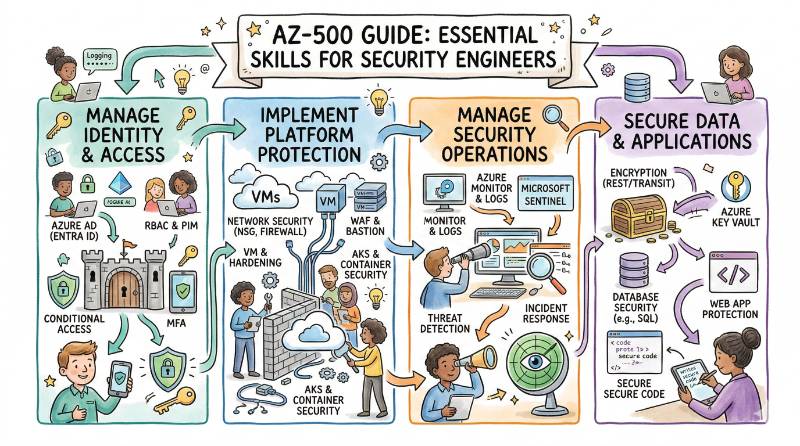
The AZ-500 is a specialized certification that validates your ability to secure Azure environments. It isn’t just a test of what you know; it is a test of what you can do. It covers how to manage identities, protect your networks, encrypt sensitive data, and set up continuous monitoring to catch threats in real-time. It moves you from being a general cloud user to becoming a security specialist who knows how to lock down every layer of the architecture.
Who should take it
This path is for the “doers” and the leaders.
- Software Engineers: To learn how to develop code that interacts safely with cloud services.
- DevOps & SRE Engineers: To automate security checks and ensure the infrastructure is hardened.
- Cloud Architects: To design systems that are secure by default.
- Engineering Managers: To understand the security posture of their products and lead their teams with confidence.
Skills you’ll gain
Achieving this certification transforms your professional perspective. You stop seeing services as just tools and start seeing them as assets that need specific protective layers. You gain the ability to act as the primary defender of your company’s digital reputation.
- Identity Control: You will master Microsoft Entra ID (formerly Azure AD), Multi-Factor Authentication (MFA), and Privileged Identity Management (PIM) to ensure only the right people have access.
- Infrastructure Hardening: You will learn to build digital “fences” using Azure Firewall, Network Security Groups (NSGs), and Web Application Firewalls (WAF).
- Data Safeguarding: You will know how to manage secrets in Key Vault and how to encrypt data so it is useless to anyone who shouldn’t see it.
- Active Monitoring: You will learn to use Microsoft Sentinel and Defender for Cloud to watch your environment 24/7 and respond to threats automatically.
Real-world projects you should be able to do after it
Knowledge is only real when you put it to work. After completing this certification, you will have the skills to lead high-impact projects that provide real business value.
- Implementing Zero-Trust: Designing a system where no user or device is trusted by default, ensuring every access request is fully verified.
- Hardening Cloud Networks: Setting up isolated environments for sensitive apps so that even if one part is compromised, the rest stays safe.
- Automated Threat Hunting: Creating custom rules in Microsoft Sentinel to find suspicious patterns of unauthorized access or data movement.
- Compliance Auditing: Using Azure Policy to automatically find and fix any resource that doesn’t meet your company’s security standards.
Preparation plan
Effective study is about consistency. Choose the plan that fits your current professional schedule.
- 7–14 days (The “Fast Track”): Best for those who already work in Azure Security daily. Spend 80% of your time on practice exams to get used to the question style and focus on the latest updates in the Azure portal.
- 30 days (The “Professional Pace”): Best for working engineers. Spend one hour a day on concepts and two hours on weekends for hands-on labs. Spend two weeks on Identity and Networking, and two weeks on Data Security and Operations.
- 60 days (The “Deep Dive”): Best for managers or those switching tracks. Take the time to build every lab twice. Understand not just how to turn on a feature, but why it is necessary.
Common mistakes
In my experience, many people fail not because they don’t know the tools, but because they don’t know the details.
- Ignoring the Labs: You cannot pass this exam by just reading. You must navigate the Azure portal and see where the settings live.
- Underestimating Identity: Many focus too much on Firewalls and forget that in the cloud, Identity is the new perimeter.
- Neglecting KQL: Microsoft Sentinel uses Kusto Query Language. If you can’t write basic queries to find logs, the security operations section will be very difficult.
- Reading Old Materials: Azure moves fast. Ensure you are using resources that reflect the current interface and service names.
Choose Your Path: The 6 Learning Journeys
Security is the thread that runs through every modern technical career. Depending on your interest, here is how you can use the AZ-500:
- DevOps Path: Focus on “Policy as Code.” Use your security knowledge to ensure that every server you deploy is automatically secured from the moment it is created.
- DevSecOps Path: This is the ultimate bridge. You become the person who integrates security tests directly into the development cycle, ensuring speed doesn’t compromise safety.
- SRE Path: Focus on system stability. Use security monitoring tools to catch errors or attacks that could cause a system outage.
- AIOps/MLOps Path: Protect your machine learning models. Ensure that the data used for training is encrypted and that only authorized users can access the models.
- DataOps Path: Focus on data sovereignty. Use Azure’s advanced encryption and masking tools to ensure that sensitive data is only seen by those with a “need to know.”
- FinOps Path: Secure your budget. Use Azure Policy to prevent the creation of expensive, high-end resources that aren’t needed, protecting the company from financial waste.
Role → Recommended Certifications Mapping
| Your Current Role | The Best Learning Sequence |
| DevOps Engineer | AZ-104 → AZ-500 → AZ-400 |
| SRE | AZ-104 → AZ-500 → AZ-700 |
| Platform Engineer | AZ-104 → AZ-500 → AZ-305 |
| Cloud Engineer | AZ-900 → AZ-104 → AZ-500 |
| Security Engineer | AZ-500 → SC-200 → SC-300 |
| Data Engineer | DP-203 → AZ-500 |
| FinOps Practitioner | AZ-900 → AZ-500 |
| Engineering Manager | AZ-900 → AZ-500 |
Next Certifications to Take
Once you have mastered the AZ-500, your next move depends on where you want your career to go.
- Same Track (Specialization): SC-100 (Microsoft Cybersecurity Architect) – This is the ultimate goal for security professionals looking to design global security strategies for entire organizations.
- Cross-Track (Broadening): AZ-400 (Designing and Implementing Microsoft DevOps Solutions) – This is the best choice if you want to lead a DevSecOps team and master automation.
- Leadership Path: AZ-305 (Designing Microsoft Azure Infrastructure Solutions) – Perfect for moving into an Architect role where you design the overall systems that engineers build.
Top Institutions for AZ-500 Training
- DevOpsSchool: A premier institution known for its deep, hands-on labs and expert-led sessions. They focus on real-world scenarios rather than just exam theory, making it perfect for working professionals who need to apply skills immediately.
- Cotocus: They specialize in high-end cloud architecture and security training. Their courses are designed for teams who need to understand the complex side of cloud governance and advanced security configurations.
- Scmgalaxy: A vibrant technical community and resource hub. They provide a unique blend of formal training and peer-to-peer learning through blogs, forums, and technical deep-dives.
- BestDevOps: Known for their streamlined and efficient training modules. They focus on the most critical skills needed in the modern market, helping professionals get certified and job-ready quickly.
- devsecopsschool: The go-to source for integrating security into the development lifecycle. They provide specialized training that connects AZ-500 concepts with modern automation and CI/CD tools.
- sreschool: Focuses on the intersection of security and reliability. Their training helps you understand how to use security monitoring to ensure maximum uptime and system stability.
- aiopsschool: Teaches you how to leverage artificial intelligence in your security operations. This is the future of threat detection, and their courses prepare you for that shift.
- dataopsschool: Dedicated to the security of the data pipeline. They help data professionals understand how to apply Azure security technologies to protect data lakes and analytical workloads.
- finopsschool: Provides a unique look at how security policies can be used to manage cloud costs. They teach you how to protect your organization’s financial health while maintaining a strong security posture.
FAQs: Career, Value, and Strategy
1. Is the AZ-500 exam difficult?
Yes, it is considered one of the more challenging associate-level exams. It requires a broad understanding of many different services and how they connect.
2. How long should I study if I work full-time?
Most working engineers find that 30 to 45 days of consistent, daily study (about 1-2 hours) is enough to prepare thoroughly.
3. Do I need to take AZ-104 first?
It isn’t mandatory, but it is highly recommended. AZ-104 gives you the foundation that makes the security concepts in AZ-500 much easier to grasp.
4. What is the value of this certification in India?
The demand for cloud security professionals in India is at an all-time high. Major IT firms and global GCCs prioritize candidates with the AZ-500 for high-paying roles.
5. How much does the exam cost?
The standard price is $165 USD, but pricing varies by region. Always check the official site for local currency pricing.
6. Does the certification expire?
Yes, it is valid for one year. However, you can renew it for free through a simple online assessment every year on the Microsoft site.
7. Is there a lot of coding involved?
You don’t need to be a software developer, but you should be comfortable with basic PowerShell or Azure CLI and reading JSON files for policies.
8. Will this help me become a DevSecOps Engineer?
Absolutely. The AZ-500 is a core requirement for anyone wanting to move into DevSecOps, as it covers the foundational security controls needed in a pipeline.
9. Are there labs in the actual exam?
Microsoft periodically adds and removes labs. You should always prepare as if you will be required to perform actual tasks in a live Azure environment.
10. Can I pass by just using “brain dumps”?
No. The exam is designed to test your understanding of scenarios. If you don’t know the logic behind the settings, you will likely fail the scenario-based questions.
11. Is this certification recognized globally?
Yes. It is a globally recognized standard for Azure security, valued by employers across the US, Europe, and Asia.
12. What is the best resource for practice tests?
Official practice tests from Microsoft or reputable institutions like DevOpsSchool are the best way to get a feel for the actual exam.
FAQs: Technical Deep-Dive
1. What is the difference between an NSG and an Azure Firewall?
An NSG is a basic filter for subnets or interfaces, while Azure Firewall is a managed, stateful service that can handle much more complex traffic rules.
2. How does Privileged Identity Management (PIM) work?
PIM allows you to give users admin rights “just in time” for a specific period, rather than having permanent admin accounts that are vulnerable to theft.
3. What is the role of Azure Key Vault in AZ-500?
It is the central service for storing secrets (like passwords), keys (for encryption), and certificates securely so they aren’t hard-coded in your apps.
4. What is Microsoft Sentinel?
Sentinel is a SIEM tool. It collects logs from all your services and uses AI to find patterns that look like a security attack.
5. Why is Azure Policy important for security?
It allows you to enforce “rules” across your entire cloud environment, such as “No public IP addresses allowed,” ensuring everyone follows the security plan.
6. What are Managed Identities?
They allow your Azure services (like a Web App) to talk to other services (like a Database) without you having to manage any passwords or connection strings.
7. How deep does the exam go into encryption?
You need to understand the difference between encryption at rest (data on a disk) and in transit (data moving over the web) and how to manage the keys for both.
8. Do I need to learn KQL?
Yes. Kusto Query Language (KQL) is essential for searching logs in Azure Monitor and Sentinel. You should know the basics of how to filter and summarize log data.
Conclusion
Mastering Microsoft Azure Security Technologies is more than just a career move; it is a commitment to building a safer digital world. Throughout my time spent helping organizations navigate the cloud, I have seen that the most respected engineers are the ones who can protect what they build. The AZ-500 certification provides you with the technical precision and the strategic mindset required to handle the sophisticated threats of today’s landscape. It bridges the gap between general IT management and high-level defensive architecture. By following this guide, leveraging the expertise of top training institutions, and committing to hands-on practice, you are doing more than just earning a certificate—you are securing your place as a leader in the next generation of cloud technology. The cloud is evolving, and with the AZ-500, you will be the one ready to defend it.
