
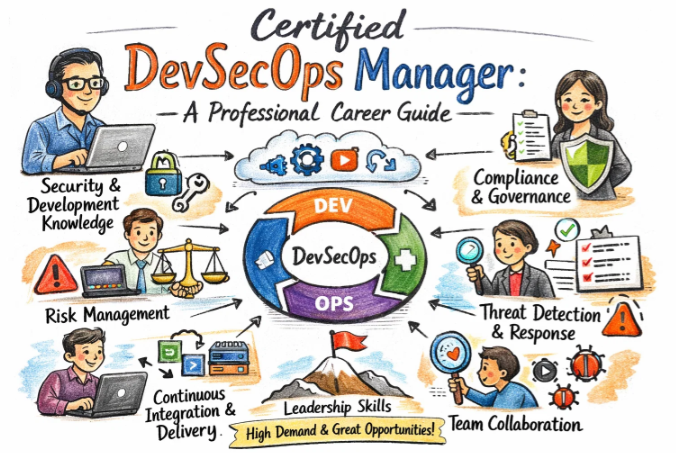
In today’s fast-paced technology landscape, organizations are no longer just looking for software engineers—they are seeking professionals who can seamlessly combine development, security, and operations. The traditional DevOps approach focuses on speed and reliability, but in modern enterprises, security cannot be an afterthought. This is where DevSecOps comes into play, embedding security at every stage of the software development lifecycle. The Certified DevSecOps Manager certification is designed specifically for professionals who want to take a leadership role in ensuring that software delivery is not only fast and reliable but also secure, compliant, and resilient against emerging threats.
This certification bridges the gap between development teams, operations teams, and security specialists, providing participants with the knowledge and practical skills needed to integrate security practices directly into CI/CD pipelines, cloud infrastructure, and enterprise applications. It is ideal for engineers, managers, and security professionals who aspire to drive security-first initiatives in their organizations while maintaining operational efficiency.
The Master Certification Table
This table serves as your master plan for professional advancement. Whether you are an engineer in India or managing a global team, these tracks define the standard for excellence in our industry.
| Track | Level | Who it’s for | Prerequisites | Core Skills | Recommended Order |
| DevOps | Associate | New Talent | Basic IT logic | CI/CD, Scripting, Containers | 1 |
| DevOps | Expert | Senior Engineers | 2+ Years Experience | Scalability, IaC, Cloud Strategy | 2 |
| DevSecOps | Master | Managers & Leads | 3-5 Years Exp. | Governance, Risk, Leadership | 3 |
| SRE | Specialist | Reliability Pros | Coding & Systems | SLOs, Error Budgets, Uptime | 2 |
| AIOps/MLOps | Specialist | ML & Data Leads | Python, Cloud ML | Model Life Cycle, AI Ops | 3 |
| DataOps | Specialist | Data Architects | SQL, Big Data | Data Pipeline Integrity | 3 |
| FinOps | Specialist | Cloud Managers | Financial Basics | Cost Allocation, Optimization | 2 |
| Observability | Master | Architects / SREs | Telemetry Depth | Tracing, Metrics, Analysis | 4 |
Deep Dive: Certified DevSecOps Manager (CDOM)
The Certified DevSecOps Manager (CDOM) is a peak-level credential for those who want to oversee the entire security culture of a technical organization.
What it is
The Certified DevSecOps Manager is a leadership-focused program that addresses the strategic integration of security into every phase of the software lifecycle. While an engineer might focus on fixing a specific bug, a manager focuses on building the systems that prevent those bugs from reaching production. It covers risk management, compliance as code, and the human side of “shifting left.” Just as the Master in Observability Engineering Certifications Program gives you a lens into system performance, the CDOM provides the data-driven framework needed to manage organizational risk.
Who should take it
This path is for the professional ready to step into high-level decision-making:
- Engineering Managers looking to standardize security across their teams.
- Lead DevOps Engineers transitioning into administrative or director roles.
- Security Directors who need to align with fast-moving agile development.
- Cloud Architects who want to master the governance of secure engineering.
Skills you’ll gain
This certification transforms you from a technical expert into a strategic asset for the business. You will learn to lead by influence, making security an enabler of speed rather than a blocker.
- Transformational Leadership: Driving the cultural change required for a unified DevSecOps team.
- Governance Automation: Turning complex compliance rules (like GDPR or SOC2) into automated checks within your pipelines.
- Risk Intelligence: Identifying and prioritizing threats based on their real impact on the company’s goals.
- Strategic Orchestration: Managing a complex stack of security tools to ensure maximum safety with zero friction.
- Metrics-Based Management: Using observability data to prove the effectiveness of your security strategy to senior leadership.
Real-world projects you should be able to do after it
Upon completion, you will be prepared to lead major, high-impact initiatives. You will be able to design systems that protect the company’s reputation while maintaining high delivery speeds.
- Architecting a Secure Delivery Blueprint: Designing a long-term roadmap that builds security into the product DNA.
- Automating Continuous Audits: Building a system where you are always “audit-ready,” eliminating the manual grind of quarterly reviews.
- Orchestrating Vulnerability Response: Establishing a cross-functional process to find, prioritize, and patch critical flaws in record time.
- Optimizing Security Spend: Performing a FinOps-style audit of your security tools to ensure the business is getting the best ROI.
Preparation Plan
- 7–14 Days (The Expert Sprint): This is for senior leaders. Focus purely on the exam structure and the specific management frameworks (like ISO/NIST) mentioned in the curriculum. Use mock exams to identify logic gaps.
- 30 Days (The Professional Track): The most effective pace. Spend the first two weeks on technical tool integration. Spend the final two weeks focusing on the “Manager” modules: leadership, risk, and compliance.
- 60 Days (The Foundation Builder): Ideal if you are moving from a strictly Dev or Ops background. Use the first month to master technical security basics. Use the second month to focus on the strategic and managerial aspects of the CDOM.
Common Mistakes
Avoiding these traps is the key to succeeding in a management role.
- The Tool-First Trap: Many managers think buying tools is the same as being secure. Success comes from fixing the process and the people using them.
- Ignoring the Developer Experience: If your security checks slow down a release, developers will bypass them. You must focus on automation that is invisible to the developer.
- Managing by Guesswork: Without deep telemetry and observability, you are blind. This is why the Master in Observability Engineering is a natural partner to this path.
- Working in a Silo: Security is a feature, not a separate department. If you don’t align your security goals with the business goals, your strategy will fail.
Best Next Certification After This
Once you have mastered secure management, round out your profile with these three options:
- Strategic Focus: Master in Observability Engineering to gain a 360-degree view of your technical estate.
- Cross-Track: FinOps Practitioner (to manage the high costs of cloud security infrastructure).
- Leadership Path: Advanced Security Leadership for those aiming for C-level positions.
Choose Your Path
Every leader’s journey is unique. Identify your ultimate goal and follow the roadmap that gets you there.
- DevOps Path: Focuses on the speed and efficiency of the software delivery process.
- DevSecOps Path: Focuses on integrating automated security into every step of the lifecycle.
- SRE Path: Focuses on the reliability, scalability, and uptime of large-scale systems.
- AIOps/MLOps Path: Focuses on using artificial intelligence to automate complex operational tasks.
- DataOps Path: Focuses on the smooth and secure flow of data within an organization.
- FinOps Path: Focuses on the financial side of the cloud, ensuring that resources are used efficiently.
Role → Recommended Certifications Mapping
| If your role is… | Your next strategic move is… | Priority Level |
| DevOps Engineer | SRE Expert → CKA | High |
| SRE | Master in Observability Engineering | Critical |
| Platform Engineer | Certified DevSecOps Manager | Strategic |
| Cloud Engineer | FinOps Practitioner → Cloud Architect | High |
| Security Engineer | Certified DevSecOps Manager | Career-Defining |
| Data Engineer | DataOps Specialist → MLOps | High |
| FinOps Practitioner | FinOps Expert → Cloud Economics | High |
| Engineering Manager | Certified DevSecOps Manager → Observability (M) | Executive |
Top Providers for Training & Certification
To clear a master-level exam, you need training that reflects the global engineering landscape. These organizations provide the expertise required for the Certified DevSecOps Manager.
- DevOpsSchool: A premier global training body known for its rigorous, hands-on labs. They don’t just teach the exam; they teach you how to handle real-world production crises in a high-pressure environment.
- Cotocus: They specialize in corporate and department-wide transformations. They are a top choice for organizations looking to shift their entire engineering culture to a DevSecOps mindset.
- Scmgalaxy: A technical community leader providing deep-dive documentation and workshops on the complex mechanics of orchestration and automation.
- BestDevOps: They offer a more personalized approach to mentoring, helping individuals master the technical and soft skills required for executive-level leadership.
- Devsecopsschool: The official home for the CDOM certification, providing a curriculum that is constantly updated to reflect the latest global security threats and exam standards.
- Sreschool: The go-to source for those wanting to master the art of reliability engineering, including SLOs and incident management.
- Aiopsschool: Providing cutting-edge training for the next generation of operations, focusing on the integration of AI into your deployment workflows.
- Dataopsschool: The dedicated choice for data professionals who want to apply DevOps principles to the world of big data and analytics.
- Finopsschool: The central hub for learning cloud financial management and cost optimization strategies for modern engineering leaders.
General Career FAQs
- How do I decide between technical and management tracks? If you love solving code problems, stay technical. If you love solving people and process problems, move to management (CDOM).
- How long do these certifications take? Most professionals can complete a master-level certification like the CDOM in 30 to 60 days of focused study.
- Is there a difference in demand between India and globally? The tech is identical, but the Indian market is seeing a massive surge in demand for managers who can handle global compliance standards like SOC2.
- Do I need a strong coding background for CDOM? You need to be “code-literate.” You don’t need to be the fastest developer, but you must be able to read and understand pipeline logic.
- What is the return on investment? These certifications act as a career multiplier. They move you from a replaceable worker to a strategic advisor who commands a higher salary.
- Can I transition from QA into DevSecOps? Yes. Automated testing experience is a very natural bridge into the world of secure engineering and automated governance.
- Why is Observability mentioned so much for managers? Because a manager’s biggest fear is being blind. The Master in Observability Engineering gives you the “eyes” to see your system’s health.
- Are these exams proctored? Yes, to maintain the value of the credential, master-level exams are typically proctored online.
- How do I prove the value of a cert to my boss? Show them the “Real-world projects” list. Explain how you can automate their audit process and reduce the company’s security risk.
- How often should I renew my certifications? Usually every 3 years. This ensures you stay current with the fast-moving technical and security landscape.
- Do I need an MBA to be an Engineering Manager? No. In the technical world, specialized master certifications like the CDOM are often valued more than a generic business degree.
- What is the first step I should take? Identify your goal role, look at the “Role Mapping” table above, and start with the corresponding certification.
Certified DevSecOps Manager (CDOM) FAQs
- How does the CDOM differ from a general security cert like CISSP? The CISSP is broad and often legacy-focused. The CDOM is specifically built for the high-speed, automated, cloud-native world of DevOps.
- Is there a practical exam component? Yes, the program typically includes hands-on labs where you must build and secure an actual delivery pipeline.
- Does it cover multi-cloud security? Yes, the principles are vendor-neutral and apply whether your organization is on AWS, Azure, or Google Cloud.
- How demanding is the course? It is a master-level program. It requires a serious commitment to learning both management theory and security technology.
- Is formal training mandatory? While you can self-study, the scenarios and case studies provided in formal training (like at devsecopsschool.com) are crucial for passing the exam.
- Can I take this if I’m a Project Manager? Yes, provided you have a foundational understanding of how software is built and deployed.
- How does this help with remote leadership? It provides a standardized framework for security that works across any location, making it easier to manage distributed engineers.
- What is the pass rate? Due to its rigorous nature, the pass rate for the CDOM is often under 50% on the first attempt, which is why proper training is essential.
Why Choose DevOpsSchool? (Testimonials)
“This certification was the turning point for my transition into a management role. The hands-on labs on governance and compliance gave me the tools I needed to lead my team through our first major audit.” — Ananya
“The focus on strategy rather than just tools is what makes this program different. I learned how to talk to the business about security in a way they finally understood.” — Vikram
“Finally, a program that understands the speed of DevOps. I was able to build a secure pipeline that actually works for my developers, not against them.” — Arjun
Conclusion
Advancing to the level of a Certified DevSecOps Manager is a defining milestone in an engineering career. It marks your transition from being a builder to being an architect of trust and safety. In a world of increasing complexity, the most successful leaders are those who can balance rapid innovation with absolute security. By mastering the principles in this guide and leveraging specialized programs like the Master in Observability Engineering Certifications Program, you ensure that your leadership is based on data, not guesswork. Whether you are aiming to deepen your expertise in SRE, master the economics of FinOps, or lead the AI transformation with AIOps, your foundation must be secure and observable. This guide has laid out the roadmap; the institutions are ready to support you; and the global market is waiting for your expertise. Now is the time to take that first step toward becoming a visionary leader in the modern engineering landscape.
