
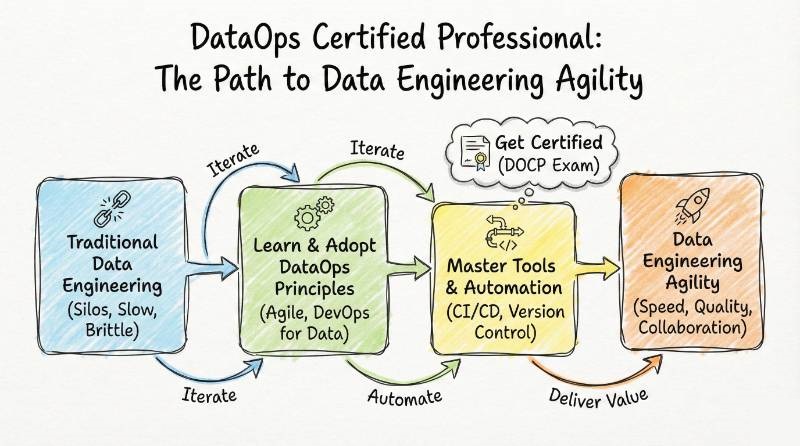
In the current technological climate, data is no longer a passive byproduct of business; instead, it has become the very engine of innovation. However, many organizations are finding that their “engine” is frequently stalling due to manual processes and disconnected teams. Because of these challenges, the industry is undergoing a massive shift toward DataOps. This methodology treats data with the same rigor that DevOps brought to software development, ensuring speed, quality, and reliability.
For engineers and managers looking to lead this transition, the DataOps Certified Professional (DOCP) has emerged as a cornerstone credential. By mastering this domain, you transition from a traditional data handler to a modern data architect. This guide serves as your comprehensive blueprint for understanding, preparing for, and succeeding in the DataOps landscape.
Choose Your Path: 6 Learning Paths for the Modern Ecosystem
Before specializing in one area, it is essential to understand how various disciplines intersect. Depending on your career goals, you can choose from these six primary learning paths.
1. The DevOps Path
This is the fundamental track for anyone interested in automation. It focuses on breaking down the walls between developers and operations through CI/CD and automated testing. Consequently, it provides the structural mindset required for all other advanced certifications.
2. The DevSecOps Path
Security is a non-negotiable priority in the modern enterprise. This path teaches you how to integrate security checks directly into the delivery pipeline. By doing so, you ensure that high-speed deployments do not create vulnerabilities, making security a shared responsibility.
3. The SRE (Site Reliability Engineering) Path
SREs are software engineers who manage infrastructure. They focus on scalability, uptime, and the “error budget.” If you are passionate about building systems that never go down, this path offers the technical depth you need.
4. The AIOps / MLOps Path
This is the intersection of artificial intelligence and operations. While MLOps focuses on the lifecycle of machine learning models, AIOps uses AI to manage IT infrastructure. Specifically, these tracks are ideal for those working on complex, data-heavy AI projects.
5. The DataOps Path
Our primary focus is the DataOps track. This discipline applies the principles of DevOps to the data lifecycle. It ensures that the flow of information from source to consumer is automated, monitored, and high-quality.
6. The FinOps Path
As cloud bills continue to rise, financial accountability is becoming a top priority. FinOps practitioners manage the variable spend of the cloud. Consequently, they help organizations balance performance with cost-efficiency.
Role → Recommended Certifications Mapping
To help you decide which path to take, use the following mapping to align your current role with the most impactful certifications.
| Current Professional Role | Recommended Certification Roadmap |
| DevOps Engineer | Certified DevOps Professional (CDP) |
| SRE / Systems Engineer | SRE Certified Professional (SREC) |
| Platform Engineer | Certified DevOps Architect (CDA) |
| Cloud Engineer | Cloud-Specific DevOps Specialist (AWS/Azure) |
| Security Engineer | DevSecOps Certified Professional (DSOCP) |
| Data Engineer | DataOps Certified Professional (DOCP) |
| FinOps Practitioner | Certified FinOps Professional |
| Engineering Manager | Certified DevOps Manager (CDM) |
Complete Certification Master Table
The following table provides a high-level view of every major certification track offered by DevOpsSchool and its partners.
| Track | Level | Who it’s for | Prerequisites | Skills Covered | Recommended Order |
| DevOps | Foundation | Beginners | Basic Linux | Git, Docker, CI/CD | 1st |
| DevOps | Professional | Engineers | 2+ years exp | Kubernetes, Terraform | 2nd |
| DataOps | Professional | Data Pros | SQL / Python | Airflow, Kafka, dbt | Specialist |
| SRE | Professional | Ops Experts | DevOps basics | Observability, SLAs | Advanced |
| DevSecOps | Professional | Security Pros | CI/CD knowledge | Vault, SonarQube | Advanced |
| MLOps | Professional | Data Scientists | Python, ML | Model CI/CD, MLFlow | Specialist |
| AIOps | Professional | SREs/Managers | Ops knowledge | ELK, Prometheus, AI | Specialist |
Deep Dive: DataOps Certified Professional (DOCP)
What it is
The DataOps Certified Professional (DOCP) is a practitioner-level certification that validates your technical ability to manage the automated data lifecycle. It confirms your mastery of building pipelines that are fast, reliable, and compliant with modern standards.
Who should take it
This program is perfect for Data Engineers, Software Developers, and Database Administrators who want to automate their workflows. Additionally, Technical Managers should take it to understand the architecture of high-performing data teams.
Skills you’ll gain
- Workflow Orchestration: You will learn to use Apache Airflow to schedule and manage complex data dependencies.
- Stream Processing: You will master high-velocity data ingestion using Apache Kafka.
- Automated Data Quality: You will implement testing frameworks that identify errors before they reach the data warehouse.
- Infrastructure as Code: You will gain the ability to deploy data environments using Docker and Kubernetes.
- Governance and Compliance: You will understand how to maintain data lineage and security across the entire pipeline.
Real-world projects you should be able to do
- Construct an end-to-end automated ETL pipeline that processes data from a raw API into a structured warehouse.
- Build a real-time observability dashboard that monitors the health and accuracy of all data flows.
- Implement a “Data-as-Code” system that utilizes Git for version-controlling data schemas.
- Develop a self-healing ingestion system that automatically retries failed data jobs without manual intervention.
The DOCP Preparation Plan
Success in this certification depends on your preparation strategy. Use these timelines based on your current level of experience:
- Fast Track (7–14 days): Ideal for those already in DevOps roles. Spend 5 hours daily on the specific syntax of Airflow and Kafka. Focus your energy on practical labs that simulate pipeline failures.
- Professional Path (30 days): The best choice for working engineers. Dedicate two weeks to data transformation and storage. Furthermore, spend the final two weeks on orchestration, security, and governance.
- Mastery Roadmap (60 days): Recommended for those transitioning from non-technical backgrounds. Spend the first month mastering SQL and Linux. Consequently, use the second month to dive deep into automation and cloud-native tools.
Common Mistakes to Avoid
- Ignoring Data Quality: Speed is useless if the data is inaccurate. Always build automated validation gates.
- Manual Production Changes: Never fix a data issue manually in production. Instead, ensure all changes are committed via code in Git.
- Over-Engineering Pipelines: Avoid building complex streaming systems if a simple batch process meets the business need.
- Neglecting Monitoring: A pipeline is only effective if you know it is working. Always implement robust observability from the start.
Best Next Certification After This
After earning your DOCP, you should consider the MLOps Certified Professional. This allows you to bridge the gap between your automated data pipelines and the deployment of machine learning models.
Expanding Your Horizons: Next Certifications to Take
Once you have mastered the DataOps domain, you should continue your growth in these three specific directions:
- Same Track (Advanced Specialization): Pursue the Certified DataOps Architect to learn how to design complex, enterprise-wide data strategies.
- Cross-Track (Broadening Expertise): Consider the SRE Certified Professional to apply reliability engineering principles to your data stacks.
- Leadership (Growth): Look into the Certified DevOps Manager (CDM) to learn how to lead high-performing teams and manage technical digital transformations.
Top Training & Certification Institutions
Choosing the right training partner is essential for your success. These institutions are recognized leaders in providing support for the DataOps Certified Professional (DOCP).
- DevOpsSchool: This is a global leader in technical training, offering immersive, tool-centric courses with lifetime access to resources. Their curriculum is heavily focused on hands-on labs and real-world project scenarios, making them the top choice for working professionals.
- Cotocus: Known for its boutique training approach, Cotocus provides high-quality lab environments that simulate complex enterprise challenges. Their instructors are industry experts who prioritize practical application over theoretical knowledge.
- Scmgalaxy: This is a massive, community-driven platform that provides thousands of resources and tutorials. They offer extensive support for students, helping them navigate the complexities of SCM, DevOps, and DataOps.
- BestDevOps: They specialize in intensive bootcamps designed to take an engineer from a beginner to an expert in a short timeframe. Their focus is on practical, job-ready skills that can be applied to enterprise projects immediately.
- devsecopsschool: While they focus on security, their DataOps integration courses are world-class. They teach you how to build pipelines that are not only fast but also completely secure from external threats.
- sreschool: This institution focuses on the reliability aspect of the data lifecycle. They are the go-to choice for learning how to make your DataOps systems self-healing and highly available.
- aiopsschool: As data and AI converge, this school helps you stay ahead of the curve. They provide specialized training on using AI to monitor, optimize, and secure your automated data workflows.
- dataopsschool: A dedicated branch that focuses purely on the data lifecycle. Their curriculum is deep and covers everything from data governance to advanced pipeline orchestration.
- finopsschool: For the cost-conscious professional, this school is essential. They teach you how to manage the massive cloud costs often associated with big data and DataOps projects effectively.
General Career & Strategy FAQs
- Is DataOps just another name for Data Engineering?Not exactly. While Data Engineering is about building pipelines, DataOps is about the automation, quality, and speed of that entire building process.
- How much coding is required for this career?You do not need to be a software architect, but a solid command of SQL and Python is definitely required for automation.
- Is the DOCP certification recognized globally?Yes, the certification is highly valued in tech-heavy regions like India, Europe, and North America by major global firms.
- Will this certification lead to a salary hike?While results vary, many professionals see a 20% to 50% increase in their market value after gaining specialized automation credentials.
- Can a manager benefit from taking the DOCP?Absolutely. Managers who understand the technical details of DataOps are better equipped to build efficient teams and set realistic goals.
- Does the course cover cloud-native tools?Yes, the program typically includes hands-on labs for major cloud providers like AWS and Azure, focusing on platform-agnostic tools.
- Is there a lot of math involved in DataOps?DataOps is more about engineering and automation than pure mathematics, though an understanding of data structures is helpful.
- What is the “DataOps Manifesto”?It is a set of 18 principles that prioritize automation, quality, and collaboration over manual processes and silos.
- How long is the final certification exam?The exam usually lasts about 2 to 3 hours and includes both conceptual questions and practical, hands-on lab assessments.
- Do I need to be a DevOps expert first?While it helps, the DOCP course is designed to teach you the necessary DevOps principles as they apply to data specifically.
- How does DataOps support AI initiatives?AI models are only as good as the data they consume. Therefore, DataOps is the foundation that makes reliable and timely AI possible.
- Are there any community groups for students?Yes, institutions like Scmgalaxy and DevOpsSchool offer vibrant forums and alumni groups for ongoing networking and support.
Frequently Asked Questions: DataOps Certified Professional (DOCP)
- What is the core objective of the DOCP?The goal is to turn you into an expert who can deliver high-quality data to the business faster and more reliably.
- Which specific tools will I learn to use?You will primarily focus on Apache Airflow, Kafka, Docker, Kubernetes, and various cloud data warehouse environments.
- Is the certification exam conducted online?Yes, most providers offer remote proctoring so you can take the certification exam from your home or office.
- How difficult is the DOCP certification?It is a professional-level certification, meaning it is challenging. However, with consistent lab practice and study, it is very achievable.
- Does the curriculum cover data privacy?Yes, a significant part of the course is dedicated to ensuring data remains secure and compliant with global privacy laws like GDPR.
- Will I receive a digital badge upon passing?Yes, successful candidates receive a globally recognized certificate and a digital badge to share on professional networks.
- Is there a prerequisite for the DOCP?A basic understanding of databases and Linux command-line tools is generally recommended before you begin the professional track.
- Does it cover real-time data ingestion?Yes, mastering real-time data streaming and processing is a major component of the professional certification requirements.
Conclusion
The era of manual data processing is officially coming to a close. As companies continue to evolve, the need for automated, high-quality data pipelines will only grow. The DataOps Certified Professional (DOCP) is not just another certificate; it is your passport to a more efficient and rewarding career in the data-driven world. By mastering these skills, you are ensuring that your expertise remains relevant and highly sought after in the global market.
Whether you are an engineer looking to master new tools or a manager striving for better team performance, embracing DataOps is the smartest move you can make today.
