
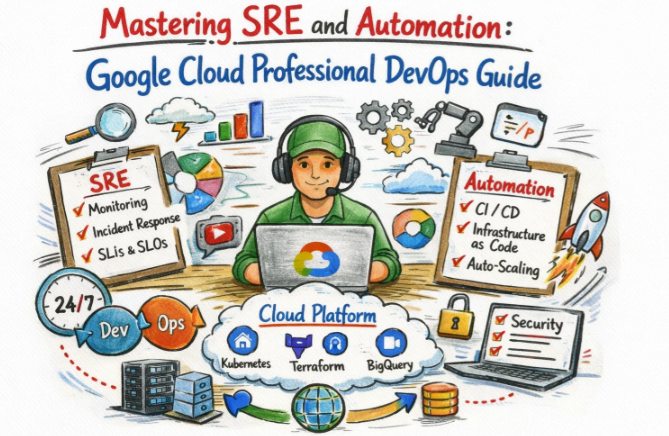
For anyone working in modern software engineering, the goal is clear: we want to build things that do not break. In my long career helping teams move to the cloud, I have seen that the best engineers are those who take responsibility for their code even after it is finished. Google Cloud Platform (GCP) is built on the idea of Site Reliability Engineering (SRE), which is a way of using software to solve problems that used to be handled by hand.
Whether you are an engineer in India or a manager looking at systems across the globe, understanding how to run a reliable system is the most important skill you can have. The Google Cloud Professional Cloud DevOps Engineer certification is the best way to prove you have these skills. This guide will show you exactly how to get there and why it matters for your career.
Understanding the Google Cloud Certification Landscape
Before we focus on the DevOps path, it is helpful to see the full range of certifications Google offers. Each track is built for a specific job, and knowing where you fit helps you plan your next move.
Master Certification Overview
| Track | Level | Who it’s for | Prerequisites | Skills Covered | Recommended Order |
| Cloud DevOps | Professional | SREs, DevOps Engineers | 3+ years in tech | CI/CD, SRE, Monitoring | 3rd |
| Cloud Architect | Professional | Solutions Architects | 3+ years in tech | Design, Infrastructure | 2nd |
| Cloud Security | Professional | Security Leads | 3+ years in tech | IAM, Network Defense | 4th |
| Data Engineer | Professional | Data Scientists | 3+ years in tech | Big Data, ML Pipelines | 3rd |
| Cloud Developer | Professional | App Developers | 3+ years in tech | APIs, Testing, Debug | 2nd |
| Cloud Network | Professional | Network Engineers | 3+ years in tech | Hybrid Cloud, DNS | 4th |
| Cloud Database | Professional | Database Admins | 3+ years in tech | SQL, Spanner, Migration | 3rd |
Detailed Focus: Google Cloud Professional Cloud DevOps Engineer
This certification is special because it teaches you how to think like a reliability expert. It is not just about tools; it is about a way of working that keeps businesses running smoothly.
What it is
The Google Cloud Professional Cloud DevOps Engineer certification proves that you can manage the speed of software delivery without losing the stability of the system. It is built on the principles of Site Reliability Engineering (SRE). Instead of manual work, you learn to use automation to build, deploy, and monitor applications. You will learn how to set goals for system health and how to handle problems before they affect your users.
Who should take it
This is the right path for Software Engineers who want to understand how their code works in a production environment. It is also perfect for current DevOps Engineers who want to move into the Google ecosystem. Managers also find this useful because it gives them a framework for how a high-performing team should operate. If you care about uptime and automation, this is for you.
Skills you’ll gain
Studying for this certificate will change how you solve daily technical problems. You will move away from manual fixes and toward scalable solutions.
- SRE Fundamentals: You will learn how to set Service Level Objectives (SLOs) and Service Level Indicators (SLIs). You will understand how to use an “Error Budget” to manage the risk of releasing new features.
- Pipeline Automation: You will learn to use Cloud Build and Artifact Registry to create fully automated paths for your code. This ensures that every piece of software is tested before it goes live.
- System Visibility: You will master the Cloud Operations suite to monitor logs and metrics. This gives you the ability to see exactly how your system is behaving in real-time.
- Managing Incidents: You will learn the right way to act when things break, including how to set up alerts and how to perform a “blameless” review after an outage to make sure it does not happen again.
Real-world projects you should be able to do
After earning this certification, you will have the technical skills to lead important projects that help your company grow.
- Safe Deployments: You can set up “Canary” or “Blue-Green” releases where only a few users see a change at first. This keeps the rest of your users safe if there is a bug.
- Self-Healing Infrastructure: Using Google Kubernetes Engine (GKE), you can build systems that automatically restart or fix themselves if they crash.
- Infrastructure as Code: You can use scripts to write your entire cloud setup. This makes it easy to set up the same environment in different parts of the world in minutes.
- Scaling for Traffic: You can make your system grow when many people are using it and shrink when things are quiet, which helps your company save money.
Your Preparation Plan: Choosing Your Timeline
Success on the exam depends on how much time you can spend studying. Pick the plan that matches your current schedule and experience.
7–14 Days: The Fast Track
- Best for: Engineers who already use Google Cloud every single day at work.
- Focus: Focus on the specific names of Google services and the SRE theory.
- Action: Take several practice tests to find your weak spots. Read the “Best Practices” documents for Cloud Monitoring and GKE.
30 Days: The Professional Track
- Best for: Working engineers with experience in other clouds (like AWS) but new to Google Cloud.
- Focus: Building a mental map of how the Google Cloud tools connect.
- Action: Spend the first two weeks doing hands-on labs in the cloud console. Spend the next two weeks reading about CI/CD and SRE culture.
60 Days: The Mastery Path
- Best for: Junior engineers or managers who are new to the cloud or DevOps.
- Focus: Learning the “Why” behind every tool and the fundamentals of automation.
- Action: Spend one hour every day. Read the official SRE books and build small projects on the GCP free tier. Join a structured course from a school like DevOpsSchool.
Common Mistakes (And How to Avoid Them)
Many smart people struggle with this exam because they do not follow the right strategy.
- Thinking only about technology: This exam is 50% about culture and 50% about tools. If you do not understand SRE rules like “Toil” and “Error Budgets,” you might fail even if you know the tools.
- Skipping the labs: You cannot pass by just reading books. You must spend time in the Google Cloud Console building real systems to see how they behave.
- Ignoring Best Practices: Google always wants you to choose the most automated way to solve a problem. Don’t pick a complex manual fix if there is a Google service that can do it for you automatically.
Choose Your Path: 6 Specialized Learning Tracks
Once you have the basic DevOps skills, you can focus on a specialized area that fits your career goals:
- DevOps: Focused on the speed of delivery and making the software lifecycle fast and smooth.
- DevSecOps: Adding security checks into every step of the automated pipeline so code is safe from the start.
- SRE: The highest level of reliability. You focus on keeping massive systems up and running without any downtime.
- AIOps/MLOps: Using machine learning to help manage your systems and help data scientists deploy their models.
- DataOps: Focusing on the flow of data across the cloud, ensuring data pipelines are as reliable as software code.
- FinOps: Mastering the financial side of the cloud to keep costs low while keeping performance high.
Role → Recommended Certifications Mapping
If you are not sure what to take next, follow this map based on your job title or the job you want to have:
- DevOps Engineer: Professional Cloud DevOps Engineer → Professional Cloud Architect.
- SRE: Professional Cloud DevOps Engineer → Professional Cloud Security Engineer.
- Platform Engineer: Professional Cloud Architect → Professional Cloud Developer.
- Cloud Engineer: Associate Cloud Engineer → Professional Cloud DevOps Engineer.
- Security Engineer: Professional Cloud Security Engineer → Professional Cloud DevOps Engineer.
- Data Engineer: Professional Data Engineer → Professional Cloud DevOps Engineer.
- FinOps Practitioner: Cloud Digital Leader → Professional Cloud Architect.
- Engineering Manager: Cloud Digital Leader → Professional Cloud DevOps Engineer.
Next Certifications for Long-Term Growth
After you master the DevOps track, keep growing. To stay ahead, look at certifications that broaden your expertise. Based on the career research at GurukulGalaxy, here are three ways to move forward:
- Same Track (Deep Mastery): The Professional Cloud Security Engineer is the perfect follow-up to ensure your automated pipelines are safe.
- Cross-Track (Versatility): The Professional Data Engineer helps you understand how to manage the massive amounts of data that modern apps use.
- Leadership (Growth): The Professional Cloud Architect is the best choice if you want to move into a high-level design or management role.
Top Institutions for Training and Certification
Finding the right mentor can save you months of wasted time. Here are the top institutions providing specialized help for the Google Cloud Professional Cloud DevOps Engineer (CDE):
- DevOpsSchool: This is a top-rated institution known for its practical workshops. They focus on teaching you the real skills needed for the job, helping you understand both the tools and the SRE way of thinking. Their trainers provide hands-on experience that is vital for the exam.
- Cotocus: They provide high-level training for professionals who want to master modern cloud technologies quickly. Their courses are designed to be efficient and focus on what is needed in a professional setting.
- Scmgalaxy: A great place for community learning. They have a massive library of blogs, guides, and tutorials that help you learn by doing and stay connected with other learners.
- BestDevOps: They offer coaching that is strictly aligned with the current needs of the tech industry, making sure your skills are ready for the job market.
- devsecopsschool: The best place to learn how to bridge the gap between security and DevOps automation.
- sreschool: This school focuses entirely on the reliability aspect of the cloud, which is the core of the Google DevOps exam.
- aiopsschool: Perfect for those looking at the future, teaching you how to use machine learning to manage complex cloud environments.
- dataopsschool: They focus on managing data pipelines, which is a critical skill for any modern cloud professional working with big data.
- finopsschool: Essential for managers who need to learn how to keep cloud costs low while keeping performance high.
FAQs: General Career Outcomes
1. Is the DevOps exam difficult?
Yes, it is one of the tougher ones. You need to know both the technology and the SRE rules very well.
2. How long should I study?
Most people spend 1 to 2 months preparing if they are working a full-time job.
3. Do I need to be a programmer?
You do not need to be a master, but you should be able to read code and write simple scripts to automate tasks.
4. What is the best order to take these?
I suggest starting with the Associate Cloud Engineer to learn the basics, then moving to DevOps.
5. Is the pay good for this role?
Yes, DevOps and SRE roles are some of the best-paying jobs in the tech world today, both in India and globally.
6. Does the certificate last forever?
No, it is valid for two years. You will need to take it again to stay up to date with new technology.
7. Can I take the exam from home?
Yes, Google allows you to take the test online with a person watching through your camera.
8. Is Google Cloud as good as AWS?
Both are great. Google Cloud is often liked more for its superior Kubernetes and data analytics tools.
9. Are there any rules to take the test?
Google suggests having some experience, but there are no formal rules saying you must have other certificates first.
10. What happens if I fail?
You can take it again after waiting a few weeks. Use that time to study the areas where you struggled.
11. Is this good for managers?
Yes. It helps managers understand the technical challenges their teams face every day and helps them set better goals.
12. Will this help me find a job abroad?
Yes, these certifications are recognized all over the world and are very helpful for international careers.
FAQs: Specific Questions on Google Cloud Professional Engineer
1. What is the main goal of this certificate?
The goal is to show you can manage reliable systems and delivery pipelines on Google Cloud using SRE rules.
2. Is it different from the Architect exam?
Yes. The Architect exam is about designing the whole system, while the DevOps exam is about running and deploying it.
3. How much Kubernetes is on the test?
Quite a lot. You should know how GKE works and how to manage the groups of servers it uses.
4. Why are the SRE books important?
Google created SRE, and many of the exam questions come directly from the ideas in their official SRE books.
5. Which tools are most important?
Focus on Cloud Build, Cloud Monitoring, Cloud Logging, and Google Kubernetes Engine (GKE).
6. Is networking important?
Yes, you need to know the basics of how traffic moves, like load balancing and how services talk to each other inside a network.
7. Are the questions just about facts?
No, they are “scenario” questions. They describe a problem a company has and ask you for the best way to fix it.
8. Can I get a refund if I don’t pass?
No, the fee is for the exam attempt, so it is important to be ready before you book your seat.
Conclusion
Choosing to become a Google Cloud Professional Cloud DevOps Engineer is a major step for your career. It is about more than just a piece of paper; it is about learning a way of working that the biggest tech companies in the world use every day. By understanding how to keep systems reliable and how to automate the path from code to production, you make yourself a very valuable person in any organization. The road to getting certified will teach you how to handle pressure, how to build things that don’t break, and how to help your team succeed in a competitive world. Whether you are looking for a better job, a higher salary, or just want to be better at what you do, this path is a great investment in your future. It takes effort and dedication, but the skills you learn will stay with you for your entire professional life and will help you lead with confidence in the cloud era.
