
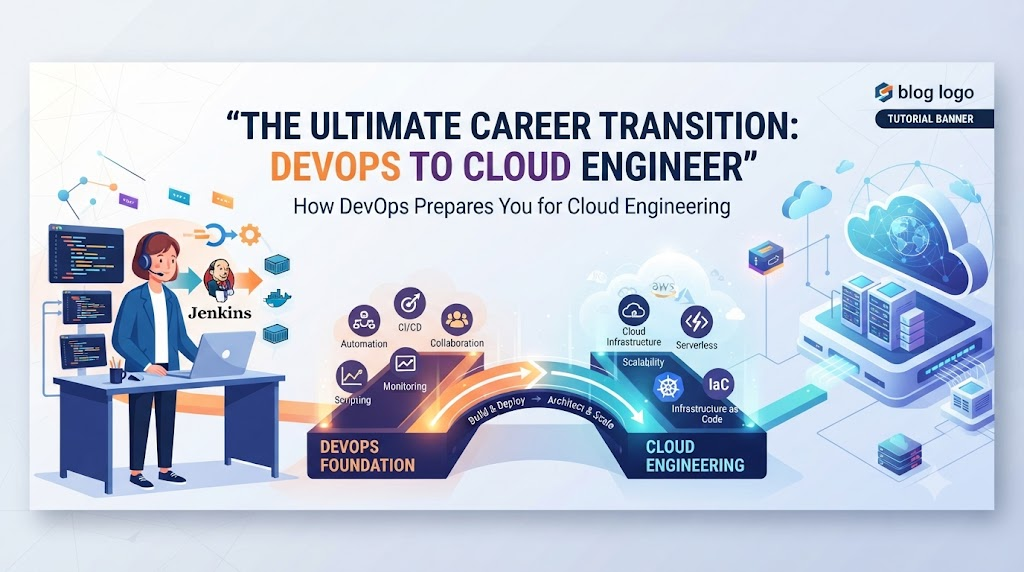
Introduction
The relationship between DevOps and cloud technologies is symbiotic. Cloud computing provides the raw compute, storage, and networking muscle, while DevOps provides the operational framework, automation tools, and cultural mindset required to harness that muscle efficiently.
When you learn DevOps, you do not just learn a set of tools; you learn how to think about systems holistically. You understand how code moves from a developer’s local machine to a production environment without manual intervention. This exact operational fluency is precisely what cloud engineers need to design, provision, and maintain large-scale environments.
What Is DevOps?
Before examining the bridge between the two fields, it helps to define terms. DevOps is a cultural and professional movement that emphasizes communication, collaboration, integration, and automation between software developers (Dev) and IT operations (Ops).
Core pillars of DevOps include:
- Collaboration: Breaking down silos between teams to accelerate delivery.
- Automation: Removing repetitive manual tasks through scripts and pipelines.
- CI/CD (Continuous Integration and Continuous Deployment): Streamlining code changes from testing to production.
- Infrastructure Management: Treating infrastructure code-like to ensure consistency.
- Monitoring and Continuous Improvement: Tracking system health to continuously optimize performance.
What Is Cloud Engineering?
Cloud engineering focuses specifically on architecting, deploying, securing, and managing cloud computing systems. A Cloud Engineer ensures that cloud infrastructure is robust, cost-effective, scalable, and secure.
Their day-to-day responsibilities include designing multi-region architectures, managing identity and access controls, optimizing cloud spending, troubleshooting resource bottlenecks, and ensuring high availability for enterprise applications.
DevOps vs Cloud Engineering: What Is the Difference?
While DevOps and cloud engineering share a massive overlap in tooling and philosophy, they have distinct primary focus areas:
- Cloud Engineering focuses heavily on the architecture, design, provisioning, and governance of cloud resources (AWS, Azure, GCP).
- DevOps focuses heavily on the lifecycle of software delivery, workflow automation, CI/CD pipelines, and operational feedback loops.
However, a modern Cloud Engineer cannot succeed without DevOps automation skills, and a DevOps Engineer cannot build reliable pipelines without deep cloud infrastructure knowledge. This is why professionals often transition smoothly between the two roles or work as “Cloud DevOps Engineers.”
Why DevOps Skills Are Important for Cloud Engineers
DevOps equips engineers with a practical understanding of how applications interact with underlying systems. Rather than viewing infrastructure as static hardware, a DevOps-trained professional views infrastructure as a flexible, programmable asset.
Key competencies gained through DevOps that transfer directly to cloud engineering include automated provisioning, seamless deployment strategies, continuous monitoring, and security enforcement at every stage of the development lifecycle.
How Linux Knowledge Helps in Cloud Engineering
Linux is the invisible backbone of modern cloud computing. The vast majority of cloud virtual machines, containers, and serverless execution environments run on Linux distributions.
- Server Management: Managing remote instances via SSH, configuring permissions, and managing system services.
- Containerization: Understanding how Linux kernel features like cgroups and namespaces enable Docker and Kubernetes.
- Troubleshooting: Analyzing logs, tracking CPU/memory usage, and diagnosing network latency using command-line utilities.
How Networking Knowledge Prepares You for Cloud
Cloud environments are essentially virtualized data centers spanning regions and availability zones. Strong networking knowledge is non-negotiable for cloud professionals.
Essential concepts include:
- IP Addressing & Subnetting: Designing secure Virtual Private Clouds (VPCs).
- DNS & Routing: Managing public and private domain name resolution and traffic flow.
- Firewalls & Security Groups: Controlling inbound and outbound traffic at the port and protocol level.
- Load Balancing: Distributing application traffic across multiple backend instances to ensure high availability.
Infrastructure as Code: A Key DevOps-to-Cloud Skill
Gone are the days of clicking through web consoles to manually provision servers, storage buckets, and databases. Infrastructure as Code (IaC) revolutionized how we build environments.
Using tools like Terraform, DevOps professionals and cloud engineers define infrastructure in human-readable configuration files. This allows teams to version-control their infrastructure, review changes via pull requests, and spin up identical development, staging, and production environments with a single command.
CI/CD Skills and Cloud Deployment
Continuous Integration and Continuous Deployment (CI/CD) pipelines are the highways along which modern software travels to the cloud. DevOps engineers build these pipelines using tools like GitHub Actions, GitLab CI, or Jenkins.
In cloud engineering, CI/CD skills are used to automatically build application artifacts, run automated tests, push container images to cloud registries, and deploy updates safely into cloud environments with zero downtime.
Containers and Kubernetes for Cloud Engineering
Containers have transformed application packaging, ensuring that software runs reliably across different computing environments.
- Docker: Allows developers to package applications and their dependencies into a single container image.
- Kubernetes: The industry standard for container orchestration. Kubernetes automates the deployment, scaling, and management of containerized applications across clusters of cloud servers.
Mastering containers through DevOps gives cloud engineers the exact skills needed to manage modern cloud-native microservices architectures.
Cloud Platforms DevOps Professionals Should Learn
To transition successfully into cloud engineering, you must gain hands-on experience with major public cloud providers. The three market leaders are:
- Amazon Web Services (AWS): The most widely adopted cloud platform with a massive ecosystem of services.
- Microsoft Azure: Highly popular in enterprise environments integrated with Microsoft ecosystems.
- Google Cloud Platform (GCP): Known for strengths in data analytics, machine learning, and Kubernetes (GKE).
When starting out, focus deeply on one platform—mastering core compute, storage, networking, and identity management—before expanding to multi-cloud strategies.
Automation Skills That Transfer From DevOps to Cloud Engineering
Automation is the core philosophy that unites DevOps and cloud engineering. Shell scripting (Bash/Python), configuration management tools (Ansible), and workflow automation scripts allow engineers to eliminate toil.
When you practice DevOps automation, you learn how to write idempotent scripts and manage configuration drift—skills that are critical when maintaining hundreds of cloud virtual instances.
Monitoring and Observability in Cloud Environments
Building a cloud environment is only half the battle; maintaining visibility into its health is equally important. DevOps practices emphasize robust monitoring and observability.
Modern cloud observability relies on three pillars:
- Metrics: Numerical data tracking CPU usage, request rates, and error percentages.
- Logs: Detailed event records generated by applications and operating systems.
- Traces: Tracking requests as they flow through distributed microservices.
Tools like Prometheus, Grafana, and Datadog are heavily utilized in both DevOps and cloud engineering workflows.
DevSecOps and Cloud Security
Security cannot be an afterthought tacked on at the end of a deployment cycle. DevSecOps integrates security practices into every phase of the software and infrastructure lifecycle.
For cloud engineers, this involves implementing Identity and Access Management (IAM) best practices, managing secrets securely (using tools like HashiCorp Vault or AWS Secrets Manager), scanning container images for vulnerabilities, and enforcing compliance guardrails on cloud infrastructure.
Cloud Infrastructure Management Through DevOps Practices
Managing cloud infrastructure requires a systematic approach. DevOps principles teach professionals how to treat compute, storage, and databases as modular components. Whether provisioning an Amazon RDS database, setting up S3 object storage, or scaling EC2 compute fleets, DevOps methodologies ensure these resources are managed efficiently, cost-effectively, and repeatably.
Scalability, Availability, and Reliability
High availability and fault tolerance are primary goals of cloud engineering. DevOps experience with automated failovers, chaos engineering, incident management, and automated scaling policies directly prepares engineers to build resilient cloud architectures that can withstand unexpected traffic spikes or hardware failures.
Real-World DevOps Skills That Help Cloud Engineers
To visualize how these concepts apply on the job, consider these practical tasks performed daily by professionals bridging DevOps and cloud engineering:
- Deploying containerized web applications to cloud Kubernetes clusters.
- Automating cloud resource provisioning across multiple regions using Terraform.
- Building CI/CD pipelines that test and deploy infrastructure updates automatically.
- Monitoring cloud workloads and setting up automated PagerDuty or Slack alerts for anomalies.
- Troubleshooting production latency bottlenecks using Linux command-line tools and cloud dashboards.
A Step-by-Step Roadmap From DevOps to Cloud Engineering
If you want to make a structured transition, follow this progressive learning path:
- Linux Fundamentals: Master the command line, file permissions, and process management.
- Networking Basics: Understand TCP/IP, DNS, subnets, and load balancers.
- Version Control (Git): Learn branching, merging, and collaboration workflows.
- Scripting: Pick up Python or Bash for automation tasks.
- DevOps Fundamentals: Understand CI/CD and agile deployment principles.
- Containers & Docker: Learn how to containerize applications.
- Kubernetes: Master pod deployment, services, and cluster management.
- Infrastructure as Code (Terraform): Practice provisioning cloud resources via code.
- Cloud Platform Fundamentals: Deep-dive into AWS, Azure, or GCP.
- Cloud Security & Monitoring: Implement IAM policies, logging, and observability tools.
- Real-World Capstone Projects: Build end-to-end cloud deployments.
Projects to Build Cloud Engineering Skills After Learning DevOps
Hands-on projects cement your knowledge better than any textbook. Try building these practical projects:
- Multi-Tier Web App Deployment: Deploy a frontend, backend, and database tier across cloud virtual private clouds (VPCs).
- Automated CI/CD Pipeline: Set up a pipeline that automatically builds a Docker image and deploys it to a cloud Kubernetes cluster upon code commit.
- Infrastructure as Code Repository: Write modular Terraform code to provision an entire cloud environment with secure networking and databases.
- Cloud Monitoring Dashboard: Set up Prometheus and Grafana to track resource utilization metrics across your cloud instances.
Common Challenges When Moving From DevOps to Cloud Engineering
Transitioning roles comes with hurdles. Some common challenges include:
- Understanding Complex Cloud Architecture: Moving from managing local scripts to designing globally distributed, multi-region cloud networks can feel overwhelming.
- Cloud Cost Management: Unlike fixed on-premise hardware, cloud resources cost money by the second. Learning FinOps and cost optimization is crucial.
- Navigating Cloud-Native Services: Each cloud provider offers hundreds of proprietary managed services, requiring continuous learning and evaluation.
How DevOps Training Can Help Build Cloud Engineering Skills
Mastering these multifaceted technologies independently can sometimes feel scattered. Structured learning programs can accelerate your progress by offering curated curriculums, guided labs, and mentorship. For professionals seeking comprehensive skill development, organizations like DevOpsSchool provide hands-on training programs covering automation, CI/CD, containers, Kubernetes, Infrastructure as Code, and cloud technologies, helping engineers bridge practical theory with real-world execution.
Career Opportunities After Combining DevOps and Cloud Skills
Combining DevOps expertise with cloud engineering opens doors to some of the most dynamic and rewarding roles in the tech industry, including:
- Cloud Engineer
- DevOps Engineer
- Cloud DevOps Engineer
- Site Reliability Engineer (SRE)
- Platform Engineer
- Cloud Infrastructure Engineer
- Cloud Architect
Future of DevOps and Cloud Engineering
The future of cloud engineering and DevOps points toward greater automation and intelligence. Key trends shaping the industry include:
- Platform Engineering: Building internal developer platforms (IDPs) to improve developer self-service.
- FinOps: Integrating financial accountability into cloud infrastructure management.
- AI-Assisted Operations: Leveraging generative AI and machine learning for automated incident detection and remediation.
- Advanced Serverless and Edge Computing: Moving compute closer to users with minimal infrastructure overhead.
Frequently Asked Questions
Can a DevOps Engineer become a Cloud Engineer?
Yes, absolutely. A DevOps Engineer already possesses the automation, scripting, CI/CD, and infrastructure management skills that make transitioning into cloud engineering seamless.
Is DevOps necessary for Cloud Engineering?
While you can manage cloud resources manually without DevOps, modern cloud engineering heavily relies on automation, IaC, and CI/CD—making DevOps knowledge virtually mandatory for advanced roles.
What DevOps skills are useful for Cloud Engineers?
Key transferable skills include Infrastructure as Code (Terraform), containerization (Docker/Kubernetes), CI/CD pipeline management, and Linux administration.
Which cloud platform should a DevOps beginner learn first?
AWS is widely recommended due to its massive market share and extensive documentation, though Azure and GCP are equally strong alternatives depending on your regional or industry focus.
Is Kubernetes required for Cloud Engineering?
While entry-level cloud roles may not require deep Kubernetes expertise, it has become an industry standard for modern containerized cloud deployments.
Is Terraform useful for Cloud Engineers?
Yes, Terraform is the leading tool for Infrastructure as Code, making it an essential daily asset for cloud engineers provisioning resources.
How long does it take to move from DevOps to Cloud Engineering?
With consistent practice and hands-on project building, professionals with a solid foundational background typically make a confident transition within 3 to 6 months.
What projects should I build to become a Cloud Engineer?
Focus on end-to-end projects such as provisioning infrastructure with Terraform, deploying container apps via CI/CD pipelines, and setting up cloud monitoring.
Is cloud certification necessary for a Cloud Engineering career?
Certifications are not strictly mandatory, but they validate your foundational knowledge, boost your resume, and help structure your learning path.
Conclusion: DevOps Builds the Foundation for Cloud Engineering
In summary, how DevOps prepares you for cloud engineering boils down to a powerful synthesis of automation, infrastructure management, continuous deployment, and robust operational mindsets. DevOps gives you the tools to look at systems not as isolated servers, but as programmable, scalable ecosystems. By mastering Linux, networking, Infrastructure as Code, CI/CD, and container orchestration, you position yourself at the forefront of modern cloud infrastructure engineering. Embrace the journey, build real-world projects, and unlock new heights in your IT career.

