
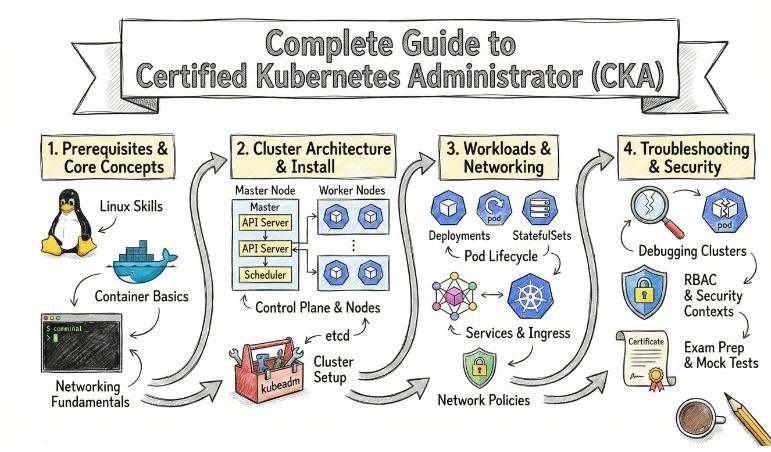
The landscape of modern software delivery has undergone a massive transformation. We have moved from the era of static servers to a world of dynamic, automated container orchestration. Having navigated these changes from the early days of physical hardware to the current cloud-native ecosystem, I can tell you that Kubernetes has become the standard for the modern enterprise.
The Certified Kubernetes Administrator (CKA) certification is the definitive proof that an engineer can manage this complex environment. It is not just about passing a test; it is about proving you can handle production-level infrastructure. This guide is designed to help engineers and managers across India and the globe understand the value of the CKA and how to achieve it.
Global Certification Master Table
Before diving into Kubernetes, use this table to see where various certifications fit into your professional growth.
| Track | Level | Who it’s for | Prerequisites | Skills Covered | Recommended Order |
| Kubernetes | Administrator | DevOps & Cloud Engineers | Docker, Linux Basics | Cluster Setup, Networking, Storage | 1st (Core) |
| DevOps | Professional | Software Engineers | Coding, Git | CI/CD, IaC, Automation | 2nd |
| DevSecOps | Specialist | Security Engineers | DevOps Basics | Security Auditing, Compliance | 3rd |
| SRE | Reliability | Operations Leads | DevOps Professional | SLOs, Error Budgets, Monitoring | 4th |
| AIOps | Advanced | Data & Ops Leads | Python, Statistics | AI/ML in Ops, Predictive Maintenance | 5th |
| FinOps | Management | Managers & Architects | Cloud Fundamentals | Cloud Cost Optimization, Budgeting | 6th |
Certified Kubernetes Administrator (CKA)
What it is
The CKA is a performance-based certification that ensures you have the skills to design, install, and manage production-ready Kubernetes clusters. Unlike multiple-choice exams, this is a hands-on test where you solve real-world problems in a live command-line environment.
Who should take it
- System Administrators looking to modernize their skills.
- DevOps Engineers responsible for cluster reliability.
- Software Engineers who want to understand the platform hosting their apps.
- Engineering Managers who need technical depth to lead cloud-native teams.
Skills you’ll gain
- Cluster Architecture: Understanding how the control plane and nodes work together.
- Installation: Bootstrapping a production-grade cluster using
kubeadm. - Networking: Implementing pod connectivity, Ingress, and DNS.
- Storage: Managing persistent volumes for stateful applications.
- Troubleshooting: Identifying and fixing node, pod, and networking failures.
Real-world projects you should be able to do after it
- Build a high-availability Kubernetes cluster for a microservices app.
- Secure a cluster using Role-Based Access Control (RBAC) and network policies.
- Automate cluster maintenance and perform zero-downtime upgrades.
- Implement persistent storage solutions for enterprise-grade databases.
Preparation Plan
7–14 Days (The Fast Track)
- Days 1-4: Focus on Core Concepts and the API. Master
kubectlimperative commands. - Days 5-9: Practice Cluster Installation and Maintenance (Backup/Restore).
- Days 10-14: High-speed mock exams. Focus on speed and CLI muscle memory.
30 Days (The Balanced Plan)
- Week 1: Review Linux fundamentals and container runtimes.
- Week 2: Master Application Lifecycle Management and Service configuration.
- Week 3: Deep dive into Networking, Storage, and Security policies.
- Week 4: Practice Troubleshooting in simulated environments.
60 Days (The Mastery Path)
- Month 1: Theory and manual builds. Follow “Kubernetes the Hard Way” to learn the internals.
- Month 2: Focus on complex scenarios, troubleshooting under pressure, and refining YAML editing.
Common Mistakes
- Typing YAML manually: Wasting time when imperative commands could generate the template.
- Ignoring Context: Forgetting to switch to the correct cluster context for each question.
- Time Management: Getting stuck on a low-point question for too long.
- Documentation Speed: Not knowing how to quickly search the official docs for example code.
Best next certification after this
The Certified Kubernetes Security Specialist (CKS) is the natural next step to focus on hardening and defending your clusters.
Choose Your Path: 6 Career Tracks
Modern engineering requires a focus. Here are six directions you can take after mastering the CKA:
- DevOps Path: Focus on the flow of software. Master CI/CD pipelines and GitOps.
- DevSecOps Path: Focus on security. Integrate auditing and compliance into the pipeline.
- SRE Path: Focus on reliability. Learn monitoring, incident response, and performance tuning.
- AIOps/MLOps Path: Focus on the future. Use Kubernetes to scale AI and machine learning models.
- DataOps Path: Focus on data. Manage complex data pipelines and distributed databases.
- FinOps Path: Focus on efficiency. Balance high performance with cloud cost optimization.
Role → Recommended Certifications
- DevOps Engineer: CKA + Certified DevOps Professional.
- SRE: CKA + SRE Certified Professional.
- Platform Engineer: CKA + Certified DevOps Architect.
- Cloud Engineer: CKA + AWS/Azure DevOps Professional.
- Security Engineer: CKA + DevSecOps Certified Professional.
- Data Engineer: CKA + DataOps Certified Professional.
- FinOps Practitioner: CKA + FinOps Certified Professional.
- Engineering Manager: CKA + Certified DevOps Manager.
Top Training Institutions for CKA
Choosing the right learning partner is vital. These institutions provide the hands-on training needed for the CKA:
- DevOpsSchool: This is the primary institution for mentor-led technical training. They focus on real-world projects and provide lifelong support. Their labs are designed to build the “muscle memory” required for high-paying roles.
- Cotocus: Specializes in high-end consulting and training. They are ideal for senior professionals who need to understand complex architecture and global-scale deployments.
- Scmgalaxy: A community-centric hub providing a massive library of technical guides and tutorials. It is an excellent resource for those who value deep technical documentation.
- BestDevOps: Known for providing streamlined and effective modules that help working professionals gain mastery in the shortest possible time.
- devsecopsschool: The place to go for security-focused engineering. They integrate deep security principles into every part of their Kubernetes training.
- sreschool: Dedicated to the discipline of Site Reliability Engineering, teaching how to maintain high availability in containerized environments.
- aiopsschool: Focuses on the next wave of automation, teaching how to use AI and machine learning to optimize infrastructure management.
- dataopsschool: Specializes in managing data-heavy workloads on Kubernetes, focusing on persistent storage and data pipelines.
- finopsschool: The leading provider for cloud financial management, teaching you how to optimize costs while maintaining performance.
Next Certifications to Take
After you clear the CKA, industry data suggests three key directions for growth:
- Same Track (Expertise): Certified Kubernetes Security Specialist (CKS).
- Cross-Track (Broad Skills): Hashicorp Certified Terraform Associate to master Infrastructure as Code (IaC).
- Leadership (Career Growth): Certified DevOps Manager (CDM) to lead organizational change.
Career & Strategy FAQs
1. How difficult is the CKA exam? It is considered a 7/10. It is challenging because it is performance-based, meaning you must actually perform tasks rather than just answer questions.
2. How much time do I need to prepare? Most professionals find that 4 to 6 weeks of daily practice is sufficient for success.
3. What are the prerequisites? There are no formal requirements, but a strong comfort level with the Linux command line is essential.
4. Should I take CKA or CKAD first? CKA is for those managing infrastructure. CKAD is better for developers focusing on app deployment.
5. Is the CKA still valuable today? Yes. Kubernetes is the industry standard for cloud-native applications globally.
6. Does the certificate expire? Yes, it is valid for 2 years, ensuring you stay updated with the fast-moving ecosystem.
7. Can I use the documentation during the exam? Yes, you are permitted to have one tab open with the official Kubernetes documentation.
8. What is the passing score? A score of 66% or higher is required to pass.
9. Will this help my salary? Yes. CKA holders generally see a significant salary increase due to the high demand for these skills.
10. Do I need to know how to code? No, but you must be comfortable with YAML and basic scripts.
11. What if I fail on my first attempt? Most vouchers from the Linux Foundation (and those through DevOpsSchool) include a free retake.
12. Can a manager benefit from the CKA? Yes. It provides the technical credibility needed to lead cloud-native transformations and manage engineering teams.
CKA Training FAQs
1. Why should I choose mentor-led training? Mentors provide real-world insights and help you fix lab errors in minutes that might otherwise take you hours to solve.
2. Are the labs provided real? Yes, top institutions like DevOpsSchool provide cloud labs that mimic actual production environments.
3. Is there a community for support? Yes, platforms like Scmgalaxy offer massive communities where you can ask technical questions even after the course ends.
4. Will I get a certificate of completion? Yes, you will receive a training certificate from the institution in addition to the global CKA certification.
5. Can I get help with the exam booking? Yes, training providers usually guide you through the registration and scheduling process.
6. Do the courses cover security? While the focus is on administration, basic security hardening is a core part of the CKA curriculum.
7. What tools will I use most? You will spend the majority of your time with kubectl, kubeadm, and Linux-based CLI tools.
8. How do I start? The best way to start is to enroll in a foundational course that covers Linux and Docker before diving into the core CKA syllabus.
Conclusion
The path to becoming a Certified Kubernetes Administrator is a defining step in a modern technical career. From my experience, those who take the time to truly master these hands-on skills are the ones who find themselves leading the most impactful projects in the world today.
Kubernetes is more than just a tool; it is a new way of thinking about infrastructure. By choosing a solid training partner and sticking to a dedicated study plan, you aren’t just passing a test—you are building the future of your career.
