
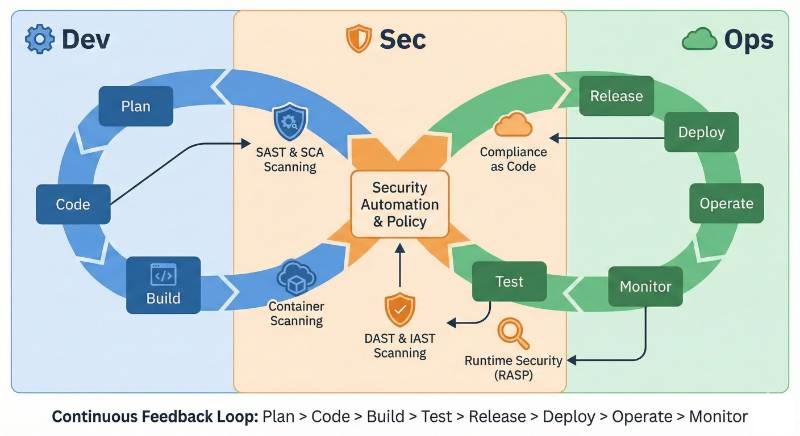
In the modern era of cloud computing and containers, simply building software fast is no longer enough; you must build it securely from the very first line of code. DevSecOps allows you to bake security directly into your CI/CD pipeline rather than treating it as a final roadblock, making it the single most valuable skill for Developers, QA, and DevOps Engineers to acquire right now. This guide provides a complete breakdown of the DevSecOps Certified Professional (DSOCP) program, detailing exactly how this training empowers you to master the automation tools needed to secure the software supply chain and significantly advance your career.
Quick View: Certification at a Glance
Before we dive deep, here is the high-level summary of this certification.
| Feature | Details |
| Certification Name | DevSecOps Certified Professional (DSOCP) |
| Track | Security & DevOps Integration |
| Level | Professional (Intermediate to Advanced) |
| Who is it for? | DevOps Engineers, Security Engineers, SREs, Developers, QA |
| Prerequisites | Basic knowledge of Linux, Git, and understanding of DevOps culture |
| Skills Covered | SAST, DAST, SCA, Container Security, Compliance as Code, Secret Management |
| Recommended Order | Take this after a fundamental DevOps course |
Deep Dive: DevSecOps Certified Professional (DSOCP)
This is the core certification for anyone looking to prove they can secure a modern software supply chain.
What it is
The DevSecOps Certified Professional (DSOCP) is a hands-on training and certification program. It focuses on “Shifting Left”—moving security earlier in the development lifecycle. Unlike traditional security certifications that focus on policy or theory, this course focuses on automation. You learn how to use tools to automatically find and fix vulnerabilities in your CI/CD pipeline.
Who should take it
- DevOps Engineers who need to add security checks to their pipelines.
- Security Professionals who need to understand modern CI/CD and automation.
- Developers who want to write secure code and understand vulnerabilities.
- Managers who need to lead secure software delivery teams.
Skills you’ll gain
- Static Application Security Testing (SAST): Analyzing source code for bugs without running it (e.g., SonarQube).
- Dynamic Application Security Testing (DAST): Testing running applications for exposure (e.g., OWASP ZAP).
- Software Composition Analysis (SCA): Checking open-source libraries for known vulnerabilities.
- Container Security: Scanning Docker images and Kubernetes clusters.
- Infrastructure as Code (IaC) Security: Scanning Terraform/Ansible scripts for misconfigurations.
- Secrets Management: managing passwords and keys securely (e.g., HashiCorp Vault).
Real-world projects you should be able to do after it
- Build a fully automated CI/CD pipeline (using Jenkins or GitLab) that breaks the build if a severe vulnerability is found.
- Implement a vulnerability management dashboard to track security debt.
- Automate Docker image scanning before pushing to a registry.
- Write custom security rules to enforce company compliance policies automatically.
Preparation plan (30 Days)
- Week 1: Master the basics of DevOps (Git, Docker, Jenkins) and Security fundamentals (OWASP Top 10).
- Week 2: Deep dive into SAST and SCA tools. Integrate them into a sample pipeline.
- Week 3: Focus on DAST and Container Security. Learn to break your own build.
- Week 4: Compliance as Code, Reporting, and Final Project implementation.
Common mistakes
- Overloading developers: Turning on every security rule at once, causing thousands of “false positives.”
- Ignoring culture: Trying to force tools on a team without explaining why security matters.
- Blocking everything: Stopping releases for minor issues (Low/Info severity) instead of focusing on Critical/High.
- Forgetting the feedback loop: Finding bugs but not giving developers an easy way to fix them.
Best next certification after this
- Certified Kubernetes Security Specialist (CKS): If you want to specialize deeply in container orchestration security.
Choose Your Path: Career Tracks
The tech world is splitting into specialized tracks. Here is where you fit in.
- DevOps Track: Focuses on speed, automation, and culture. You connect Dev and Ops.
- DevSecOps Track: Focuses on safety. You ensure that speed doesn’t kill security.
- SRE (Site Reliability Engineering) Track: Focuses on stability. You treat operations as a software problem.
- AIOps/MLOps Track: Focuses on data. You manage the lifecycle of AI/ML models.
- DataOps Track: Focuses on data pipelines. You ensure data flows quickly and reliably.
- FinOps Track: Focuses on cost. You ensure cloud spending is optimized and valuable.
Role → Recommended Certifications Mapping
If you are currently in a role, here is what you should target next.
| Current Role | Recommended Certification Path |
| DevOps Engineer | DevOps Certified Professional → DevSecOps Certified Professional |
| SRE | Site Reliability Engineer (SRE) Certification → Chaos Engineering |
| Platform Engineer | Certified Kubernetes Administrator (CKA) → DevSecOps Certified Professional |
| Cloud Engineer | AWS/Azure Solutions Architect → Terraform Associate |
| Security Engineer | DevSecOps Certified Professional → Certified Kubernetes Security Specialist (CKS) |
| Data Engineer | DataOps Certified Professional → Big Data Specialist |
| FinOps Practitioner | FinOps Certified Practitioner → Cloud Cost Management Specialist |
| Engineering Manager | DevOps Leader → DevSecOps Certified Professional (for awareness) |
Top Institutions for DevSecOps Certified Professional Training
Finding the right training partner is critical. Here are the top institutions that provide help in Training cum Certifications for DevSecOps Certified Professional Online Training.
1. DevOpsSchool DevOpsSchool is a pioneer in this space. They offer a very hands-on, project-based curriculum. Their DSOCP program is known for being rigorous and industry-aligned. They focus heavily on “doing” rather than just “listening,” which is vital for this technical field.
- Provider: DevOpsSchool.com
2. Cotocus Cotocus provides specialized consulting and training. Their approach is often tailored to corporate needs, making them a great choice if your company is sponsoring your learning. They bring real-world consulting experience into the classroom.
3. Scmgalaxy Scmgalaxy is a community-driven platform. They have a vast repository of tutorials and guides. Their training is often very affordable and accessible, making it a good entry point for beginners or self-starters.
4. BestDevOps As the name suggests, they focus on curating the best practices. Their training modules are often short, sharp, and focused on specific tools or problems, which is great for upskilling quickly.
5. devsecopsschool A niche provider focused strictly on security in DevOps. Because they specialize, their depth in security tools (like Vault, Aqua, Twistlock) is often deeper than generalist providers.
6. sreschool While focused on SRE, they offer DevSecOps modules that focus heavily on the reliability aspect of security. Great if you want to understand how security impacts system uptime.
7. aiopsschool Focuses on the intersection of AI and Ops. Their DevSecOps training often includes modern angles like using AI to detect threats in the pipeline.
8. dataopsschool Best for data engineers. They teach DevSecOps principles applied to data pipelines—securing the flow of data rather than just the application code.
9. finopsschool They focus on the cost aspect. While not a direct security trainer, they offer unique insights into the cost implications of security tools and cloud security services.
Next Certifications to Take
Once you have your DSOCP, you should look at expanding your horizon. Based on industry trends, here are your best options:
Option 1: Same Track (Deepen Technical Skills)
- Certified Kubernetes Security Specialist (CKS): This is the gold standard for container security.
- Advanced Cloud Security Certifications: AWS Certified Security – Specialty or Azure Security Engineer Associate.
Option 2: Cross-Track (Broaden Knowledge)
- Certified Site Reliability Engineer (SRE): Learn to keep the secure systems you build reliable and scalable.
- Certified DataOps Professional: Move into the world of Big Data and learn to secure data lakes and pipelines.
Option 3: Leadership (Move to Management)
- Certified Information Systems Security Professional (CISSP): The traditional “management” security cert. Good for high-level credibility.
- DevOps Leader (DOL): Focuses on the people and process side of managing technical teams.
General FAQs
1. Is DevSecOps difficult to learn? It has a learning curve. You need to understand both development (code) and operations (servers), and then add security on top. However, if you take it step-by-step, it is very logical.
2. Do I need to be a coder? You don’t need to be a developer, but you must be able to read code and understand scripts (Python, Bash, YAML).
3. How long does it take? A dedicated course usually takes 4-6 weeks (part-time) to complete if you practice the labs.
4. What are the prerequisites? Basic Linux skills, familiarity with Git, and a general understanding of the software development lifecycle (SDLC).
5. Is this certification recognized globally? Yes. DevOpsSchool and the DSOCP designation are recognized by companies worldwide looking for practical skills.
6. Will this increase my salary? Generally, yes. DevSecOps engineers are among the highest-paid technical roles because they combine two high-value skill sets: DevOps and Security.
7. Can I self-study? You can, but setting up the labs (Jenkins, Kubernetes, SonarQube, etc.) on your own can be very difficult and time-consuming. Guided training is usually faster.
8. What is the difference between DevOps and DevSecOps? DevOps is about speed and quality. DevSecOps is about speed, quality, and safety.
9. Do I need to know Cloud (AWS/Azure)? Yes, most modern DevSecOps happens in the cloud. You should know the basics of at least one cloud provider.
10. Is there an exam? Yes, most certifications end with a project-based exam or a multiple-choice test.
11. Does the certificate expire? It depends on the provider. Some are lifetime, while others require renewal every 2-3 years to ensure you stay current with new tools.
12. What tools will I learn? Typically: Jenkins/GitLab (CI/CD), Docker/K8s (Containers), SonarQube (SAST), OWASP ZAP (DAST), Terraform (IaC).
FAQs on DevSecOps Certified Professional (DSOCP)
1. What is the passing score for the DSOCP exam? Typically, you need a score of 70% or higher to pass. The exam focuses heavily on practical scenarios.
2. Does the course cover Kubernetes security? Yes. Since modern DevOps runs on Kubernetes, securing the cluster and the pods is a major part of the curriculum.
3. Is the training live or recorded? DevOpsSchool offers both. Live training is better for asking questions, while recorded is good for self-paced learning.
4. Can I retake the exam if I fail? Most providers, including DevOpsSchool, offer one free retake or a discounted retake fee. Check the specific terms when you enroll.
5. Do I get lab access? Yes, the course includes access to cloud-based labs where you can practice setting up pipelines without installing everything on your own laptop.
6. Is this suitable for freshers? It is recommended for people with at least 1-2 years of IT experience. Freshers might find the concepts of CI/CD and pipeline integration overwhelming without prior context.
7. How is this different from “Certified Ethical Hacker” (CEH)? CEH teaches you how to attack (penetration testing). DSOCP teaches you how to defend by building automated security into the software creation process.
8. Will I get job assistance? DevOpsSchool often provides resume reviews and mock interviews to help you position yourself for DevSecOps roles after certification.
Conclusion
The days of the “security guy” blocking releases at the last minute are over; the future belongs to engineers who can say, “Go fast, but here are the automated guardrails to keep us safe.” The DevSecOps Certified Professional training is your bridge to that future, transforming you from a standard operator into a guardian of the codebase who understands that security is a powerful enabler, not a bottleneck. If you are ready to master the art of “shifting left” and proving your immense value in the modern tech landscape, check out the official program at DevOpsSchool and start your journey today.
