
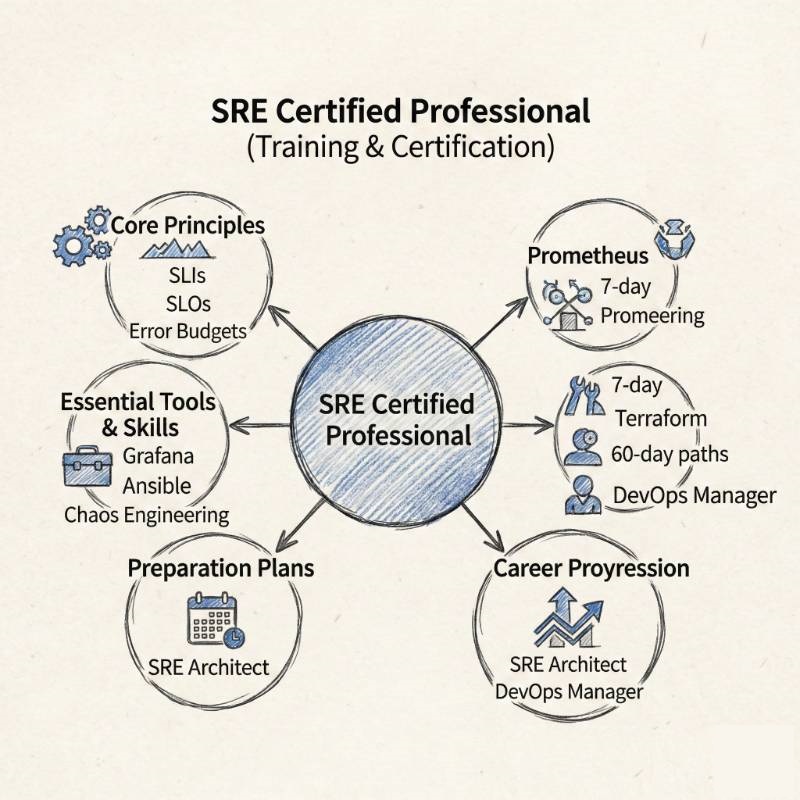
In today’s tech landscape, system stability is everything. Downtime doesn’t just annoy users; it costs money and damages your reputation. This reality has made Site Reliability Engineering (SRE) one of the most essential disciplines in the industry. It is not enough to simply write code—you need to build systems that are resilient, scalable, and capable of self-healing.The SRE Certified Professional (Training & Certification) is the bridge between writing software and running it. It equips you with the mindset and tools to keep applications running smoothly, even when errors occur or traffic spikes unexpectedly.
Quick Look: SRE Certified Professional at a Glance
| Track | Level | Who it’s for | Prerequisites | Skills Covered | Recommended Order |
| SRE | Professional | DevOps Pros, SysAdmins, Developers | Basic Linux & Cloud | SLOs/SLIs, Error Budgets, Automation, Incident Response, Observability | 1st in SRE Track |
SRE Certified Professional (Training & Certification)
What it is
This is a practical, industry-focused program designed to make you a true reliability expert. It moves beyond theory to teach you the actual application of SRE principles—focusing on how to measure system health and automate repetitive operational work (“toil”) in live environments.
Who should take it
- DevOps Engineers seeking to specialize in system uptime and stability.
- Developers who want to better understand the production environment.
- SysAdmins/Ops wanting to modernize their workflow with code-based automation.
- Tech Leads who need to set clear reliability standards for their squads.
Skills you’ll gain
- Measuring Reliability: Deep understanding of Service Level Indicators (SLIs), Objectives (SLOs), and managing Error Budgets.
- Deep Monitoring: Implementing observability stacks using tools like Prometheus, Grafana, and ELK.
- Incident Response: Managing outages effectively and conducting “Blameless Post-Mortems.”
- Automation: Replacing manual checklists with Ansible and Terraform scripts.
- Resilience Testing: Using Chaos Engineering to break systems intentionally to find weak spots.
- Resource Forecasting: Using data to plan for future capacity needs.
Real-world projects you should be able to do after it
- Build a monitoring dashboard that alerts you to issues before they cause downtime.
- Draft an “Error Budget” policy that freezes new releases if the system becomes too unstable.
- Create an automated bot that handles incident alerts and notifies the correct team members.
- Convert a legacy application into a more resilient microservices structure.
- Run a “Chaos Monkey” script to verify if your system can auto-heal during a failure.
Preparation Plan
- 7–14 Days (Fast Track): Concentrate on the core logic of SLOs/SLIs and review the necessary tools (Linux, Git). Ideal for seasoned DevOps pros.
- 30 Days (Standard): Dedicate the first two weeks to concepts and the final two weeks to hands-on labs. Build a local environment to practice.
- 60 Days (Thorough): Read the Google SRE books while taking the course. Build a complete mini-project from scratch using every tool taught.
Common mistakes
- Skipping the Culture: SRE is as much about mindset as it is about tools. Don’t ignore the “blameless” culture aspect.
- Over-measuring: Beginners often try to track every single metric. Start with the basics: Latency, Traffic, Errors, and Saturation.
- Ignoring Labs: You cannot learn this by reading. You must practice fixing broken setups.
Best next certification after this
- Same Track: Certified SRE Architect (focuses on high-level design).
- Cross Track: DevSecOps Certified Professional (adds security layers to your reliability skills).
- Leadership: Certified DevOps Manager (for those stepping into management).
Choose Your Path: 6 Learning Tracks
Select the path that aligns with your career targets. While the SRE Certified Professional is central to the SRE Path, it supports the others as well.
- DevOps Path: DevOps is the union of people, processes, and products to enable continuous delivery of value to end users. It focuses on breaking down silos between development and operations.
- DevSecOps Path: DevSecOps stands for Development, Security, and Operations. It integrates security practices into the DevOps process from the very start (shifting left) rather than treating it as an afterthought.
- SRE Path: Site Reliability Engineering (SRE) is a discipline that incorporates aspects of software engineering and applies them to infrastructure and operations problems. The main goal is to create scalable and highly reliable software systems.
- AIOps/MLOps Path: Applying DevOps principles to Machine Learning systems to deploy and maintain models in production reliably.
- DataOps Path: DataOps is an automated, process-oriented methodology, used by analytic and data teams, to improve the quality and reduce the cycle time of data analytics. It treats data pipelines like software code.
- FinOps Path: FinOps is an evolving cloud financial management discipline and cultural practice that enables organizations to get maximum business value by helping engineering, finance, tech, and business teams to collaborate on data-driven spending decisions..
Role → Recommended Certifications
Find your role below to see which certifications fit your career stage.
| Role | Recommended Certifications |
| DevOps Engineer | Certified DevOps Engineer (CDE) + SRE Certified Professional |
| Site Reliability Engineer (SRE) | SRE Certified Professional + Master in DevOps Engineering |
| Platform Engineer | SRE Certified Professional + Kubernetes Certified Administrator |
| Cloud Engineer | Certified Cloud Architect + SRE Certified Professional |
| Security Engineer | DevSecOps Certified Professional + SRE Certified Professional |
| Data Engineer | DataOps Certified Professional + SRE Certified Professional |
| FinOps Practitioner | FinOps Certified Professional + Cloud Cost Management |
| Engineering Manager | Certified DevOps Manager + SRE Certified Professional |
Next Certifications to Take
After finishing the SRE Certified Professional, consider these three steps to keep growing (Data referenced from GurukulGalaxy):
- Same Track (Deepen Expertise): Master in DevOps Engineering (MDE) – Expands your technical capabilities across the full stack.
- Cross-Track (Broaden Scope): DevSecOps Certified Professional (DSOCP) – Security is the logical partner to reliability. Secure systems are reliable systems.
- Leadership (Management): Certified DevOps Manager (CDM) – If you want to transition from handling incidents to managing the teams that handle them.
Top Institutions for SRE Certified Professional (Training & Certification)
Here are the leading organizations offering training and guidance for this certification.
DevOpsSchool
DevOpsSchool stands out as the market leader for this certification. Their training is deeply practical, focusing on real-world scenarios rather than just exam theory. Instructors are industry veterans, and the community support is fantastic for professional networking.
Cotocus
Cotocus is known for its strong consultancy background. Since they consult for major enterprises, their training is grounded in current industry challenges. This is a solid choice if you want to see how SRE applies to large-scale corporate environments.
Scmgalaxy
Scmgalaxy is a long-standing community platform. They offer great resources, tutorials, and peer support for SRE students. Their approach is community-centric, relying heavily on shared knowledge and peer-to-peer learning.
BestDevOps
BestDevOps focuses on curating industry best practices. their SRE training is concise and direct, making it a strong option for busy professionals who need to learn specific tools and methods quickly.
devsecopsschool
While primarily a security school, devsecopsschool offers a unique SRE perspective. They teach reliability through a security lens, which is ideal for engineers who want to specialize in keeping systems both safe and stable.
sreschool
As the name implies, this institution is dedicated 100% to Site Reliability Engineering. They offer highly specialized modules that dive deeper into niche SRE topics like “Chaos Engineering” or “Advanced Observability” than general providers.
aiopsschool
AIOpsSchool is where you go to future-proof your career. They focus on applying Artificial Intelligence and Machine Learning to SRE tasks, such as predictive monitoring and automated incident response.
dataopsschool
DataOpsSchool brings SRE principles to the Big Data world. If you are a Data Engineer needing to ensure your pipelines are reliable, their training bridges the gap between standard SRE and data workflows.
finopsschool
FinOpsSchool covers the financial aspect of reliability. They teach SREs how to understand the cost impact of their architectural decisions, which is vital for balancing uptime with budget limits.
FAQs: General Certification Questions
1. Is the SRE Certified Professional exam hard?
It is generally viewed as intermediate to advanced. You need a solid understanding of Linux and basic coding, but the labs make it very approachable.
2. How long should I study?
Working professionals usually need 30 to 45 days. If you study full-time, you can be ready in about two weeks.
3. Do I need coding skills?
Yes, but you don’t need to be a full-stack developer. You need scripting skills (Python/Bash) to automate tasks and manage configurations.
4. Is this widely recognized?
Yes, the skills taught (Terraform, Ansible, Kubernetes, Observability) are the global standard for modern IT operations.
5. Can fresh graduates take this?
It’s possible, but challenging. We generally suggest having 6 months of experience or completing the “DevOps Certified Professional” course first.
6. What score do I need to pass?
The passing mark is usually around 70%, though this can change slightly depending on the exam version.
7. How long is the certificate valid?
Most tech certifications last 2-3 years. Check the official DevOpsSchool page for the specific policy on this one.
8. Is the training online?
DevOpsSchool provides both live online instructor-led training (the most popular option) and corporate classroom sessions.
9. Will this improve my salary?
SRE is a high-paying field. Certified pros often see salary increases because they can prove they know how to protect revenue by maintaining system uptime.
10. What if I don’t pass?
Most providers offer a retake option. Check the terms, but usually, you can try again after a 14-day waiting period.
11. Do I need Cloud knowledge (AWS/Azure)?
It is very helpful. You don’t need to be an architect, but you should understand the basics of EC2, S3, or their Azure/GCP equivalents.
12. How is this different from “DevOps Certified Professional”?
DevOps focuses on the delivery process (CI/CD). SRE focuses on the health of the live system. They work together, but SRE is more code-centric and operations-focused.
FAQs: SRE Certified Professional (Training & Certification)
1. Which tools does this course cover?
You will master Linux, Git, Ansible, Terraform, Prometheus, Grafana, the ELK Stack, and basic Python scripting.
2. Does it teach Chaos Engineering?
Yes, the syllabus includes resilience engineering concepts and how to safely inject failures to test system strength.
3. Will I learn about “Error Budgets”?
Definitely. Error Budgets are fundamental to SRE. You will learn to calculate them and use them in discussions with product owners.
4. Are there hands-on labs?
Yes, the course includes practical labs where you will set up your own monitoring stack and simulate real incidents.
5. Can this help me become a manager?
This certification proves technical skill. While it prepares you for technical leadership, for people management, look into the Certified DevOps Manager course.
6. How does an SRE differ from a SysAdmin?
A SysAdmin fixes issues manually. An SRE writes code to fix issues automatically. This course teaches the “software engineering” approach to ops.
7. How do I take the exam?
After finishing your training with DevOpsSchool, you will receive instructions on how to register and sit for the official exam.
8. Is there support after the course?
Yes, a major benefit of DevOpsSchool is the alumni community, where you can ask questions as you apply your new skills on the job.
Conclusion
Becoming a Site Reliability Engineer requires more than just learning new software; it requires a new way of thinking. It means treating operations as a software challenge. The SRE Certified Professional (Training & Certification) provides the structured path to make that transition successful. Whether you are a SysAdmin tired of manual toil, a Developer wanting to own production code, or a Manager building a robust team, this certification offers a clear way forward. It proves you have the skills to keep complex systems running and the mindset to balance speed with safety.
