
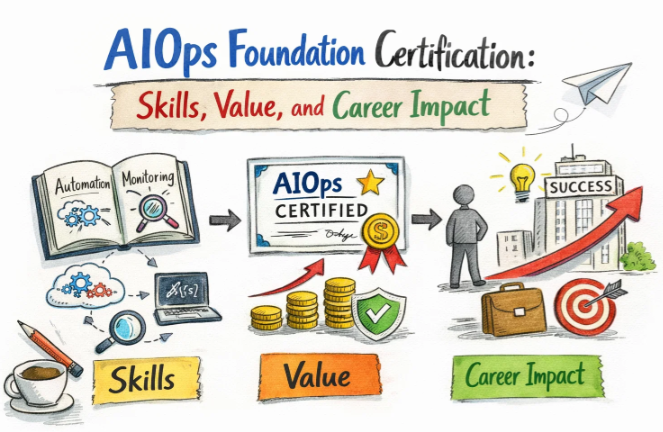
The landscape of software operations is changing rapidly as systems become too complex for manual intervention alone. This guide is designed to help you understand the AIOps Foundation Certification and how it fits into the broader ecosystem of modern engineering. Whether you are looking to enhance your current role or pivot into a new specialization, this resource from AIOps School provides a clear roadmap for your professional development.
Navigating career choices in DevOps, cloud-native environments, and platform engineering requires a focus on sustainable skills rather than just chasing tools. This guide helps professionals make better career decisions by breaking down the practical utility of algorithmic operations. We will explore how this certification bridges the gap between traditional monitoring and intelligent automation to ensure high availability in production.
What is the AIOps Foundation Certification?
The AIOps Foundation Certification represents a shift from reactive troubleshooting to proactive, data-driven system management. It exists because modern enterprise environments generate more telemetry data than human operators can analyze in real-time. This certification focuses on the practical application of big data and machine learning to IT operations, emphasizing production-focused learning over abstract theory.
By earning this credential, you demonstrate an understanding of how to use algorithmic insights to enhance observability and automate incident response. It aligns perfectly with modern engineering workflows where speed and reliability must coexist. It moves beyond basic scripting and introduces the concepts of noise reduction, anomaly detection, and automated root cause analysis within enterprise practices.
Who Should Pursue AIOps Foundation Certification?
This certification is highly beneficial for Site Reliability Engineers (SREs), DevOps professionals, and Cloud Architects who manage large-scale infrastructure. Security engineers and data professionals will also find value in learning how automated insights can improve system integrity and data pipeline health. It serves as a strong entry point for beginners and a structured validation of skills for experienced engineers.
In the context of the global market, including India’s massive IT sector, the demand for professionals who can manage complex distributed systems is skyrocketing. Engineering managers and technical leaders should also consider this path to better lead teams through digital transformation journeys. Understanding the logic behind automated operations allows leaders to make informed decisions about tool selection and team structure.
Why AIOps Foundation Certification is Valuable and Beyond
The value of this certification lies in its longevity; while specific tools may come and go, the principles of algorithmic operations are here to stay. As enterprises adopt multi-cloud and microservices architectures, the demand for AIOps skills will only grow. It helps professionals stay relevant by teaching them how to manage the “data deluge” that characterizes modern software environments.
Investing time in this certification offers a high return on career growth by positioning you at the forefront of operational innovation. It moves you away from “firefighting” and toward a role where you design systems that can self-heal and self-optimize. This proactive mindset is what distinguishes senior engineers and architects in a competitive global job market.
AIOps Foundation Certification Overview
The AIOps Foundation Certification program is delivered via the official course portal and is hosted on the AIOps School website. The assessment approach is designed to be practical, testing your ability to apply concepts to real-world scenarios rather than just memorizing definitions. It covers the core pillars of AIOps, including data collection, analysis, and the automation of operational tasks.
The certification structure is clear and logical, making it accessible for working professionals who need to balance study with full-time responsibilities. It provides a baseline of knowledge that is required before moving on to more specialized professional or advanced tracks. By completing this foundation, you gain a recognized credential that validates your readiness for modern, automated IT operations.
AIOps Foundation Certification Tracks & Levels
The certification ecosystem is divided into three primary levels: Foundation, Professional, and Advanced. The Foundation level establishes the core vocabulary and concepts, ensuring everyone on a team is speaking the same language. As you progress to the Professional level, the focus shifts toward implementation strategies and selecting the right algorithms for specific operational challenges.
The Advanced level is intended for architects and leaders who design entire AIOps strategies for large organizations. These levels align with career progression, moving from individual contributor roles to strategic leadership positions. Specialist tracks also allow you to lean into specific domains like SRE-focused AIOps or FinOps-integrated automated cost management.
Complete AIOps Foundation Certification Table
| Track | Level | Who it’s for | Prerequisites | Skills Covered | Recommended Order |
| Operations | Foundation | Junior Engineers, Managers | Basic IT Knowledge | Observability, AI Basics | First |
| Engineering | Professional | SREs, DevOps Engineers | Foundation Cert | ML Models, Automation | Second |
| Architecture | Advanced | Solutions Architects | Professional Cert | Strategy, Governance | Third |
| Specialized | Expert | Principal Engineers | Advanced Cert | Custom Algorithm Dev | Fourth |
Detailed Guide for Each AIOps Foundation Certification
AIOps Foundation – Level 1
What it is
This certification validates a professional’s understanding of the core concepts of Artificial Intelligence for IT Operations. It ensures the candidate can identify use cases for automation and understands the data lifecycle in a production environment.
Who should take it
This is suitable for junior DevOps engineers, system administrators, and IT managers who need a foundational understanding of modern automation. It is ideal for those with 0-2 years of experience in operations who want to future-proof their skills.
Skills you’ll gain
- Understanding the difference between traditional monitoring and AIOps.
- Identifying noise in telemetry data and how to reduce it.
- Knowledge of basic machine learning models used in operations.
- Ability to map AIOps tools to the existing DevOps pipeline.
Real-world projects you should be able to do
- Configure a basic anomaly detection alert for a web service.
- Create a dashboard that correlates events across different infrastructure layers.
- Audit an existing monitoring setup to identify manual bottlenecks.
Preparation plan
- 7-14 Days: Focus on the core vocabulary and the five stages of AIOps.
- 30 Days: Review case studies of enterprise AIOps implementation and take practice tests.
- 60 Days: Build a small lab environment to test open-source observability tools.
Common mistakes
- Focusing too much on specific tool features rather than underlying principles.
- Underestimating the importance of data quality and cleaning.
- Skipping the foundational theory of how algorithms process operational data.
Best next certification after this
- Same-track option: AIOps Professional Certification.
- Cross-track option: SRE Practitioner Certification.
- Leadership option: IT Strategy and Automation Leadership.
Choose Your Learning Path
DevOps Path
The DevOps path focuses on integrating intelligent feedback loops into the CI/CD pipeline. Professionals here learn how to use automated insights to gate deployments and monitor health in real-time. The goal is to reduce the “mean time to recovery” by letting algorithms identify deployment-related regressions before they impact the majority of users.
DevSecOps Path
In this path, the focus is on applying algorithmic operations to security telemetry. You will learn how to use AIOps to identify patterns indicative of a breach or a vulnerability exploit. This allows security teams to move faster, using automation to filter out false positives and focus on genuine threats to the infrastructure.
SRE Path
The SRE path is deeply rooted in reliability and performance optimization. Here, AIOps is used to manage Service Level Objectives (SLOs) and predict when a system might violate its reliability targets. This path teaches you how to build “self-healing” systems that can take corrective actions based on algorithmic triggers without human intervention.
AIOps Path
This path is for those who want to become pure specialists in algorithmic operations. It involves a deep dive into data science for IT, focusing on how to build and maintain the models that drive automation. You will learn about data lake management, model training, and the ethics of automated decision-making in technical environments.
MLOps Path
MLOps is about the operationalization of machine learning models themselves. This path teaches you how to build pipelines that treat ML models as first-class citizens in the software lifecycle. It covers versioning models, monitoring for data drift, and ensuring that the infrastructure supporting AI remains stable and scalable.
DataOps Path
The DataOps path focuses on the agility and quality of data pipelines. By applying AIOps principles here, you ensure that the data feeding your business intelligence and machine learning models is accurate and timely. It involves automating the testing and deployment of data workflows to reduce errors in the data supply chain.
FinOps Path
The FinOps path uses AIOps to bring financial accountability to the cloud. You will learn how to use automated insights to identify wasteful spending and optimize resource allocation in real-time. This path is essential for organizations looking to scale their cloud presence without seeing their costs spiral out of control.
Role → Recommended AIOps Foundation Certifications
| Role | Recommended Certifications |
| DevOps Engineer | AIOps Foundation, DevOps Professional |
| SRE | AIOps Foundation, SRE Practitioner |
| Platform Engineer | AIOps Foundation, Cloud Architecture |
| Cloud Engineer | AIOps Foundation, Multi-Cloud Specialist |
| Security Engineer | AIOps Foundation, DevSecOps Expert |
| Data Engineer | AIOps Foundation, DataOps Specialist |
| FinOps Practitioner | AIOps Foundation, FinOps Certified |
| Engineering Manager | AIOps Foundation, Technical Leadership |
Next Certifications to Take After AIOps Foundation Certification
Same Track Progression
Once the foundation is established, the logical step is to move toward professional-level certifications that involve hands-on implementation. This deep specialization allows you to become the “subject matter expert” within your organization for all things related to automated operations. You will move from understanding “what” AIOps is to mastering “how” it is built and maintained at scale.
Cross-Track Expansion
Broadening your skills into SRE or DevSecOps is a powerful way to increase your value as a T-shaped professional. By combining AIOps with security or reliability engineering, you can solve complex cross-departmental problems that others cannot. This makes you an asset to any team, as you can bridge the gap between different technical domains using data-driven insights.
Leadership & Management Track
For those looking to transition into management, focusing on strategy and governance is key. Future leaders need to understand how to build teams that embrace automation and how to calculate the ROI of AIOps initiatives. This track prepares you to lead digital transformation efforts and manage high-performing engineering departments in a technology-first world.
Training & Certification Support Providers for AIOps Foundation Certification
DevOpsSchool
DevOpsSchool is a well-established training provider that offers comprehensive courses across the entire DevOps and AIOps spectrum. They focus on providing high-quality, instructor-led training that covers both the theoretical and practical aspects of modern engineering. Their curriculum is updated frequently to reflect the latest industry trends and toolsets, ensuring students receive relevant knowledge. They provide a supportive environment for professionals looking to upskill and transition into more advanced roles within the software development lifecycle. Their commitment to student success is reflected in their detailed course materials and expert guidance.
Cotocus
Cotocus is known for its strong emphasis on hands-on, lab-based learning experiences. They believe that the best way to master technical skills is through direct practice in real-world scenarios. Their training programs are designed to be interactive, allowing students to work on production-grade projects that simulate actual industry challenges. This approach helps candidates build confidence and gain the practical experience needed to excel in their careers. Cotocus offers a variety of specialized tracks that cater to different engineering needs, making it a versatile choice for professionals at various stages of their journey.
Scmgalaxy
Scmgalaxy is a community-driven platform that provides a wealth of resources for DevOps and SRE professionals. They offer a unique blend of training, blog content, and community forums where engineers can share knowledge and solve problems together. Their focus is on fostering a collaborative learning environment where real-world experience is valued above all else. Scmgalaxy provides technical deep dives into specific tools and methodologies, making it an excellent resource for those who want to go beyond the basics. Their community engagement ensures that the information provided is always grounded in practical reality.
BestDevOps
BestDevOps specializes in providing tailored training solutions for corporate teams and individual professionals alike. They focus on the core competencies required to succeed in a modern DevOps environment, including automation, observability, and continuous integration. Their instructors are experienced industry veterans who bring a wealth of practical knowledge to the classroom. BestDevOps offers flexible learning options, including online and in-person sessions, to accommodate the busy schedules of working engineers. Their commitment to quality and professional development makes them a trusted partner for organizations looking to modernize their engineering practices.
devsecopsschool.com
DevSecOpsSchool is dedicated to the integration of security into the modern DevOps pipeline. They recognize that security cannot be an afterthought and must be baked into the software development process from the start. Their training programs focus on providing engineers with the skills needed to automate security checks and maintain system integrity without slowing down delivery. By teaching the principles of DevSecOps, they help organizations build more resilient and secure software. Their curriculum is essential for any professional looking to specialize in the intersection of security and operations.
sreschool.com
SRESchool focuses specifically on the discipline of Site Reliability Engineering. They provide in-depth training on how to build and maintain highly available and scalable systems. Their courses cover essential SRE concepts such as error budgets, service level objectives, and incident management. By focusing on reliability as a core feature, SRESchool helps engineers move from reactive troubleshooting to proactive system design. Their training is highly practical and designed to help professionals implement SRE principles in their own organizations effectively. It is an ideal choice for anyone committed to system stability.
aiopsschool.com
AIOpsSchool is the primary provider for certifications related to algorithmic operations. They offer a structured learning path that takes students from the basics of AIOps to advanced implementation strategies. Their training is designed to bridge the gap between data science and IT operations, providing engineers with the tools they need to manage complex systems. AIOpsSchool emphasizes the importance of data-driven decision-making and automated root cause analysis. Their certifications are recognized industry-wide and provide a clear validation of a professional’s expertise in the growing field of AIOps.
dataopsschool.com
DataOpsSchool addresses the growing need for agility and quality in data management. They provide training on how to apply DevOps and AIOps principles to data pipelines, ensuring that data is delivered accurately and efficiently. Their courses cover data versioning, automated testing of data workflows, and the management of data infrastructure. By focusing on the “Ops” side of data, DataOpsSchool helps professionals build more reliable and scalable data systems. This is an essential resource for data engineers and architects who want to improve the reliability of their data supply chains.
finopsschool.com
FinOpsSchool is dedicated to the practice of cloud financial management. They provide training on how to bring financial accountability to the variable spend model of the cloud. Their courses teach professionals how to collaborate across engineering, finance, and business teams to optimize cloud costs. FinOpsSchool focuses on the cultural shift required to manage cloud spending effectively and provides the technical skills needed to implement automated cost-saving measures. This training is vital for any organization looking to maximize the value of their cloud investments while maintaining financial control.
Frequently Asked Questions (General)
- What is the primary goal of earning a foundation certification?
The goal is to establish a solid understanding of core concepts and terminology so you can contribute effectively to modern engineering teams. - How long does it typically take to prepare for a foundation exam?
Most professionals find that 30 to 60 days of consistent study is sufficient to master the material and feel confident. - Are there any strict prerequisites for the foundation level?
Generally, there are no strict prerequisites, but a basic understanding of IT operations and software development is highly recommended. - Is this certification recognized globally?
Yes, these certifications are designed to meet global industry standards and are valued by employers in India and internationally. - How does this help in a job interview?
It provides a structured way to discuss complex topics and proves that you have taken the initiative to stay current with industry trends. - Can a manager benefit from this technical certification?
Absolutely, it helps managers understand the technical challenges their teams face and makes them better at strategic planning. - What is the format of the assessment?
The assessment usually consists of multiple-choice questions that focus on situational judgment and the application of concepts. - Is there a need to renew the certification?
Most certifications recommend a refresher or an upgrade to a higher level every two to three years to stay current. - Does this certification focus on a specific tool?
No, foundation certifications are typically vendor-neutral and focus on the principles that apply to all tools in the category. - What is the return on investment for this certification?
The ROI is high, as it opens doors to higher-paying roles and provides the skills needed to manage more complex, high-impact systems. - Can I take the exam online?
Yes, most providers offer proctored online exams that you can take from the comfort of your home or office. - How does AIOps differ from standard automation?
AIOps uses machine learning to make decisions, whereas standard automation follows pre-defined, static rules created by humans.
FAQs on AIOps Foundation Certification
- Why should I choose AIOps over traditional DevOps certifications?
AIOps is the next evolution, focusing on using data and AI to handle scale that traditional DevOps tools cannot manage alone. - Does this certification require deep knowledge of mathematics?
No, the foundation level focuses on the application of AI in operations rather than the underlying mathematical proofs of the algorithms. - Will this certification help me move into a Data Science role?
It provides a bridge, but you would likely need further specialized training in data science to make a full transition. - How does AIOps improve Site Reliability Engineering?
It automates the analysis of vast amounts of telemetry data, allowing SREs to find and fix issues much faster than manual methods. - Is AIOps only for very large companies?
While large companies see the most immediate benefit, any organization with complex cloud infrastructure can benefit from algorithmic operations. - What are the most important skills covered in this foundation course?
The most important skills are observability, noise reduction, event correlation, and understanding the AIOps lifecycle. - Can I self-study for this certification?
Yes, there are many resources available, but a structured course from a provider can help ensure you cover all the necessary topics. - How does this certification address cloud-native environments?
It focuses on how algorithms can manage the dynamic and ephemeral nature of containers, microservices, and serverless architectures.
Final Thoughts: Is AIOps Foundation Certification Worth It?
In my experience, the transition to automated, intelligent operations is not a matter of “if,” but “when.” The complexity of modern software systems has already surpassed what a human can manage with manual scripts and static alerts. Earning the AIOps Foundation Certification is a practical, forward-thinking move that sets you apart from those who are stuck in traditional ways of working. It is an investment in your ability to handle the next decade of technical challenges.
My advice is to look beyond the hype of “AI” and focus on the practical utility of these tools. This certification is worth it because it gives you a framework for thinking about data and automation that will remain relevant regardless of which specific tools your company uses. It is a solid step toward a more stable, rewarding, and future-proof career in engineering. Focus on the fundamentals, build your labs, and keep learning.

