
Introduction
The Certified AIOps Engineer program is a professional validation designed for those looking to master the intersection of artificial intelligence and IT operations. This guide is crafted for engineers and managers who recognize that traditional manual operations are no longer sufficient for the scale of modern cloud-native environments. By moving toward an algorithmic approach to system health, professionals can significantly reduce mean time to resolution and eliminate operational noise.
This comprehensive roadmap helps you understand the nuances of the curriculum provided by AIOps School and how it fits into your broader career trajectory. Whether you are coming from a traditional DevOps background or specialized SRE roles, this certification provides the framework needed to implement intelligent automation. Navigating the shift from reactive monitoring to proactive, AI-driven observability is a critical step for any technical leader. This guide ensures you make an informed decision about your learning path and long-term career investment.
What is the Certified AIOps Engineer?
The Certified AIOps Engineer represents a paradigm shift in how we manage complex distributed systems and large-scale infrastructure. It is not just a theoretical course but a production-focused validation that emphasizes the application of machine learning models to operational data. It exists to bridge the gap between pure data science and systems engineering, ensuring that automation is grounded in operational reality.
In modern enterprise practices, this certification signifies that an engineer can handle high-velocity data streams from logs, metrics, and traces. It aligns with engineering workflows by teaching participants how to integrate AI/ML into CI/CD pipelines and incident management systems. The focus remains on real-world outcomes, such as reducing alert fatigue and improving system reliability through predictive analytics rather than just static thresholds.
Who Should Pursue Certified AIOps Engineer?
This certification is highly beneficial for Site Reliability Engineers (SREs), DevOps professionals, and Cloud Architects who are managing large-scale infrastructure. Security engineers and data professionals will also find immense value, as the principles of anomaly detection and automated response are universal across these domains. It serves as a bridge for engineers who want to move beyond basic scripting into the world of intelligent, self-healing systems.
Both early-career engineers looking to specialize and seasoned managers aiming to lead digital transformation efforts should consider this path. In the global market, including the rapidly growing tech hubs in India, there is a massive demand for professionals who can manage the complexity of multi-cloud environments. Companies are looking for talent that can leverage AI to provide a competitive edge in operational efficiency and cost management.
Why Certified AIOps Engineer is Valuable and Beyond
As enterprise adoption of cloud-native technologies continues to accelerate, the volume of telemetry data generated by these systems has exceeded human capacity to analyze. The longevity of this certification is rooted in the fundamental need for automated intelligence to keep pace with microservices and serverless architectures. It helps professionals stay relevant by shifting their focus from mundane maintenance to high-value architectural improvements.
The return on time and career investment is substantial, as AIOps is becoming a core component of the “Platform Engineering” evolution. Organizations are moving away from legacy monitoring tools toward unified observability platforms that require skilled engineers to tune and manage. By mastering these skills, you position yourself as a rare talent capable of managing the next generation of enterprise IT infrastructure.
Certified AIOps Engineer Certification Overview
The program is delivered via the official portal and hosted on the specialized training platform. The certification approach is grounded in practical assessments rather than simple multiple-choice questions, ensuring that candidates can actually apply the concepts. It is designed to be rigorous, reflecting the high standards required for production-grade operational environments.
Ownership of the program lies with industry experts who have practical experience in deploying AI models for system monitoring. The structure is broken down into modular components, allowing learners to progress through different domains of AIOps at their own pace. This modularity ensures that the learning process is manageable for working professionals who need to balance their studies with daily operational responsibilities.
Certified AIOps Engineer Certification Tracks & Levels
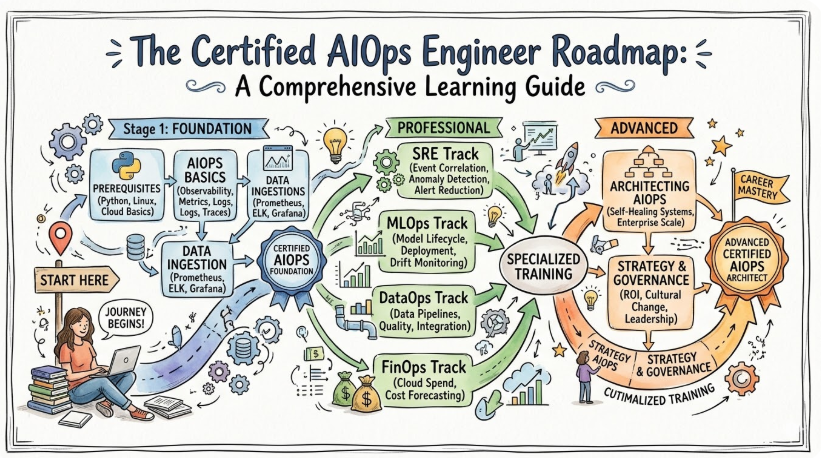
The certification is structured into three distinct levels: Foundation, Professional, and Advanced. The Foundation level focuses on the core concepts of data ingestion, basic statistics, and the AIOps landscape. This level is perfect for those new to the domain who need to understand how AI interacts with traditional monitoring frameworks.
The Professional level moves into specialized tracks such as AIOps for SRE or AIOps for FinOps, where the focus is on specific outcomes like incident correlation or cloud cost optimization. The Advanced level is reserved for architects and technical leads who are responsible for designing the entire AIOps strategy for an organization. This progression ensures that as your career grows, your certification level can reflect your deepening expertise.
Complete Certified AIOps Engineer Certification Table
| Track | Level | Who it’s for | Prerequisites | Skills Covered | Recommended Order |
| Core AIOps | Foundation | Aspiring AIOps Engineers | Basic Linux & Python | Telemetry, ELK, ML Basics | 1 |
| SRE Focus | Professional | SREs & Platform Engineers | Foundation Cert | Pattern Matching, NLP for Logs | 2 |
| Data Focus | Professional | Data Engineers | Foundation Cert | Feature Engineering, Pipelines | 2 |
| Strategic | Advanced | Architects & Managers | Professional Cert | Governance, ROI, Architecture | 3 |
Detailed Guide for Each Certified AIOps Engineer Certification
Certified AIOps Engineer – Foundation Level
What it is
This certification validates a professional’s understanding of the basic pillars of AIOps, including data collection, normalization, and the fundamental role of machine learning in IT operations.
Who should take it
It is suitable for junior DevOps engineers, system administrators, and recent graduates who want to build a career in modern IT operations and cloud management.
Skills you’ll gain
- Understanding of the AIOps maturity model.
- Ability to configure data ingestion pipelines for metrics and logs.
- Basic understanding of supervised and unsupervised learning for IT data.
- Familiarity with observability tools and open-source AIOps frameworks.
Real-world projects you should be able to do
- Set up a basic centralized logging system with anomaly detection alerts.
- Create a dashboard that visualizes system health based on historical trends.
Preparation plan
- 7–14 days: Focus on core terminology and the relationship between DevOps and AIOps.
- 30 days: Deep dive into data ingestion tools like Prometheus, Fluentd, and ELK stack.
- 60 days: Complete mock exams and practice setting up basic ML models for thresholding.
Common mistakes
- Ignoring the importance of data quality before applying AI models.
- Over-complicating simple monitoring tasks with unnecessary machine learning.
Best next certification after this
- Same-track option: Professional AIOps Engineer (SRE Track).
- Cross-track option: Certified Cloud Security Professional.
- Leadership option: ITIL Managing Professional.
Certified AIOps Engineer – Professional Level
What it is
This level validates the ability to implement specific AIOps use cases such as automated root cause analysis, event correlation, and predictive scaling in a production environment.
Who should take it
Intermediate to senior SREs, DevOps engineers, and Cloud Architects who are responsible for maintaining high-availability systems and reducing operational overhead.
Skills you’ll gain
- Implementing clustering algorithms for event de-duplication.
- Designing automated remediation workflows using AI triggers.
- Managing the lifecycle of ML models specifically for operational telemetry.
- Advanced log analytics using Natural Language Processing (NLP).
Real-world projects you should be able to do
- Build an automated incident response system that triggers scripts based on predicted failures.
- Implement an event correlation engine that reduces alert volume by 70%.
Preparation plan
- 7–14 days: Review advanced statistics and Python libraries for data science (Pandas, Scikit-learn).
- 30 days: Work through lab environments involving real-world datasets and high-traffic scenarios.
- 60 days: Focus on integration patterns between AIOps platforms and existing ITSM tools.
Common mistakes
- Failing to account for “model drift” as the infrastructure evolves.
- Neglecting the cultural shift required for teams to trust automated AI decisions.
Best next certification after this
- Same-track option: Advanced Certified AIOps Architect.
- Cross-track option: Certified MLOps Engineer.
- Leadership option: Certified Engineering Manager.
Choose Your Learning Path
DevOps Path
The DevOps path focuses on integrating AI within the continuous integration and continuous delivery pipelines. Engineers learn to use AIOps to predict deployment failures and automate the rollback process based on real-time performance data. This path ensures that the speed of delivery does not compromise the stability of the production environment. It is ideal for those who want to build smarter, more resilient software delivery life cycles.
DevSecOps Path
In the DevSecOps track, the focus shifts to using AI for security orchestration and automated response. Engineers learn to detect anomalous patterns that might signify a security breach or a sophisticated DDoS attack. This path bridges the gap between traditional security monitoring and modern, AI-driven threat hunting. It empowers security professionals to respond to threats at machine speed rather than relying on manual intervention.
SRE Path
The SRE path is perhaps the most natural fit for AIOps, focusing heavily on reliability and observability. It covers the implementation of Service Level Objectives (SLOs) that are dynamically adjusted based on AI-driven insights. Engineers learn how to automate the “toil” out of their daily routines by using intelligent incident management. This path is essential for anyone managing large-scale, complex distributed systems where human monitoring is no longer feasible.
AIOps Path
The dedicated AIOps path is for those who want to specialize deeply in the algorithmic side of operations. It focuses on the end-to-end lifecycle of operational data, from ingestion to intelligent action. Professionals in this track become experts in choosing the right models for different types of infrastructure behavior. This path is designed for engineers who want to be the primary architects of an organization’s intelligent automation strategy.
MLOps Path
The MLOps path focuses on the operationalization of machine learning models themselves. While AIOps uses AI to help operations, MLOps applies operational best practices to AI development. This path covers model versioning, monitoring for drift, and ensuring that ML models are deployed reliably and at scale. It is a critical path for data engineers and DevOps professionals who are supporting data science teams.
DataOps Path
DataOps focuses on the automated, policy-based management of data to improve its quality and speed of delivery. In this path, engineers learn how to treat data as code and apply DevOps principles to data pipelines. This is foundational for AIOps, as the quality of AI insights is entirely dependent on the quality of the underlying data. This path is perfect for those who want to ensure the data “plumbing” of an organization is robust and scalable.
FinOps Path
The FinOps path uses AIOps to bring financial accountability to the variable spend model of the cloud. Engineers learn how to use predictive analytics to forecast cloud costs and identify anomalies in spending patterns. This path helps organizations optimize their cloud footprint by using AI to recommend rightsizing and spot instance usage. It is an increasingly vital role as cloud budgets become a significant portion of enterprise spending.
Role → Recommended Certified AIOps Engineer Certifications
| Role | Recommended Certifications |
| DevOps Engineer | Certified AIOps Foundation, Professional (DevOps Track) |
| SRE | Certified AIOps Foundation, Professional (SRE Track) |
| Platform Engineer | Certified AIOps Foundation, Advanced Architect |
| Cloud Engineer | Certified AIOps Foundation, Professional (FinOps Track) |
| Security Engineer | Certified AIOps Foundation, DevSecOps Specialist |
| Data Engineer | Certified AIOps Foundation, Professional (DataOps Track) |
| FinOps Practitioner | Certified AIOps Foundation, Professional (FinOps Track) |
| Engineering Manager | Certified AIOps Foundation, Advanced Strategic Track |
Next Certifications to Take After Certified AIOps Engineer
Same Track Progression
Once you have mastered the Professional level, the natural progression is to move toward the Advanced Architect status. This involves moving from implementing tools to designing entire ecosystems that can self-heal and self-optimize. Deep specialization in a specific domain, such as networking AIOps or storage AIOps, is also a viable path. This ensures you remain the go-to expert for complex, high-level technical challenges within your organization.
Cross-Track Expansion
After gaining competence in AIOps, broadening your skills into MLOps or DataOps provides a powerful combination. Understanding both how to use AI for operations and how to operate AI systems makes you a highly versatile engineer. This cross-pollination of skills is what modern organizations look for in their principal engineers. It allows you to speak the language of both data scientists and infrastructure specialists, acting as a vital bridge.
Leadership & Management Track
For those looking to transition into leadership, moving toward certifications in Engineering Management or IT Strategy is a logical step. AIOps provides the data-driven foundation needed to make high-level business decisions about infrastructure and team resource allocation. Leaders with a background in AIOps are better equipped to justify investments in automation and digital transformation. This path leads to roles such as Director of Platform Engineering or CTO.
Training & Certification Support Providers for Certified AIOps Engineer
DevOpsSchool
DevOpsSchool provides a robust ecosystem for those seeking to master the intricacies of automated operations. Their curriculum is designed by industry practitioners who understand the daily challenges of managing large-scale systems. They offer a blend of theoretical knowledge and hands-on laboratory exercises that simulate real-world production issues. The support team is known for providing personalized guidance, helping students navigate the complexities of AIOps and related technologies. Their focus is on ensuring that every learner can translate their certification into tangible career growth and technical proficiency.
Cotocus
Cotocus focuses on delivering high-impact technical training that is specifically tailored to the needs of the modern enterprise. Their approach to AIOps education emphasizes the integration of various open-source tools to create a cohesive observability platform. They provide specialized mentoring sessions that go beyond the standard curriculum, offering insights into industry best practices and emerging trends. The training modules are structured to be flexible, catering to both full-time professionals and those looking for a more intensive learning experience. Cotocus is a reliable partner for organizations looking to upskill their entire engineering workforce.
Scmgalaxy
Scmgalaxy is a well-established community and training hub that has been at the forefront of the DevOps and SRE movement for years. Their resources for AIOps are deeply rooted in their extensive experience with software configuration management and continuous delivery. They offer a wealth of community-driven content, including tutorials, forums, and case studies that provide a practical perspective on AIOps implementation. Their training programs are designed to be accessible and highly practical, making them a popular choice for engineers at all levels. Scmgalaxy remains a vital resource for staying updated on the latest operational tools.
BestDevOps
BestDevOps prides itself on offering some of the most comprehensive and up-to-date training programs in the field of intelligent automation. Their AIOps curriculum is regularly updated to reflect the latest advancements in machine learning and cloud-native technologies. They provide a supportive learning environment with access to expert instructors who have real-world experience in deploying AIOps at scale. The focus is on practical outcomes, ensuring that students can immediately apply what they learn to their professional roles. BestDevOps is an excellent choice for those who want a structured and high-quality learning path.
devsecopsschool.com
This provider specializes in the intersection of security and operations, making them a unique choice for AIOps training. Their courses focus on how AI can be used to enhance security posture and automate threat detection and response. They provide a deep dive into the security implications of AIOps and how to build resilient, self-protecting systems. The training is highly relevant for security professionals who want to leverage the power of AI to stay ahead of increasingly sophisticated threats. Their specialized focus ensures that learners gain a niche but highly valuable set of skills.
sreschool.com
Sreschool.com is dedicated to the principles of Site Reliability Engineering and how AIOps can be used to achieve higher levels of system availability. Their training covers the essential aspects of observability, incident management, and automated remediation within an SRE framework. They emphasize the use of AI to manage and reduce “toil,” allowing SREs to focus on high-value engineering tasks. The courses are designed to be practical and aligned with the standards used by top-tier technology companies. For those looking to excel in an SRE role, this is a premier destination for learning.
aiopsschool.com
As the primary host for the Certified AIOps Engineer program, aiopsschool.com offers the most direct and focused training available. Their curriculum is built specifically around the certification requirements, ensuring that students are fully prepared for the assessment. They offer a wide range of resources, including specialized labs, practice exams, and detailed documentation on AIOps concepts. The instructors are experts in the field who are dedicated to helping students master the art and science of AI-driven operations. This is the definitive starting point for anyone serious about earning this specific certification.
dataopsschool.com
Dataopsschool.com addresses the critical need for robust data management as a foundation for successful AIOps implementation. Their courses teach engineers how to build and manage the data pipelines that feed into AI models. They focus on data quality, governance, and the automation of data delivery within an engineering context. Understanding these principles is essential for ensuring that AIOps insights are accurate and actionable. For engineers who want to specialize in the “data” side of AIOps, this provider offers specialized and highly relevant training programs.
finopsschool.com
Finopsschool.com provides specialized training on how AIOps can be used to manage and optimize cloud spending. Their courses cover the tools and techniques needed to bring financial transparency to cloud operations through automated analysis. They focus on the cultural and technical shifts required to implement a successful FinOps practice within an organization. This training is increasingly valuable as cloud costs continue to be a top concern for businesses of all sizes. By mastering these skills, engineers can demonstrate a direct impact on their organization’s bottom line.
Frequently Asked Questions (General)
- How difficult is the Certified AIOps Engineer exam?
The exam is considered moderately difficult as it requires a solid understanding of both IT operations and basic machine learning concepts. Success depends heavily on practical experience and hands-on lab work. - How much time is required to prepare for this certification?
For most working professionals, a period of 30 to 60 days is recommended. This allows for a thorough review of the materials and enough time to complete practical projects. - Are there any specific prerequisites for the foundation level?
There are no formal prerequisites, but a basic understanding of Linux, Python, and cloud computing is highly recommended to keep up with the technical content. - What is the return on investment (ROI) for this certification?
The ROI is seen in higher salary potential, better job security, and the ability to work on cutting-edge projects. It positions you as a forward-thinking engineer in a high-demand field. - Should I take the DevOps certification before the AIOps one?
It is generally helpful to have a background in DevOps, but it is not strictly necessary. AIOps can be learned in parallel if you are willing to put in the extra effort on the operational basics. - How often do I need to renew this certification?
The certification is typically valid for two to three years, after which you may need to pass an updated exam or earn continuing education credits. - Does the certification focus on specific tools like Splunk or Datadog?
The certification is designed to be tool-agnostic, focusing on the underlying principles and frameworks that can be applied across various platforms. - Is this certification recognized globally?
Yes, the concepts taught are universal and the certification is recognized by major technology companies and service providers worldwide. - Can I pass this exam using only theoretical knowledge?
It is highly unlikely. The assessment includes practical components that require you to demonstrate your ability to solve real operational problems. - What kind of career support is provided after certification?
Many training providers offer career coaching, resume reviews, and access to an alumni network to help you find relevant job opportunities. - Are there any discounts available for students or groups?
Many providers offer group discounts for corporate teams or special pricing for students. It is best to check the official website for current offers. - What is the format of the final assessment?
The assessment usually consists of a mix of scenario-based questions and practical tasks that must be completed in a controlled lab environment.
FAQs on Certified AIOps Engineer
- How does this certification differ from a standard Data Science program?
Unlike general data science, this program focuses specifically on the application of AI to IT operations data like logs and metrics. It prioritizes operational outcomes over general model building. - Is Python the only language used in the practical exercises?
While Python is the primary language due to its extensive ML libraries, the concepts can be applied using other languages like Go or Java depending on the toolset. - How does AIOps help in reducing “Mean Time to Resolution” (MTTR)?
AIOps reduces MTTR by using automated correlation to identify the root cause of an issue much faster than a human could by manual log analysis. - Can this certification help me move into a management role?
Yes, it provides the technical authority and strategic overview needed to lead teams responsible for modern, automated infrastructure. - What role does observability play in this certification?
Observability is a core pillar of the program, as it provides the high-quality telemetry data that AI models need to function effectively. - Will this certification help me with cloud cost optimization?
Yes, particularly in the Professional and FinOps tracks, where you learn to use AI to predict and manage cloud resource usage. - Is there a focus on open-source vs. proprietary tools?
The program covers both, ensuring you can work in environments ranging from pure open-source stacks to enterprise-grade licensed platforms. - How relevant is this for legacy on-premise infrastructure?
While the focus is on cloud-native systems, the principles of AI-driven monitoring and automated remediation are equally applicable to legacy data centers.
Final Thoughts: Is Certified AIOps Engineer Worth It?
From my perspective as a mentor in this field, the Certified AIOps Engineer is one of the most strategic investments you can make right now. We are moving toward a world where systems are too complex for humans to manage without the help of intelligent machines. If you enjoy the challenge of building systems that can think and act for themselves, this is the right path for you.
Don’t pursue this certification just for the badge; pursue it for the depth of understanding it provides. The ability to look at a chaotic stream of system data and build a model that finds the needle in the haystack is a rare and valuable skill. Focus on the labs, embrace the complexity, and remember that the best engineers are those who never stop learning. This certification is a solid foundation for the next decade of your career in technology.

