
Introduction
The Certified Site Reliability Professional is a comprehensive program designed to validate the technical and operational skills required to maintain high-availability systems. This guide is built for engineers and managers who are navigating the complex transition from traditional operations to modern reliability engineering. As cloud-native architectures become the standard, the ability to manage distributed systems at scale has become a critical requirement for career progression in DevOps and platform engineering.
By exploring this roadmap, professionals can understand how to bridge the gap between software development and systems engineering. This guide helps you navigate the various certification tiers available through SREschool and provides a clear path for skill acquisition. Whether you are an individual contributor looking to master error budgets or a technical leader aiming to build a resilient engineering culture, this documentation offers the practical insights needed to make informed career decisions.
What is the Certified Site Reliability Professional?
The Certified Site Reliability Professional represents a shift away from theoretical IT management toward practical, code-centric reliability. It exists to provide a standardized framework for implementing SRE principles like Service Level Objectives (SLOs), error budgets, and toil reduction in real-world production environments. Unlike traditional certifications that focus on a single cloud provider, this program emphasizes the cross-functional engineering practices required to manage any modern infrastructure.
This certification aligns with contemporary enterprise workflows where speed of delivery must be balanced with system stability. It focuses on the “how-to” of production engineering, covering everything from observability pipelines to automated incident response. For the modern enterprise, having professionals who hold this credential means having a team capable of building self-healing systems and maintaining high levels of customer satisfaction through consistent uptime.
Who Should Pursue Certified Site Reliability Professional?
Software engineers who want to take ownership of their code in production will find immense value in this program. It is equally beneficial for DevOps engineers, platform specialists, and cloud architects who need to formalize their understanding of reliability as a feature. Security professionals and data engineers also benefit, as the principles of SRE are increasingly being applied to the stability of security posture and data pipelines.
For beginners, the certification provides a structured entry point into the world of large-scale systems management. Experienced engineers can use the advanced tracks to validate their expertise in complex areas like chaos engineering and multi-region failover strategies. Engineering managers and technical leaders should pursue this to better understand how to allocate resources between feature development and reliability work, ensuring their teams are not burned out by constant manual interventions.
Why Certified Site Reliability Professional is Valuable and Beyond
The demand for reliability expertise continues to outpace the supply of qualified engineers as more organizations move toward microservices and serverless architectures. As systems become more fragmented, the “human factor” in managing those systems requires a disciplined, engineering-led approach. This certification ensures that a professional’s skills remain relevant even as specific tools like Kubernetes or Terraform evolve, by focusing on the underlying principles of system health.
Longevity in the tech industry is built on the ability to manage complexity, and this program provides the mental models necessary to do just that. The enterprise adoption of SRE practices is no longer limited to high-tech giants; it has spread to finance, healthcare, and retail sectors. Investing time in this certification offers a high return because it positions you as a specialist who can protect the company’s most valuable asset: its digital services.
Certified Site Reliability Professional Certification Overview
The program is delivered via the official Certified Site Reliability Professional portal and is hosted on the SREschool.com platform. The certification is structured into distinct tiers that cater to different stages of professional growth, ranging from entry-level foundational knowledge to expert-level architectural mastery. Each level involves a rigorous assessment approach that combines theoretical exams with practical, scenario-based evaluations.
Ownership of the certification remains with a body of industry experts who ensure the curriculum stays updated with current industry trends. The structure is designed to be modular, allowing candidates to focus on specific areas of interest or progress through a full stack of reliability competencies. By maintaining a focus on production-grade outcomes, the program ensures that every certified professional is ready to contribute to a live environment immediately.
Certified Site Reliability Professional Certification Tracks & Levels
The certification is divided into three primary levels: Foundation, Professional, and Advanced. The Foundation level introduces the core vocabulary and concepts of SRE, such as the distinction between SLAs and SLOs. The Professional level deepens this knowledge by requiring candidates to implement monitoring, logging, and tracing solutions. The Advanced level is reserved for those who can design resilient architectures and lead large-scale incident retrospectives.
Specialization tracks allow professionals to align their certification with their specific career path, whether that be in DevOps, FinOps, or Security. For example, an engineer focusing on cost-efficiency might take the FinOps-aligned SRE modules. These levels act as a staircase for career progression, where each step represents an increase in both technical capability and the ability to influence organizational culture toward better reliability.
Complete Certified Site Reliability Professional Certification Table
| Track | Level | Who it’s for | Prerequisites | Skills Covered | Recommended Order |
| Core SRE | Foundation | Entry-level Engineers | Basic Linux/Cloud | SLOs, SLIs, Toil, SRE Culture | 1st |
| Implementation | Professional | DevOps/SRE Engineers | Foundation Cert | Observability, Incident Management | 2nd |
| Architecture | Advanced | Principal/Lead Engineers | Professional Cert | Chaos Engineering, Scalability | 3rd |
| Security | Specialist | DevSecOps Engineers | Foundation Cert | Reliable Security Pipelines | Optional |
| Automation | Specialist | Automation Engineers | Foundation Cert | Python/Go for SRE, IaC | Optional |
Detailed Guide for Each Certified Site Reliability Professional Certification
Certified Site Reliability Professional – Foundation
What it is
This certification validates a candidate’s understanding of the fundamental principles of Site Reliability Engineering. It covers the core philosophy that distinguishes SRE from traditional systems administration.
Who should take it
Aspiring SREs, developers looking to understand production, and junior operations staff will find this the ideal starting point. It requires no deep prior experience in SRE but assumes basic IT literacy.
Skills you’ll gain
- Defining and measuring SLIs and SLOs.
- Understanding the impact of error budgets on release velocity.
- Identifying and eliminating toil through automation.
- Implementing a blameless post-mortem culture.
Real-world projects you should be able to do
- Draft an initial SLO document for a simple web service.
- Calculate an error budget based on availability targets.
- Identify three manual tasks in a workflow that qualify as toil.
Preparation plan
- 7-14 days: Review official study guides and memorize core SRE vocabulary.
- 30 days: Read the Google SRE Book and complete basic hands-on labs.
- 60 days: Engage in community forums and apply concepts to a personal project.
Common mistakes
- Confusing SLAs with SLOs during the examination.
- Over-complicating the definition of toil.
- Ignoring the cultural aspects of the SRE role.
Best next certification after this
- Same-track option: Certified Site Reliability Professional – Professional
- Cross-track option: Certified DevSecOps Professional
- Leadership option: Engineering Management Foundation
Certified Site Reliability Professional – Professional
What it is
This level focuses on the technical implementation of reliability tools and processes. It validates the ability to build and maintain the observability stacks that power modern SRE teams.
Who should take it
Mid-level DevOps engineers and SREs who are actively managing production workloads. It is designed for those who want to prove they can handle the “heavy lifting” of system reliability.
Skills you’ll gain
- Setting up comprehensive monitoring and alerting systems.
- Managing distributed tracing for microservices.
- Leading incident response and coordination efforts.
- Automating infrastructure changes with reliability in mind.
Real-world projects you should be able to do
- Configure a Prometheus/Grafana stack for a multi-service application.
- Design an automated alerting threshold that reduces “pager fatigue.”
- Lead a mock incident response drill and write the subsequent post-mortem.
Preparation plan
- 7-14 days: Focused review on monitoring tools and incident response protocols.
- 30 days: Practical labs involving Kubernetes and observability frameworks.
- 60 days: Full project implementation including automated failover testing.
Common mistakes
- Focusing too much on tool syntax rather than the underlying logic.
- Failing to demonstrate an understanding of distributed systems.
- Neglecting the communication aspect of incident management.
Best next certification after this
- Same-track option: Certified Site Reliability Professional – Advanced
- Cross-track option: Certified FinOps Professional
- Leadership option: Technical Lead Certification
Certified Site Reliability Professional – Advanced
What it is
The advanced level is for experts who design the architectural safeguards that prevent systemic failure. It focuses on high-level strategy, chaos engineering, and massive-scale operations.
Who should take it
Senior, Staff, or Principal engineers responsible for the reliability of entire organizations. Candidates should have several years of experience managing high-traffic, complex environments.
Skills you’ll gain
- Designing for multi-region and multi-cloud resilience.
- Implementing chaos engineering experiments safely in production.
- Building advanced capacity planning and forecasting models.
- Mentoring junior SREs and shaping organizational reliability strategy.
Real-world projects you should be able to do
- Execute a “GameDay” exercise to test system resilience.
- Develop a cross-region disaster recovery plan with a low RTO/RPO.
- Create a customized dashboard that tracks the business impact of downtime.
Preparation plan
- 7-14 days: Deep dive into complex case studies of major system outages.
- 30 days: Advanced architecture modeling and whiteboarding sessions.
- 60 days: Comprehensive review of all SRE disciplines and leadership training.
Common mistakes
- Underestimating the complexity of chaos engineering.
- Failing to link technical metrics to business outcomes.
- Proposing overly complex solutions where simple ones would suffice.
Best next certification after this
- Same-track option: Specialized Chaos Engineering Expert
- Cross-track option: Certified AIOps Architect
- Leadership option: Director of Engineering / CTO Path
Choose Your Learning Path
DevOps Path
The DevOps path focuses on integrating reliability directly into the Continuous Integration and Continuous Deployment (CI/CD) pipelines. Engineers on this path learn how to make reliability a “shift-left” priority, ensuring that code is tested for stability before it ever reaches production. This involves mastering automated testing, deployment strategies like blue-green or canary, and infrastructure as code to ensure environments are reproducible and stable.
DevSecOps Path
In this track, the focus is on building “reliable security” where the security tools themselves do not become a bottleneck or a point of failure. Professionals learn how to automate security scanning and compliance checks within the SRE framework of error budgets. It emphasizes the concept that a system cannot be reliable if it is not secure, and uses SRE principles to manage the lifecycle of security incidents and vulnerabilities.
SRE Path
The pure SRE path is the most direct route, focusing heavily on the operations-as-engineering mindset. This path prioritizes the management of production environments, observability, and incident response. It is ideal for those who want to specialize in the “Goldilocks zone” between software development and traditional systems administration, focusing on maximizing uptime while allowing for a high rate of change.
AIOps Path
This path explores the use of artificial intelligence to enhance reliability engineering. Professionals learn how to use machine learning models to predict potential outages, automate root cause analysis, and manage the massive amounts of data generated by modern monitoring systems. The goal is to move from reactive incident management to proactive, AI-driven system health management, reducing the burden on human operators.
MLOps Path
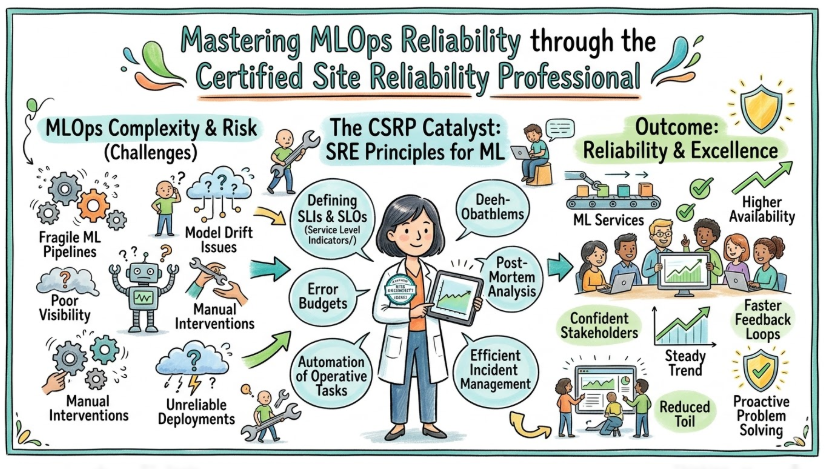
The MLOps path applies SRE principles specifically to the lifecycle of machine learning models. Reliability in this context includes monitoring for data drift, ensuring model serving latency is within SLOs, and automating the retraining and redeployment of models. It addresses the unique challenges of maintaining non-deterministic software systems at scale, ensuring that AI-driven features remain available and accurate.
DataOps Path
DataOps focuses on the reliability and quality of data pipelines. Like SRE, it uses automation and monitoring to ensure that data flows seamlessly from sources to consumers without corruption or delays. This path is essential for organizations that rely on real-time data for decision-making, as it applies the rigor of site reliability engineering to the specific complexities of data engineering and database management.
FinOps Path
The FinOps path merges SRE principles with cloud financial management. Engineers learn how to optimize cloud spend as a component of system reliability—recognizing that an inefficient, over-provisioned system is a different kind of failure. This path focuses on building “cost-aware” architectures and using error budgets to manage the trade-offs between performance, reliability, and the cost of cloud resources.
Role → Recommended Certified Site Reliability Professional Certifications
| Role | Recommended Certifications |
| DevOps Engineer | Foundation, Professional, Automation Specialist |
| SRE | Foundation, Professional, Advanced, Automation Specialist |
| Platform Engineer | Foundation, Professional, Advanced |
| Cloud Engineer | Foundation, Professional, FinOps Specialist |
| Security Engineer | Foundation, Professional, DevSecOps Specialist |
| Data Engineer | Foundation, DataOps Specialist |
| FinOps Practitioner | Foundation, FinOps Specialist |
| Engineering Manager | Foundation, Leadership Track |
Next Certifications to Take After Certified Site Reliability Professional
Same Track Progression
Deepening your specialization within the SRE domain involves pursuing niche certifications that focus on specific technologies or methodologies. For instance, after completing the Advanced level, one might look into specialized Chaos Engineering certifications or deep dives into specific observability platforms like OpenTelemetry. This ensures you remain the go-to expert for the most difficult technical challenges your organization faces.
Cross-Track Expansion
Broadening your skills into adjacent fields can make you a more versatile “T-shaped” professional. Moving from SRE into FinOps allows you to speak the language of finance, while moving into AIOps prepares you for the next generation of automated operations. This cross-pollination of skills is highly valued in modern organizations that prefer engineers who can understand the holistic impact of technical decisions.
Leadership & Management Track
For those looking to move away from individual contribution, the leadership track focuses on the human and organizational side of engineering. This includes certifications in technical leadership, engineering management, and strategic planning. Transitioning to leadership requires a shift from managing systems to managing the people who build them, using SRE principles like “blamelessness” to foster a high-performing culture.
Training & Certification Support Providers for Certified Site Reliability Professional
DevOpsSchool
DevOpsSchool provides an extensive array of training modules specifically tailored for those pursuing the Certified Site Reliability Professional designation. Their curriculum is deeply rooted in industry practices, offering students access to live projects and interactive lab environments. The instructors are veteran engineers who bring a wealth of practical knowledge to the classroom, helping students understand not just the “what” but the “why” of SRE. Their support extends beyond the classroom with comprehensive study materials and exam preparation sessions designed to ensure high success rates. For professionals in India and abroad, they offer flexible scheduling to accommodate working hours, making it a preferred choice for many.
Cotocus
Cotocus stands out for its hands-on approach to technical training, focusing heavily on the automation and architectural aspects of the Certified Site Reliability Professional program. They offer specialized bootcamps that are designed to take a candidate from zero to hero in a matter of weeks. Their training methodology emphasizes real-world scenarios, ensuring that students can apply what they learn directly to their jobs. Cotocus also provides dedicated mentorship programs where students can interact with experts to solve complex technical queries. Their commitment to quality is evident in their updated course content, which reflects the latest changes in the cloud-native ecosystem and SRE methodologies.
Scmgalaxy
Scmgalaxy is a well-known community and training hub that offers a treasure trove of resources for SRE aspirants. Their training for the Certified Site Reliability Professional is built on years of experience in the software configuration management and DevOps space. They provide a unique blend of community-driven content and professional instruction, making it a vibrant place for learning. Their focus is often on the integration of SRE with existing CI/CD frameworks, providing a holistic view of the software delivery lifecycle. With a vast library of blogs, videos, and tutorials, Scmgalaxy serves as a lifelong learning partner for many engineering professionals seeking to maintain their edge.
BestDevOps
BestDevOps focuses on delivering high-quality, streamlined training for busy professionals seeking the Certified Site Reliability Professional credential. Their courses are designed to be concise yet comprehensive, stripping away the fluff to focus on the core competencies required for the exam. They offer a variety of self-paced and instructor-led options, catering to different learning styles. The platform is known for its practical labs that simulate real production environments, allowing students to practice incident response and monitoring in a safe setting. BestDevOps maintains a strong focus on the ROI of certification, ensuring that their students are well-prepared for both the exam and their career progression.
devsecopsschool.com
While specializing in the intersection of security and operations, devsecopsschool.com offers excellent support for the security-focused tracks of the Certified Site Reliability Professional program. Their training emphasizes the “Reliability of Security,” teaching students how to build resilient security pipelines. The curriculum covers a wide range of topics, from automated compliance to secure secret management within an SRE context. Their instructors are experts in the field of DevSecOps, providing insights that are often missing from more general SRE courses. This provider is ideal for security professionals looking to adopt an engineering mindset or SREs looking to bolster their security expertise.
sreschool.com
As the primary hosting site and authority for the Certified Site Reliability Professional, sreschool.com offers the most direct and authoritative training available. Their programs are designed by the same experts who developed the certification standards, ensuring a perfect alignment between course content and exam requirements. They provide an end-to-end ecosystem for SRE learning, from foundational courses to advanced architectural masterclasses. The platform features integrated lab environments, progress tracking, and a community of peers and mentors. For those seeking the most official and comprehensive path to certification, this is the foundational resource that sets the standard for SRE education.
aiopsschool.com
aiopsschool.com is the leading provider for those looking to integrate artificial intelligence into their reliability practices. Their training for the Certified Site Reliability Professional AIOps track is cutting-edge, covering topics like predictive maintenance and automated anomaly detection. They bridge the gap between data science and systems engineering, making complex AI concepts accessible to operations professionals. The courses focus on practical applications, showing students how to use AI tools to reduce noise in monitoring systems and speed up incident resolution. This specialized focus makes them an essential resource for engineers looking to future-proof their careers in the age of automation.
dataopsschool.com
dataopsschool.com provides specialized training for the DataOps track of the Certified Site Reliability Professional program. They focus on the unique reliability challenges associated with large-scale data systems and pipelines. Their curriculum covers data quality monitoring, pipeline automation, and the application of SLOs to data delivery. As organizations become more data-driven, the skills taught here are becoming increasingly vital. The instructors are experienced data engineers who understand the nuances of database management and distributed data processing. This provider is the top choice for those who want to ensure that their organization’s data remains as reliable as its applications.
finopsschool.com
finopsschool.com offers dedicated support for the FinOps track, focusing on the critical link between system reliability and cloud costs. Their training for the Certified Site Reliability Professional helps engineers understand how to build cost-efficient architectures without sacrificing performance or uptime. They teach the principles of cloud financial management, including budgeting, forecasting, and cost allocation, all within an SRE framework. This training is particularly valuable for senior engineers and managers who are responsible for the financial health of their cloud operations. By mastering these skills, professionals can demonstrate their value as strategic partners who contribute to the company’s bottom line.
Frequently Asked Questions (General)
- How difficult is the Certified Site Reliability Professional exam?
The difficulty varies by level. The Foundation exam is accessible for those with a basic IT background, while the Professional and Advanced levels require significant hands-on experience and a deep understanding of complex system interactions. - How much time does it take to prepare for the certification?
Most candidates spend between 30 to 60 days preparing, depending on their existing experience. Foundation levels can often be cleared in 2 weeks of intensive study, whereas Advanced levels may require months of practice. - Are there any prerequisites for taking the Foundation exam?
There are no formal prerequisites for the Foundation level, though a basic understanding of Linux, cloud computing, and the software development lifecycle is highly recommended for success. - What is the return on investment (ROI) for this certification?
Professionals often see immediate benefits in terms of job opportunities and salary increases. Organizations benefit from reduced downtime and a more efficient engineering culture, making it a win-win for both parties. - Can I take the exams online?
Yes, the exams are typically offered through an online proctored format, allowing you to take them from the comfort of your home or office while maintaining the integrity of the testing process. - How long is the certification valid?
The certification is generally valid for two to three years. Given the rapid pace of technological change, recertification ensures that your skills remain current with the latest industry standards. - Is this certification recognized globally?
Yes, the principles of SRE are universal, and the Certified Site Reliability Professional credential is recognized by major enterprises and technology firms across the globe, including in India. - Does the certification focus on a specific cloud provider like AWS or Azure?
No, the program is cloud-agnostic. It focuses on engineering principles that can be applied to any cloud environment, on-premises data centers, or hybrid setups. - What kind of questions are asked in the exam?
The exams include a mix of multiple-choice questions, case study analyses, and in some levels, practical hands-on labs where you must solve problems in a live environment. - Is there a community for certified professionals?
Yes, being certified gives you access to a global network of SRE professionals, forums, and exclusive events where you can share knowledge and find career opportunities. - How does this differ from a standard DevOps certification?
While DevOps is a broad cultural movement, SRE is a specific implementation of DevOps. This certification is more technical and prescriptive, focusing on the metrics and engineering tasks required for reliability. - Are there any study groups available?
Many training providers like SREschool.com and DevOpsSchool facilitate study groups and peer-to-peer learning communities to help candidates prepare collectively.
FAQs on Certified Site Reliability Professional
- What specific SRE tools are covered in the curriculum?
The program covers a wide range of tools including Prometheus, Grafana, ELK Stack, Jaeger, and Kubernetes. The focus remains on the implementation logic rather than just the tool’s syntax. - How does the certification handle the concept of Error Budgets?
Error budgets are a core component. The exam tests your ability to calculate budgets, define consequences for exhausting them, and use them to negotiate with product teams. - Is coding required for the Professional level?
Yes, a basic proficiency in scripting (Python, Go, or Bash) is required to demonstrate your ability to automate toil and build custom monitoring solutions. - Does the program cover Chaos Engineering?
Yes, especially at the Advanced level. You will learn the principles of “breaking things on purpose” to uncover system weaknesses before they cause real outages. - How is “Toil” defined in the exam context?
Toil is defined as manual, repetitive, automatable work that provides no long-term value. You will be tested on your ability to identify and eliminate it. - Are Service Level Objectives (SLOs) a major part of the exam?
Absolutely. SLOs are the heart of SRE. You must be able to define, measure, and report on them accurately across different service types. - Can I skip the Foundation level if I have experience?
While experienced engineers may find the Foundation level easy, it is often a prerequisite for higher-level certifications to ensure a standardized vocabulary and understanding. - How does the certification address incident management?
It covers the entire lifecycle: from detection and alerting to coordination, resolution, and the creation of blameless post-mortems to prevent recurrence.
Final Thoughts: Is Certified Site Reliability Professional Worth It?
From the perspective of a senior mentor with two decades in the industry, the answer is a clear yes. We have moved past the era where “keeping the lights on” was a separate job from “building the house.” Today, the most successful engineers are those who understand how their code behaves when thousands of people are using it at once. This certification provides the structure and the discipline needed to master that environment.
However, remember that a certification is a beginning, not an end. It provides you with the map, but you still have to walk the path. The real value of the Certified Site Reliability Professional lies in the mindset shift it triggers—moving from a reactive mode of fixing things to a proactive mode of engineering for success. If you are willing to do the work and apply these principles to your daily tasks, this credential will be one of the most significant milestones in your career journey.

