
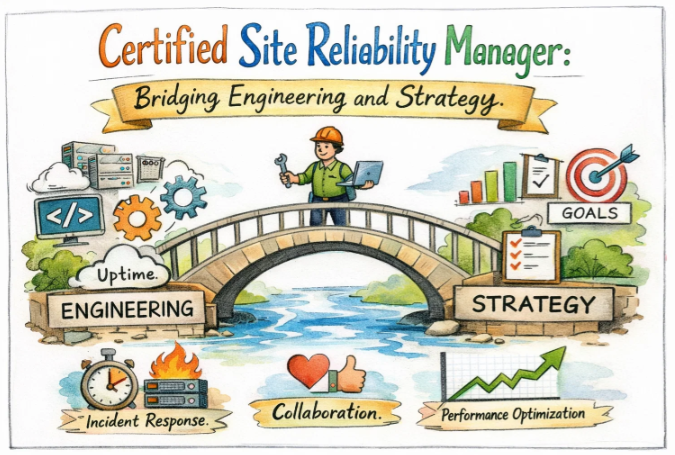
The role of a leader in production environments has shifted from traditional infrastructure management to a software-centric approach. This guide is designed for professionals seeking to master the Certified Site Reliability Manager designation. It provides a strategic roadmap for those who need to balance the velocity of feature delivery with the absolute necessity of system stability. Whether you are an aspiring lead or a seasoned manager, this resource at SREschool helps you navigate the complexities of modern reliability.
Navigating career decisions in the cloud-native era requires more than just knowing tools; it requires a deep understanding of operational culture. This certification guide helps engineers and technical leaders determine if management-level SRE skills are the right investment for their specific career trajectory. By the end of this article, you will have a clear picture of how this credential maps to real-world roles and enterprise expectations.
What is the Certified Site Reliability Manager?
The Certified Site Reliability Manager represents a professional standard for individuals who oversee the reliability, scalability, and performance of complex distributed systems. Unlike basic certifications that focus solely on tool syntax, this program emphasizes the management of service-level objectives, error budgets, and the human elements of incident response. It exists to bridge the gap between high-level business goals and the technical realities of maintaining 24/7 availability in cloud environments.
This certification focuses on production-readiness and the engineering workflows that define modern site reliability. It is built on the principle that reliability is a shared responsibility across the entire organization. By obtaining this credential, professionals demonstrate they can implement enterprise practices that reduce toil, automate manual interventions, and foster a culture of blameless post-mortems.
Who Should Pursue Certified Site Reliability Manager?
This certification is tailored for mid-to-senior level professionals who are either currently in or moving toward leadership positions. Engineering managers, team leads, and senior SREs find significant value here as they transition from individual contributors to strategic decision-makers. It is also highly relevant for cloud architects and platform engineers who need to design systems with operational excellence as a core requirement.
In the global market, and particularly within India’s massive IT and product engineering hubs, there is a surge in demand for leaders who understand both software development and systems operations. Beginners with a strong foundation in computer science can use this as a north star for their career progression. For experienced security and data professionals, it provides the management framework necessary to ensure their specialized pipelines remain resilient and available.
Why Certified Site Reliability Manager is Valuable and Beyond
The longevity of a career in technology depends on mastering principles that outlast specific software versions. The Certified Site Reliability Manager credential offers this by focusing on the core tenants of reliability engineering that remain constant regardless of whether you use Kubernetes, serverless, or legacy VMs. As enterprises continue to migrate mission-critical workloads to the cloud, the need for leaders who can defend an error budget is non-negotiable.
The return on investment for this certification is seen in the ability to drive organizational change. It empowers managers to argue for technical debt reduction using data-driven metrics rather than intuition. This relevance ensures that professionals remain indispensable during market shifts, as their expertise is tied to the fundamental requirement of any business: keeping the service running and the customers satisfied.
Certified Site Reliability Manager Certification Overview
The Certified Site Reliability Manager program is delivered through SREschool.com, a platform dedicated to specialized reliability training. The certification is structured to validate a candidate’s ability to manage the entire lifecycle of a service, from design-phase reliability to decommissioning. The assessment approach involves practical scenarios that test decision-making under pressure and the ability to align technical output with business value.
The ownership of this certification ensures that the curriculum is updated to reflect current industry standards and the evolving nature of distributed systems. It is not just an exam; it is a framework for professional development that includes foundation-level concepts and advances into professional management strategies. The focus remains on the “Manager” aspect, ensuring that participants can lead teams, manage stakeholders, and drive operational policy.
Certified Site Reliability Manager Certification Tracks & Levels
The certification is organized into a progressive hierarchy that allows professionals to enter at the level most appropriate for their current experience. The Foundation level focuses on the vocabulary and core metrics of SRE, such as SLIs and SLOs. It is the entry point for those new to the management side of reliability, providing the basic tools needed to participate in high-level operational discussions.
As candidates progress to the Professional and Advanced levels, the focus shifts toward specialization and organizational leadership. This includes tracks that delve into SRE for FinOps, where cost and reliability intersect, or SRE for Security, focusing on the resilience of defensive systems. These levels align with career progression from a team lead to a Director of Reliability or a VP of Engineering.
Complete Certified Site Reliability Manager Certification Table
| Track | Level | Who it’s for | Prerequisites | Skills Covered | Recommended Order |
| SRE Management | Foundation | Aspiring Managers | 2+ years in IT | SLO basics, Incident Response | 1st |
| SRE Management | Professional | Current Team Leads | Foundation Cert | Error Budgets, Toil Reduction | 2nd |
| SRE Management | Advanced | Senior Leaders | Professional Cert | Organizational Design, Policy | 3rd |
| Specialized | SRE-FinOps | Platform Managers | Foundation Cert | Cost vs. Reliability, Budgeting | 4th |
| Specialized | SRE-Sec | Security Managers | Foundation Cert | Resilience Engineering, DevSecOps | 4th |
Detailed Guide for Each Certified Site Reliability Manager Certification
What it is This certification validates a professional’s understanding of the fundamental concepts that underpin site reliability management. It ensures that the candidate can speak the language of reliability and understands how to measure service performance effectively.
Who should take it It is suitable for software engineers looking to move into management, junior SREs, and project managers who work closely with production teams. No prior management experience is required, but a general understanding of the software development lifecycle is essential.
Skills you’ll gain
- Defining Service Level Indicators (SLIs).
- Setting realistic Service Level Objectives (SLOs).
- Understanding the lifecycle of an incident.
- Basics of automation and toil identification.
Real-world projects you should be able to do
- Create a basic reliability dashboard for a microservice.
- Write a simple post-mortem report for a minor outage.
- Identify manual tasks in a deployment pipeline that can be automated.
Preparation plan
- 7–14 days: Focus on memorizing SRE terminology and the relationship between SLIs and SLOs.
- 30 days: Read core SRE handbooks and practice defining metrics for sample applications.
- 60 days: Deep dive into incident management workflows and study real-world outage reports.
Common mistakes
- Confusing SLAs with SLOs during the assessment.
- Focusing too much on specific tools rather than the underlying management principles.
Best next certification after this
- Same-track: Certified Site Reliability Manager – Professional.
- Cross-track: Cloud Architect Foundation.
- Leadership: Certified Scrum Master.
Choose Your Learning Path
DevOps Path
In this path, the focus is on integrating reliability into the continuous integration and delivery pipeline. A manager here ensures that every code change is assessed for its impact on system stability before it reaches production. The goal is to move from “deploying often” to “deploying reliably” by using automated testing and canary releases as standard management requirements.
DevSecOps Path
The DevSecOps path emphasizes that a system cannot be reliable if it is not secure. Managers in this track learn how to apply SRE principles to security operations, such as treating security vulnerabilities as a form of technical debt. They manage the “security error budget,” ensuring that protection mechanisms do not become a bottleneck for system performance.
SRE Path
This is the core path for those dedicated to pure site reliability management. It covers the full spectrum of production operations, from capacity planning and change management to emergency response. It is ideal for those who want to build and scale dedicated SRE teams that act as consultants to the broader engineering organization.
AIOps Path
The AIOps path explores the use of machine learning to enhance reliability management. Managers learn how to oversee systems that use predictive analytics to identify potential failures before they occur. This involves managing the data pipelines that feed operational AI and ensuring the models provide actionable insights for the human SREs.
MLOps Path
Focusing on the reliability of machine learning models in production, this path deals with “model drift” as a reliability issue. Managers learn to treat ML training and inference pipelines with the same rigorship as standard microservices. It ensures that the reliability of the business logic remains intact even as the underlying data evolves.
DataOps Path
Reliability in DataOps is about the integrity and availability of the data lifecycle. This path focuses on managing the pipelines that move, transform, and store massive datasets. A manager here ensures that data “uptime” is treated with the same urgency as application uptime, preventing downstream business intelligence failures.
FinOps Path
The FinOps path connects reliability with cloud cost management. Managers learn how to make trade-offs between system redundancy and budget constraints. This track is essential for leaders who need to justify the cost of reliability to stakeholders and optimize cloud spend without sacrificing service quality.
Role → Recommended Certified Site Reliability Manager Certifications
| Role | Recommended Certifications |
| DevOps Engineer | CSRM Foundation, DevOps Professional |
| SRE | CSRM Foundation, CSRM Professional |
| Platform Engineer | CSRM Foundation, Advanced Infrastructure |
| Cloud Engineer | CSRM Foundation, Cloud Specialized Track |
| Security Engineer | CSRM Foundation, SRE-Sec Specialized |
| Data Engineer | CSRM Foundation, DataOps Management |
| FinOps Practitioner | CSRM Foundation, SRE-FinOps Track |
| Engineering Manager | CSRM Foundation, CSRM Professional, Advanced |
Next Certifications to Take After Certified Site Reliability Manager
Same Track Progression
Once you have mastered the management aspects of reliability, the logical next step is to achieve the Advanced level. This involves shifting your focus from team-level management to organizational strategy. You will learn how to build a global SRE culture, manage multi-region availability, and influence the entire engineering department’s approach to production excellence.
Cross-Track Expansion
Reliability managers often benefit from expanding their skills into related domains like FinOps or DevSecOps. Broadening your expertise allows you to speak the language of finance and security, making you a more effective leader. For example, understanding how reliability affects the cloud bill can help you lead more impactful cost-optimization initiatives within your department.
Leadership & Management Track
For those looking to move into executive roles like CTO or VP of Engineering, formal leadership certifications are a great supplement. These programs focus on the “soft skills” of management, such as conflict resolution, strategic planning, and talent acquisition. Combining technical reliability expertise with high-level leadership training makes for a powerful executive profile.
Training & Certification Support Providers for Certified Site Reliability Manager
DevOpsSchool
DevOpsSchool provides a robust platform for professionals seeking to master the intricacies of site reliability. They offer a comprehensive curriculum that blends theoretical knowledge with intense practical exercises. Their instructors are industry veterans who bring real-world production experience into the virtual classroom. Students benefit from an environment that encourages deep dives into automation, monitoring, and incident response frameworks. The school is particularly well-known for its hands-on labs and its ability to prepare candidates for the rigors of modern enterprise environments. By focusing on both the technical and cultural aspects of DevOps and SRE, they ensure that graduates are ready to lead.
Cotocus
Cotocus stands out as a specialized provider that focuses on high-end engineering training and consulting. They offer tailored programs that align closely with the requirements of the site reliability management domain. Their approach is highly consultative, ensuring that the training addresses the specific challenges faced by teams in the field. Cotocus emphasizes the use of cutting-edge tools and methodologies, helping professionals stay ahead of the curve in a fast-moving industry. Their commitment to excellence is reflected in their course design, which prioritizes real-world application over rote memorization. For those looking for a premium learning experience, Cotocus provides the necessary depth and expertise.
Scmgalaxy
Scmgalaxy is a widely recognized community and training hub for software configuration management and reliability professionals. They provide a wealth of resources, including tutorials, forums, and structured certification paths. Their focus is on building a strong community where knowledge is shared freely among practitioners. Scmgalaxy’s training programs are designed to be accessible yet thorough, covering everything from basic version control to advanced reliability management. They are an excellent resource for professionals who value peer-to-peer learning and want to stay connected with the latest trends in the SRE space. Their long-standing presence in the industry makes them a trusted name for career development.
BestDevOps
BestDevOps focuses on delivering high-impact training that translates directly into career advancement. They offer a streamlined path to mastering reliability engineering, with a curriculum that is frequently updated to reflect the latest industry shifts. Their programs are designed for busy professionals, providing flexible learning options without compromising on depth. BestDevOps places a strong emphasis on the practical skills required to manage production systems at scale. By focusing on the “best practices” of the industry, they help candidates avoid common pitfalls and implement efficient, reliable workflows. Their goal is to produce leaders who can immediately contribute to their organization’s success.
devsecopsschool.com
DevSecOpsSchool is a niche provider dedicated to the intersection of security and operations. They recognize that modern reliability cannot exist without a strong security foundation. Their training programs for site reliability managers include specialized modules on resilience engineering and security automation. They teach professionals how to integrate security checks into the reliability lifecycle without slowing down the pace of innovation. This school is ideal for those who want to specialize in the management of secure, resilient systems. Their curriculum is highly technical and focused on the practical implementation of security-as-code principles within a reliability framework.
sreschool.com
SREschool.com is the primary destination for professionals dedicated to the discipline of site reliability engineering. As the host of the management certification, they offer a curriculum that is specifically designed to meet the highest industry standards. Their focus is entirely on SRE, ensuring that every course is deep, relevant, and authoritative. They provide a clear roadmap for career progression, from entry-level concepts to advanced organizational leadership. The school’s emphasis on production-focused learning ensures that candidates gain skills that are immediately applicable in high-stakes environments. It is the go-to resource for anyone serious about a career in reliability management.
aiopsschool.com
AIOpsSchool is at the forefront of the movement toward automated, intelligent operations. They provide specialized training for managers who need to oversee the next generation of reliability tools. Their curriculum covers the application of machine learning and data science to IT operations, helping professionals move beyond manual monitoring. Students learn how to manage systems that can self-heal and predict outages before they impact users. This school is essential for leaders who want to stay relevant in an era where data-driven decision-making is becoming the norm. Their training bridges the gap between traditional SRE practices and the future of AI-driven reliability.
dataopsschool.com
DataOpsSchool addresses the unique reliability challenges of data-intensive organizations. They offer training that focuses on the lifecycle of data, from ingestion to analysis, with a focus on uptime and integrity. For site reliability managers, this school provides the tools needed to manage complex data pipelines and ensure that information remains available for critical business functions. Their curriculum emphasizes automation, testing, and monitoring within the data ecosystem. By applying SRE principles to data management, they help professionals ensure that their organization’s data remains a reliable asset. This specialized focus is increasingly important as businesses become more data-dependent.
finopsschool.com
FinOpsSchool is dedicated to the growing field of cloud financial management. They provide training that helps reliability managers understand the cost implications of their technical decisions. Their curriculum focuses on the intersection of cloud spend and system performance, teaching professionals how to optimize resources without compromising on availability. Students learn how to implement “unit economics” for reliability, allowing them to communicate the value of SRE in financial terms. This school is vital for leaders who need to manage large cloud budgets and justify technical investments to executive stakeholders. Their training provides a unique and necessary perspective on modern operational management.
Frequently Asked Questions (General)
- How difficult is the Certified Site Reliability Manager exam?
The exam is moderately difficult as it requires both technical knowledge and managerial intuition. It focuses on situational judgment rather than simple recall. - How much time does it take to prepare?
Most professionals spend between 30 and 60 days preparing, depending on their existing experience with production systems and SRE concepts. - Are there any specific prerequisites for the Foundation level?
There are no formal prerequisites, but at least two years of experience in a software or systems engineering role is highly recommended for context. - What is the return on investment for this certification?
The ROI is high, as it qualifies you for leadership roles in SRE and DevOps, which often command higher salaries and provide greater job security. - In what order should I take the certifications?
Start with the Foundation level, move to Professional, and then choose a specialization or the Advanced track based on your career goals. - Does this certification cover specific tools like Terraform or Jenkins?
While tools are mentioned, the focus is on the principles of management and the workflows that these tools support, rather than the tools themselves. - How does this certification differ from a standard DevOps cert?
DevOps focuses on the entire lifecycle, while this certification deep-dives into the “run” and “maintain” phases, focusing specifically on reliability. - Is the certification recognized globally?
Yes, SRE principles are universal, and this certification is designed to meet international standards for reliability management. - Can I skip the Foundation level if I have many years of experience?
It is generally recommended to start with Foundation to ensure you are aligned with the specific terminology and framework used in the program. - What kind of support is available during preparation?
Providers like SREschool.com offer labs, study guides, and community forums to assist candidates throughout their learning journey. - How often do I need to recertify?
Typically, recertification is required every two to three years to ensure that your skills remain current with evolving industry practices. - Is there a focus on “soft skills” in this certification?
Yes, the Professional and Advanced levels specifically address leadership, communication, and cultural change management.
FAQs on Certified Site Reliability Manager
- What makes the “Manager” aspect of this certification unique?
It focuses on the strategic oversight of reliability, including team leadership and business alignment, rather than just technical implementation. - How does this certification handle the concept of “Error Budgets”?
It teaches you how to negotiate, implement, and defend error budgets as a tool for balancing speed and stability. - Does the program include incident command training?
Yes, it covers the roles and responsibilities required to lead an effective incident response team during major outages. - Is the curriculum based on the original Google SRE model?
It draws heavily from the Google model but adapts those principles for a wider variety of enterprise environments and cloud-native setups. - How are the practical labs structured?
Labs involve managing simulated production environments where you must respond to failures and maintain SLOs under varying load conditions. - Can this certification help me build an SRE team from scratch?
Absolutely, the management tracks provide a blueprint for organizational design and the hiring profiles needed for a successful SRE function. - What is the focus on “Toil” in this program?
It teaches managers how to identify, measure, and systematically eliminate manual, repetitive work that hinders team productivity. - How does the certification address cloud-native technologies?
It applies reliability principles to modern architectures like Kubernetes and microservices, ensuring you can manage reliability in dynamic environments.
Final Thoughts: Is Certified Site Reliability Manager Worth It?
In my two decades in this industry, I have seen many trends come and go, but the need for reliable systems is a constant that only grows more critical over time. The Certified Site Reliability Manager is not just another badge for your profile; it is a rigorous validation of your ability to lead in the most challenging area of technology—production. If you are serious about moving into engineering leadership, this certification provides the structural framework you need to succeed.
Choosing this path requires a commitment to a “reliability-first” mindset. It is an investment in your ability to handle the pressure of high-stakes environments and to lead teams that the business can depend on. For the professional who wants to be more than just a manager and instead wants to be an architect of operational excellence, this is undoubtedly a worthy pursuit.

