
Introduction
In professional software engineering, there is a significant gap between theoretical tutorials and the reality of a 3:00 AM production outage. Real-world DevOps is not merely about using the right tools, but about managing complex trade-offs, ensuring system resilience, and creating processes that survive the pressures of a live enterprise environment. At DevOpsSchool, we teach that successful implementation requires moving beyond simple “happy path” automation to building reliable, secure, and observable systems. This guide bridges that gap, offering a practical, architect-level view of how DevOps concepts actually function in high-stakes production projects.
What Does “DevOps in Real Projects” Actually Mean?
In theoretical DevOps, the goal is often defined as “collaboration between development and operations.” In a real project, this definition is far more granular. It means managing the friction between speed of delivery and stability of the platform.
Theory vs. Reality
| Concept | The Theory | The Reality in Production |
| CI/CD Pipeline | Code pushes to production automatically. | Code pushes involve staging gates, security scans, and manual approval triggers. |
| Infrastructure | Provisioned instantly via script. | Provisioning requires auditing, cost management, and complex networking rules. |
| Collaboration | Dev and Ops sit together. | Teams are distributed across time zones with siloed knowledge bases. |
| Monitoring | Everything is green. | Alert fatigue, false positives, and correlating logs across microservices are common. |
Real-world DevOps is the practice of engineering systems that handle the inevitable failures of hardware, network, and human error. It is about defining the guardrails that allow developers to move fast without breaking the customer experience.
End-to-End DevOps Lifecycle in Real Projects
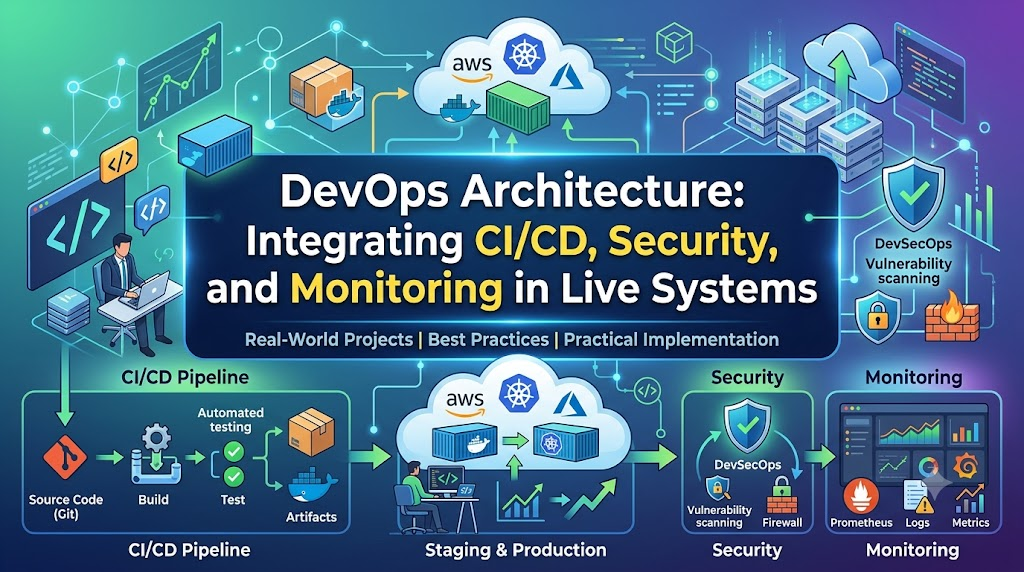
A professional DevOps lifecycle is a continuous loop, not a linear progression. In a production environment, the workflow looks like this:
- Code Development: Developers write code in feature branches. The focus is on modularity and testability.
- Version Control Workflow: Git is the source of truth. Real projects use branch protection rules, code owners, and pull request reviews.
- CI Pipeline Execution: This is where the code is compiled, tested (Unit, Integration, and Regression), and scanned for security vulnerabilities.
- CD Deployment Process: Artifacts (containers or binaries) are pushed to an artifact repository and then deployed to environments (Dev, QA, Staging, Prod).
- Monitoring and Feedback Loop: Metrics, logs, and traces are collected. Alerts trigger incidents that feed back into the development process for bug fixes or feature requests.
Real Project Example: CI/CD Pipeline for a Web Application
In a production environment, a CI/CD pipeline is the central nervous system of the project. Let us look at a typical workflow for a standard web application.
The Git Workflow
Developers work on feature branches. They push to a centralized repository (GitHub, GitLab, or Bitbucket). A merge request triggers the pipeline. The key here is quality gating. If the code does not pass linting (code style checks) or unit tests, the pipeline fails immediately. This is the first line of defense against production bugs.
Build and Test Automation
Once the code passes the initial checks, the pipeline creates an immutable build. In a modern stack, this usually involves building a Docker image. This image is tagged with the commit SHA and pushed to a private Container Registry.
Deployment Strategy
We rarely deploy directly to production. The pipeline deploys to a “Staging” environment that mimics production as closely as possible. Integration tests run here. Once verified, the deployment to production follows a Blue-Green or Canary deployment pattern. We never just “overwrite” the live application. We shift traffic from the old version to the new version, ensuring we have a zero-downtime rollback path if something goes wrong.
Real Project Example: Microservices Deployment on Kubernetes
Kubernetes is the standard for container orchestration, but in real projects, it is significantly more complex than a local “minikube” setup.
Containerization and Scaling
We package applications into containers. However, in production, we must define resource requests and limits. Without these, a single rogue microservice could consume the entire cluster’s memory, causing a cascading failure.
Cluster Setup and Service Discovery
Real-world Kubernetes implementations involve:
- Ingress Controllers: To manage external access to the services.
- ConfigMaps and Secrets: Managing sensitive data, like database credentials, without hardcoding them into the container image.
- Service Discovery: Using Internal DNS so that Service A can find Service B without knowing its IP address.
Strategy for Scaling
We implement Horizontal Pod Autoscalers (HPA) based on CPU or memory usage. But a senior engineer knows that scaling is not just about pods; it is about node pools, cluster autoscaling, and ensuring that our underlying cloud provider can provision new virtual machines fast enough to meet the demand.
Real Project Example: Infrastructure Automation Using IaC
Manual configuration of servers, known as “click-ops,” is a major failure point in real-world projects.
Terraform or OpenTofu
We use Infrastructure as Code (IaC) to define our networking (VPCs, Subnets), database instances, and load balancers. The code is version-controlled just like application code.
Environment Provisioning
The power of IaC in a real project is idempotency. If we run the script once, it creates the infrastructure. If we run it again, it ensures the infrastructure matches the code, making only the necessary changes (drift detection). We manage state files securely (e.g., in S3 with locking) to ensure that two engineers do not try to modify the same infrastructure simultaneously.
Real Project Example: Monitoring and Observability Setup
You cannot fix what you cannot see. In production, “monitoring” is insufficient; we need “observability.”
Metrics Collection
We use tools like Prometheus to scrape metrics from our applications and infrastructure. We look at the RED method: Rate (requests per second), Errors (request failure rate), and Duration (latency).
Logging Systems
Centralized logging (e.g., ELK Stack or Splunk) is essential. In a microservices architecture, requests span multiple services. We use Distributed Tracing (e.g., Jaeger or Honeycomb) to follow a single user request as it traverses the system, identifying exactly which service is causing latency.
Alerting Mechanisms
The goal is to avoid “alert fatigue.” We configure alerts for actionable issues—service down, high latency, or error spikes. We integrate these with incident management tools (like PagerDuty) so that the right engineer is notified at the right time.
Real Project Example: DevSecOps Integration in Pipeline
Security is not a final step; it is a continuous process.
Security Scanning in CI
Every pipeline includes automated scanning:
- SAST (Static Application Security Testing): Scanning source code for vulnerabilities.
- SCA (Software Composition Analysis): Checking dependencies (libraries) for known vulnerabilities (CVEs).
- Container Scanning: Ensuring the Docker image itself does not have outdated packages.
Secure Deployment Practices
We apply the Principle of Least Privilege. Kubernetes pods do not run as root. Infrastructure is not accessible from the public internet; it lives in private subnets, accessible only through a bastion host or VPN.
How DevOps Concepts Work Together in Real Systems
These concepts do not exist in isolation. They form a feedback loop.
- IaC defines the environment where the Application runs.
- CI/CD automates the delivery of that application to the environment.
- Observability provides data on how the application behaves in that environment.
- DevSecOps ensures the entire chain—from the infrastructure definition to the code deployment—is secure.
When a monitor fires an alert (Observability), the team checks the deployment history (CI/CD) to see what changed, fixes the code or infrastructure (IaC), and pushes a new version (CI/CD) to remediate the issue. This is the true DevOps flywheel.
Common Challenges in Real DevOps Projects
Even with the best tools, reality often presents obstacles:
- Legacy Systems Integration: Modernizing a monolith that has been running for ten years is a massive, slow, and high-risk operation.
- Deployment Failures: They are inevitable. The challenge is not avoiding them, but having a “Rollback Strategy” that can be executed in seconds.
- Toolchain Complexity: There are too many tools. Teams often suffer from “analysis paralysis,” spending more time choosing a tool than using it.
- Skill Gaps: DevOps is a culture, not a role. It requires developers to understand operations and operations to understand development.
- Environment Inconsistencies: “It works on my machine” is the classic DevOps problem. We solve this with containerization (Docker).
Real-World Mistakes Teams Make in DevOps Implementation
- Over-Automation: Automating a broken process just makes the broken process run faster. Optimize the workflow before automating it.
- Ignoring Monitoring: Building a pipeline without logging and metrics is flying blind. You will eventually crash.
- Weak Rollback Strategies: If you cannot undo a deployment in under 5 minutes, you are not ready for production.
- Poor Collaboration: When DevOps is treated as a “team” rather than a “philosophy,” silos reappear. Developers stop caring about operations, and operations stop caring about features.
Best Practices From Real DevOps Projects
- Start Simple, Scale Gradually: Do not try to implement a complex Kubernetes cluster with service mesh on day one. Start with basic CI/CD.
- Automate Critical Workflows First: Focus on the parts of the process that cause the most pain, such as manual deployments or database migrations.
- Focus on Reliability Over Speed: Speed is a byproduct of stability. If your deployments are unreliable, you cannot move fast anyway.
- Maintain Observability From Day One: If you build a new service, you must build the dashboard for it simultaneously.
- Ensure Rollback Mechanisms: Every deployment should have an “Undo” button.
Role of DevOpsSchool in Understanding Real-World DevOps
Learning DevOps requires exposure to professional, industry-standard workflows. It is about understanding the “why” behind the “how.” At DevOpsSchool, the focus is on bridging the gap between theoretical knowledge and the practical skills required in an enterprise environment. Whether you are learning about the intricacies of CI/CD pipelines, the nuances of infrastructure automation, or the architectural requirements of microservices, the goal is to develop a mindset that prioritizes maintainability, scalability, and security. Practical DevOps is a journey of continuous learning, and having the right guidance helps navigate the complexities of production systems.
Industries Where DevOps Is Applied in Real Projects
DevOps is universal, but its application varies by industry:
- SaaS Applications: High velocity, frequent updates (multiple times a day). Focus is on rapid CI/CD.
- Banking Systems: High security and compliance. Focus is on auditable, immutable deployments and strict DevSecOps.
- E-Commerce Platforms: Massive scale during peak times (e.g., sales). Focus is on auto-scaling and high availability.
- Healthcare Systems: Focus is on data privacy (HIPAA compliance) and rigid environment segregation.
- Telecom Infrastructure: Focus is on low latency and edge computing, requiring complex network automation.
- Enterprise IT Systems: Focus is on migrating legacy, on-premise systems to cloud-native architectures.
Future of Real-World DevOps Implementations
The next wave of DevOps is already here:
- AI-Driven Automation: Using AI to analyze logs and suggest fixes before human intervention is needed.
- Self-Healing Systems: Kubernetes already does this to an extent, but we are moving toward systems that can automatically rollback based on performance degradation metrics.
- GitOps-Based Deployments: Using Git as the single source of truth for both code and infrastructure state, where tools like ArgoCD automatically synchronize the cluster state with the Git repository.
- Fully Automated Infrastructure Lifecycle: Moving beyond just provisioning servers to managing the entire data lifecycle, compliance checks, and cost optimization automatically.
FAQs
1. What is DevOps in real projects?
It is the application of engineering principles to build, test, and release software. It balances the need for rapid updates with the necessity of system stability and security.
2. How is CI/CD used in production?
CI/CD automates the repetitive parts of releasing software. It ensures that every code change is tested, scanned for security, and deployed to a staging environment before it ever reaches a customer.
3. What tools are used in real DevOps environments?
Common tools include Jenkins, GitLab CI, GitHub Actions (CI/CD), Terraform/OpenTofu (IaC), Kubernetes (Orchestration), Prometheus/Grafana (Monitoring), and Vault (Secret Management).
4. Is Kubernetes used in all projects?
No. Kubernetes is powerful but complex. Small projects or simple applications may be better served by serverless functions or managed container services, which have less operational overhead.
5. What is a real DevOps workflow?
A real workflow involves coding in feature branches, peer-reviewing code, triggering an automated CI pipeline that tests and builds the application, and deploying it to staging for validation before production release.
6. How do companies deploy applications?
Most modern companies use automated pipelines. Some use rolling updates for zero-downtime, while others use Blue-Green deployments for safer testing.
7. What is infrastructure automation?
It is the practice of managing hardware and cloud resources using code (IaC) rather than manual setup. This makes infrastructure repeatable, versionable, and less prone to human error.
8. How does DevSecOps work in real systems?
DevSecOps embeds security checks directly into the CI/CD pipeline, ensuring that every piece of code is scanned for vulnerabilities before it is packaged or deployed.
9. Why is monitoring important in DevOps?
Without monitoring, you cannot detect when a system fails. Real-world monitoring provides visibility into performance, errors, and user experience, which is critical for incident response.
10. What is the biggest challenge in DevOps?
Culture. Getting teams to work together, breaking down silos, and changing the mindset from “it’s not my job” to “we are responsible for the system” is the hardest part.
11. How do you handle database migrations in DevOps?
Database migrations are usually handled by automated scripts that run during the deployment phase, ensuring the database schema is updated before or during the application code update.
12. What is “drift” in infrastructure?
Drift happens when the actual state of your infrastructure deviates from the code that defined it, usually because of manual changes made by administrators. IaC tools help detect and fix this.
13. How often should we deploy?
As often as you have the confidence to do so. Some teams deploy ten times a day; others deploy once a week. The frequency should be dictated by your ability to test and roll back effectively.
14. Do developers need to learn operations?
Yes. In a DevOps environment, developers must understand how their code behaves in production, how it uses resources, and how to debug it when it fails.
15. What are common DevOps metrics?
Key metrics (often called DORA metrics) include Deployment Frequency, Lead Time for Changes, Change Failure Rate, and Time to Restore Service.
Final Thoughts
Real DevOps is complex, interconnected, and constantly evolving. It is not a final destination, but a state of continuous improvement. The tools we use—Kubernetes, Terraform, Jenkins—are merely levers; the actual work lies in the discipline of the process, the rigors of our testing, and the strength of our team collaboration.
Production systems require discipline. They require a culture that values post-mortems over blame, and reliability over raw speed. If you are starting your DevOps journey, do not be overwhelmed by the list of tools. Focus on understanding the lifecycle of a deployment, the mechanics of infrastructure as code, and the necessity of observability. Learning these workflows is the key to mastering the craft of DevOps in the real world.

