
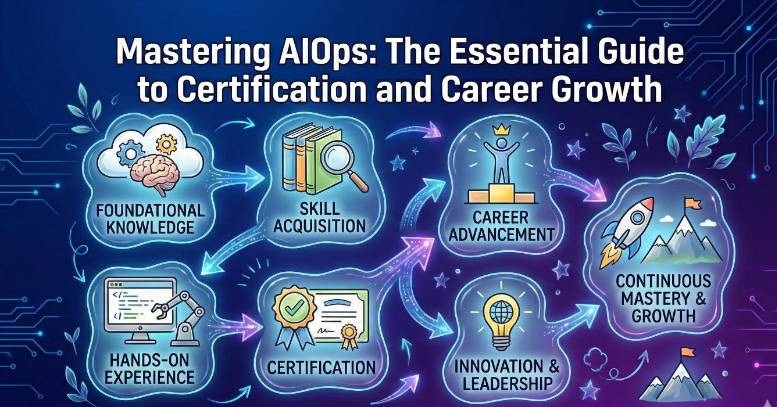
The world of technology moves at a speed that is hard to imagine. A few years ago, we were worried about managing a few dozen servers. Today, we manage thousands of containers and microservices. The amount of data these systems create is huge. Humans simply cannot watch every log, every metric, and every alert anymore. This is why AIOps (Artificial Intelligence for IT Operations) has become the most important skill for any modern engineer.
Throughout my career, I have seen many shifts. We moved from physical servers to the cloud, and then from manual deployments to DevOps. But AIOps is different. It is not just a tool; it is a way of using data and machine learning to make our systems smarter. This guide is designed to help you understand how to master this field and which certification will get you there.
The Need for AIOps in Modern Engineering
Modern software is complex. When something goes wrong, it usually causes a “storm” of alerts. A single database failure can trigger hundreds of notifications across different teams. This leads to “alert fatigue,” where engineers start ignoring notifications because there are too many of them.
AIOps uses artificial intelligence to solve this. It looks at all the data, finds the root cause, and can even fix the problem automatically. For managers, this means less downtime and lower costs. For engineers, it means fewer late-night calls and more time to build cool features.
AIOps Certification Overview
Choosing the right training is the first step toward becoming a leader in this space. Below is a detailed list of the tracks available for those looking to specialize in AIOps.
AIOps Certification Tracks and Levels
| Track | Level | Who it’s for | Prerequisites | Skills Covered | Recommended Order |
| AIOps Foundation | Beginner | Managers & Freshers | Basic IT knowledge | AI Basics, Monitoring, Log Analysis | 1 |
| AIOps Certified Professional | Intermediate | DevOps/SRE Engineers | Linux, Python, DevOps | Event Correlation, Automation, ML | 2 |
| AIOps Specialist | Advanced | Platform Engineers | 3+ years in Ops | Predictive Analytics, Self-healing | 3 |
| AIOps Architect | Expert | Senior Leads & Architects | Deep SRE experience | Strategy, Scaling AI, Tool Choice | 4 |
Deep Dive: AIOps Certification Training Course | AIOps
The core of your journey will likely be the AIOps Certification Training Course | AIOps provided by DevOpsSchool. This is a professional-level program designed for people who are already working in the field and want to upgrade their skills.
What it is
This course is a comprehensive program that teaches you how to apply Machine Learning (ML) and Big Data to IT operations. It bridges the gap between traditional monitoring and intelligent, automated systems.
Who should take it
This course is perfect for Software Engineers, SREs, and DevOps professionals who want to move away from manual troubleshooting. It is also highly recommended for Engineering Managers who need to implement AI-driven strategies in their organizations.
Skills you’ll gain
- Data Ingestion: Learning how to collect data from hundreds of sources.
- Event Correlation: Reducing “noise” by grouping related alerts together.
- Anomaly Detection: Finding weird patterns in system behavior before they cause a crash.
- Predictive Maintenance: Using historical data to guess when a server might fail.
- Root Cause Analysis (RCA): Using AI to find the exact line of code or hardware piece causing a problem.
- Automated Remediation: Writing scripts that AI triggers to fix issues without human help.
Real-world projects you should be able to do
- Smart Alerting System: Build a system that filters out 90% of useless alerts and only notifies engineers of real problems.
- Automatic Scaling Engine: Create a tool that uses AI to predict traffic spikes and scales cloud resources up or down to save money.
- Log Intelligence Tool: Deploy a machine learning model that reads millions of logs to find security threats.
- Self-Healing Infrastructure: Design a setup where common errors (like a full disk or a crashed service) are fixed automatically by the system.
Preparation plan
- 7–14 days: If you are already a DevOps expert. Focus on understanding the specific AIOps tools and the Machine Learning vocabulary.
- 30 days: The standard path for most engineers. Spend 1 hour a day on theory and 1 hour on hands-on labs provided by the training.
- 60 days: Recommended if you are new to Python or data science. Take your time to understand how data is structured before moving to the AI parts.
Common mistakes
- Forgetting the “Ops”: Many people focus so much on the AI that they forget they are trying to solve real operational problems.
- Bad Data Quality: If you feed “dirty” or messy data into an AI model, you will get wrong results. Always clean your data first.
- Over-Automation: Trying to automate everything on day one. Start by automating the easy, repetitive tasks first.
Best next certification after this
Once you finish this, the SRE Certified Professional or the MLOps Certification is the best next step. It helps you apply your AI knowledge to broader site reliability or machine learning lifecycles.
Choose Your Path: 6 Learning Directions
In the modern IT world, you cannot just be a “Generalist.” You need a clear path. Here are the six most important directions you can take your career:
1. The DevOps Path
This is about the speed of delivery. You focus on CI/CD pipelines and making sure code moves from a developer’s laptop to production as fast as possible. AIOps helps here by checking the “health” of code automatically during the release.
2. The DevSecOps Path
Security is no longer a separate team’s problem. In this path, you learn how to build security into the pipeline. AIOps is used to detect strange patterns that might be a hacker trying to break into your system.
3. The SRE (Site Reliability Engineering) Path
SREs care about uptime and reliability. This is the most natural path for AIOps. You use AI to manage “Error Budgets” and ensure the system stays online even when things get crazy.
4. The AIOps/MLOps Path
This is for the engineers who love data. You will spend your time managing machine learning models. You make sure the AI itself is working correctly and getting better over time.
5. The DataOps Path
Data is the fuel for AI. This path focuses on the pipelines that move data around. You ensure that the data being used by the company is high-quality, fast, and secure.
6. The FinOps Path
Cloud costs can spiral out of control. FinOps practitioners use AIOps to look at cloud bills and find ways to save money. The AI can suggest which servers to turn off or which reserved instances to buy.
Role → Recommended Certifications
If you are wondering what you should study based on your current job title, use this simple mapping:
| Current Role | Recommended Certifications |
| DevOps Engineer | AIOps Certified Professional + Kubernetes Specialist |
| SRE | AIOps Certified Professional + SRE Master |
| Platform Engineer | Infrastructure as Code + AIOps Specialist |
| Cloud Engineer | AIOps Foundation + AWS/Azure/GCP Cloud Architect |
| Security Engineer | DevSecOps Professional + AI Security Specialist |
| Data Engineer | DataOps Professional + Big Data Certification |
| FinOps Practitioner | FinOps Certified Practitioner + AIOps for Finance |
| Engineering Manager | DevOps Leader + AIOps Strategy for Managers |
Top Training Institutions for AIOps
Finding the right place to learn is half the battle. Here are the top institutions that help with training and certification for AIOps (CDE).
DevOpsSchool
DevOpsSchool is a global leader in “Ops” training. They provide a very hands-on AIOps program that includes real-world projects and lab access. Their trainers are industry experts who help you understand not just the “how” but the “why” of AIOps.
Cotocus
Cotocus focuses on specialized training for corporate teams. They are known for their deep technical sessions and their ability to tailor courses to specific business needs. If you want a focused environment, this is a great choice.
Scmgalaxy
Scmgalaxy is one of the oldest and most respected communities in the DevOps space. They offer a wealth of free resources, but their paid certification programs are highly valued by employers for their technical depth.
BestDevOps
As the name suggests, they focus on providing the best possible curriculum for modern engineers. Their AIOps course is updated frequently to include the latest tools and ML frameworks used in the industry today.
DevSecOpsSchool
If you want to combine AIOps with security, this is the place to go. They specialize in “Shift Left” security and show you how AI can be used to protect cloud-native applications.
Sreschool
This institution is dedicated entirely to the world of Site Reliability Engineering. Their AIOps modules are specifically designed to help SREs reduce toil and improve system availability through intelligent automation.
Aiopsschool
This is a dedicated platform for AIOps. Because they specialize only in this field, their content is very deep. They cover everything from basic data science for ops to advanced predictive modeling.
Dataopsschool
Data is the backbone of AIOps. This school teaches you how to manage data pipelines at scale. It is a perfect choice if you want to understand the “Data” part of AIOps in extreme detail.
Finopsschool
For those who want to focus on the business side of technology, this school offers certifications on how to use AI to manage cloud costs and financial accountability in engineering teams.
Next Certifications to Take
Once you have completed your AIOps Certification, you should keep growing. According to data from industry experts, here are the three best ways to expand:
- Same Track (Deep Dive): Master in AIOps Architecture. This is for those who want to design the entire AI strategy for a large company.
- Cross-Track (Broadening Skills): DevSecOps Certified Professional. Combining AI with Security makes you one of the highest-paid engineers in the market.
- Leadership (Career Growth): Certified DevOps Manager. This is for those who want to move into management. It teaches you how to lead teams that use these advanced technologies.
FAQs: AIOps Certification Training Course | AIOps
1. Is AIOps hard to learn for someone with no AI background?
No, it is not too hard. The course is designed for IT professionals, not mathematicians. You will learn the AI concepts you need specifically for IT work.
2. How long does the certification take?
Most students finish the training and get certified in about 30 to 45 days.
3. Do I need to know how to code?
Yes, basic knowledge of Python or Bash scripting is very helpful. Most AIOps automation is done using these languages.
4. What is the exam format for the AIOps certification?
The exam usually consists of multiple-choice questions and some practical lab-based tasks where you have to solve a real problem.
5. Will this certification help me get a job in India?
Yes, absolutely. Indian tech hubs like Bangalore, Pune, and Hyderabad have a huge demand for AIOps experts because many global companies run their operations from there.
6. What is the difference between AIOps and traditional monitoring?
Monitoring tells you that something is broken. AIOps tells you why it broke and how to fix it automatically.
7. Is the certification recognized globally?
Yes, certifications from providers like DevOpsSchool are recognized by major MNCs and tech startups around the world.
8. Can I take this course while working a full-time job?
Yes, the courses are designed for working professionals with flexible hours and recorded sessions.
9. What is the salary increase after AIOps certification?
While it depends on the company, many engineers see a salary increase of 25% to 40% after adding AIOps to their skill set.
10. Does this course cover specific tools?
Yes, you will learn about popular tools like ELK stack, Prometheus, and various ML-based event correlation platforms.
11. Is there a renewal fee for the certification?
Most professional certifications require a small renewal fee or proof of continued learning every 2 years.
12. What if I fail the exam on the first try?
Most programs offer a retake option. It’s best to review the lab exercises and try again after a week of study.
13. How does AIOps help with Cloud Cost?
AIOps can analyze usage patterns and suggest when to shut down unused servers or move workloads to cheaper regions.
14. What is the future of AIOps?
The future is “NoOps,” where the system is so smart that it manages itself entirely. Learning AIOps now puts you at the front of that trend.
15. Is there a community for AIOps professionals?
Yes, platforms like Scmgalaxy and DevOpsSchool have large communities where you can ask questions and share knowledge.
16. Do I need a high-end computer for the labs?
No, most of the labs are cloud-based. You just need a standard laptop and a good internet connection.
17. Can I move from a non-technical role to AIOps?
It is difficult but possible. You should start with the AIOps Foundation track and learn the basics of Linux first.
18. Why choose DevOpsSchool for this training?
They offer the most practical, real-world focused curriculum and provide excellent support for job placements and interviews.
19. Does AIOps replace SRE?
No, AIOps is a tool that SREs use. It makes the SRE role more powerful and efficient.
20. Is the AIOps market growing?
Yes, the market is expected to grow by over 20% every year as more companies move to complex cloud environments.
Conclusion
The era of manual IT operations is coming to an end. As systems become more complex, the only way to manage them is through intelligence and automation. Earning an AIOps Certification is the best way to ensure your career remains relevant and high-paying.
By following the paths outlined in this guide and choosing a trusted training partner like DevOpsSchool, you are taking a major step toward becoming a leader in the next generation of engineering. Start small, focus on the data, and keep learning. The future of operations is smart, and it starts with you.

