
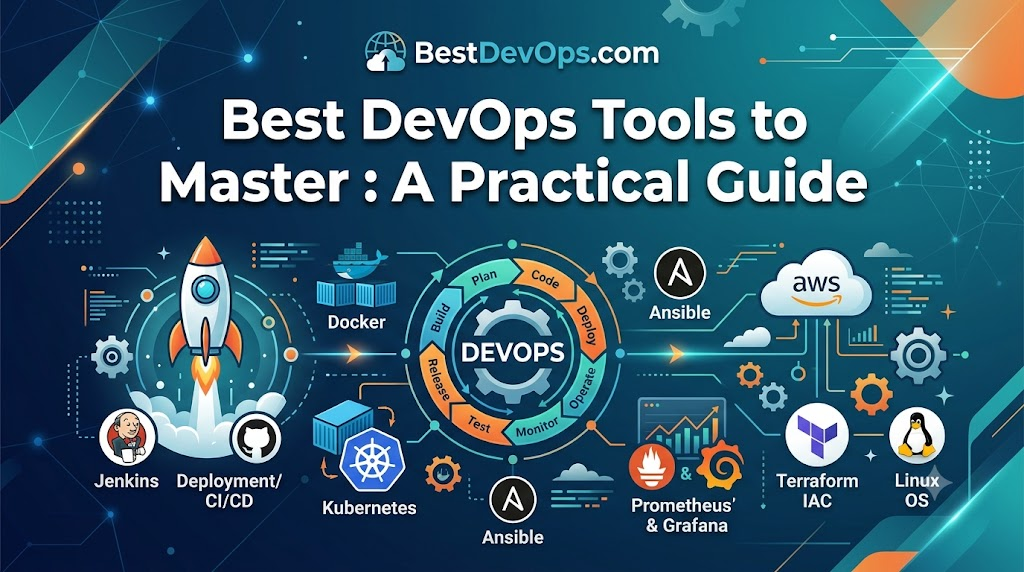
The tech landscape is shifting rapidly. With the rise of Platform Engineering and Site Reliability Engineering (SRE), the demand for automation, speed, and reliability has never been higher. If you want to stay competitive, understanding the best DevOps tools is no longer optional—it is the foundation of modern software delivery.
Navigating this ecosystem can feel overwhelming. Whether you are looking for a comprehensive DevOps tutorial for beginners, trying to map out a clear DevOps roadmap, or looking to upgrade your current DevOps engineer skills, finding the right starting point matters. This guide breaks down the essential tools and practices you need to succeed in today’s cloud-native world.
Why Tool Selection Matters in Modern DevOps
In software development, tools are not just utilities; they define how teams communicate, build, and ship code. Choosing the wrong stack creates friction, siloes, and deployment delays. Conversely, a well-optimized toolchain accelerates your continuous integration and continuous delivery (CI/CD) pipelines, minimizes manual errors, and ensures stable infrastructure.
For organizations trying to optimize performance, tracking execution is critical. Teams rely heavily on specialized DORA metrics tools to measure deployment frequency, lead time for changes, mean time to recovery (MTTR), and change failure rate. Mastering these tools ensures you can deliver measurable business value, which directly influences a DevOps engineer salary.
[Code Commit] ➔ [CI/CD Pipeline (Jenkins/GitHub)] ➔ [Containerization (Docker)] ➔ [Orchestration (Kubernetes)] ➔ [Monitoring]
The DevOps Tool Ecosystem Overview
The modern DevOps landscape is built on automation, cloud computing, and microservices. Instead of monolithic structures, we rely on modular, scalable containerized environments.
To help you navigate the ecosystem, here is a quick breakdown of how these technologies fit together across different layers of the lifecycle:
| Lifecycle Phase | Core Concept | Leading Technologies |
| Source Control | Version Tracking & Collaboration | Git, GitHub, GitLab |
| CI/CD Automation | Continuous Integration & Delivery | Jenkins, GitHub Actions, GitLab CI |
| Containerization | Environment Isolation & Packaging | Docker, Podman |
| Orchestration | Managing Containers at Scale | Kubernetes (EKS, GKS) |
| Infrastructure | Infrastructure as Code (IaC) | Terraform, OpenTofu, Ansible |
| Cloud Providers | Scalable Remote Computing | AWS, Azure, GCP |
| Observability | Monitoring & Alerting Systems | Prometheus, Grafana, Datadog |
Step-by-Step Breakdown of Essential DevOps Categories
1. Version Control and Collaboration
Everything in DevOps starts with code. Version control allows multiple engineers to work on the same codebase without overwriting each other’s changes.
- Git & GitHub: The industry standard for tracking changes and managing code repositories.
- GitLab & Bitbucket: Excellent alternatives that offer built-in pipelines and tight enterprise integration.
2. Continuous Integration & Continuous Delivery (CI/CD)
CI/CD eliminates manual deployment headaches by automatically building, testing, and deploying code changes.
- Jenkins: The traditional, highly customizable king of automation with a massive plugin ecosystem.
- GitHub Actions: A modern, cloud-native approach that allows you to trigger workflows directly from code repositories.
3. Containerization and Orchestration
Containers ensure that an application runs exactly the same way on a local laptop as it does in production.
- Docker: The tool that popularized containers, isolating applications and their dependencies.
- Kubernetes: The industry standard for managing, scaling, and orchestrating thousands of containers across cloud environments.
4. Infrastructure as Code (IaC) and Configuration Management
Instead of clicking buttons in a cloud console, IaC allows you to write scripts to provision servers, networks, and databases automatically.
- Terraform: A declarative tool used to spin up infrastructure across providers like AWS, Azure, and GCP.
- Ansible: An agentless tool perfect for configuring software and managing patches on servers once they are running.
5. Observability and Monitoring
You cannot fix what you cannot see. Observability tools track application health, system logs, and server performance.
- Prometheus & Grafana: A powerful open-source duo for gathering metrics and creating visual, real-time dashboards.
- ELK Stack (Elasticsearch, Logstash, Kibana): The go-to solution for searching, analyzing, and aggregating system logs.
Key DevOps Concepts to Remember
To use these tools effectively, you must understand the core engineering philosophies behind them:
- Immutability: Infrastructure should never be modified after it is deployed. If a change is needed, build a new server from scratch and destroy the old one.
- Shift-Left Security (DevSecOps): Integrating security audits, dependency scanning, and vulnerability checks early in the CI/CD pipeline rather than right before production.
- Declartive vs. Imperative: Declarative tools (like Terraform) let you define what the final state should look like, and the tool figures out how to achieve it. Imperative tools require you to list the exact commands to execute.
Benefits of Tool Standardization
Standardizing your toolchain across development teams yields clear advantages:
- Reduced Onboarding Time: New engineers can commit code on day one if every project uses the same GitHub Action layout and Docker setup.
- Predictable Deployments: Eliminates the classic “it worked on my machine” excuse by enforcing identical runtime environments.
- Cost Efficiency: Using automated IaC allows teams to schedule non-production servers to turn off outside of business hours, saving cloud spend.
Common Challenges and How to Overcome Them
- Tool Fatigue: Trying to learn every tool at once leads to burnout. Focus on mastering one tool per category (e.g., Git, Docker, Terraform) before branching out.
- Configuration Drift: When engineers manually tweak server settings outside of IaC scripts. Prevent this by revoking manual write access to cloud consoles and forcing all changes through automated pipelines.
- Alert Fatigue: Setting up too many low-priority system alerts leads to teams ignoring notifications. Focus alerts strictly on actionable issues that directly impact user experience.
Practical Implementation: A Real-World Scenario
Imagine you are deploying a Python web application. Instead of manually copying files to a server over SSH, an automated, production-ready workflow looks like this:
1. Developer pushes code to a GitHub repository.
2. GitHub Actions triggers a build job to run automated unit tests.
3. If tests pass, a Docker image is built and pushed to Amazon ECR (Elastic Container Registry).
4. Terraform provisions an Amazon EKS (Kubernetes) cluster safely.
5. Kubernetes pulls the new Docker image and performs a rolling update with zero downtime.
6. Prometheus tracks response times and alerts the team if errors spike.
Career Opportunities and Industry Insights
As companies push for digital transformation, the need for skilled infrastructure engineers remains incredibly high. Gaining hands-on experience by building your own DevOps projects—such as deploying a microservices application or setting up an automated monitoring stack—is the fastest way to stand out to employers.
If you are preparing for technical interviews, practicing common DevOps interview questions around container networking, branching strategies, and troubleshooting live production outages will give you a significant competitive edge.
To help map out your trajectory, here is an overview of the current financial landscape across different experience brackets:
[Junior DevOps Engineer] ──(Average: $95k - $120k)──>
[Senior Infrastructure Specialist] ──(Average: $140k - $180k)──>
[Principal Cloud Architect / Director] ──(Average: $190k+)
Salaries vary based on location, remote flexibility, and specialized skill sets like Kubernetes security or cloud cost optimization. Staying updated on current DevOps engineer salary trends can help you negotiate better offers.
How to Start Your Learning Journey
If you want a structured path to mastering these skills, explore these steps:
- Learn the Fundamentals: Start with Linux command-line basics, networking concepts, and Git version control.
- Take a Structured Course: Finding the best DevOps course that offers hands-on labs rather than just video lectures is crucial for building real competence.
- Get Certified: Earning well-regarded best DevOps certifications (such as the AWS Certified DevOps Engineer or Certified Kubernetes Administrator) validates your expertise to hiring managers.
- Leverage Community Resources: For comprehensive learning materials, step-by-step guides, and deep-dive technical insights, checking out platforms like BestDevOps.com can accelerate your growth.
Frequently Asked Questions
What are the absolute best DevOps tools for beginners to learn first?
Beginners should focus on Git (version control), Docker (containerization), and Jenkins or GitHub Actions (CI/CD). Mastering these three foundational layers makes learning advanced tools like Kubernetes much easier.
How can I find a comprehensive DevOps roadmap for my career transition?
A solid roadmap should guide you from Linux fundamentals and scripting (Bash/Python) to cloud networking, container orchestration, and Infrastructure as Code. You can find up-to-date roadmap tracks directly on educational platforms like BestDevOps.com.
What are some high-value DevOps projects I can add to my portfolio?
Build an end-to-end automated pipeline: write a Terraform script to provision cloud resources, configure a GitHub Actions workflow to build a Docker image, deploy it to a Kubernetes cluster, and set up Grafana dashboards to monitor resource usage.
What kind of DevOps engineer salary can I expect as an entry-level professional?
Entry-level salaries typically range from $85,000 to $110,000 per year in the United States, depending on location and demonstration of hands-on skills. Highly skilled senior engineers and architects frequently exceed $170,000.
What are the best DevOps certifications to boost my resume?
The most valued certifications include the Certified Kubernetes Administrator (CKA), AWS Certified DevOps Engineer – Professional, and HashiCorp Certified: Terraform Associate.
Why are DORA metrics tools important for engineering teams?
DORA metrics tools allow teams to track deployment speed and systemic stability objectively. By measuring these key indicators, engineering organizations can identify workflow bottlenecks and improve deployment velocity.
Is coding or software development experience required for DevOps?
Yes, basic programming or scripting knowledge is highly beneficial. You don’t need to be a full-stack developer, but comfort with languages like Python, Go, or Bash helps immensely with automating infrastructure tasks.
Where can I find realistic DevOps interview questions to prepare for tech loops?
Preparing with real-world scenarios—such as debugging failed CI/CD pipelines, explaining container isolation, or designing resilient cloud architectures—is essential. Specialized tech sites like BestDevOps.com offer curated lists of common interview scenarios.
Key Takeaways
- Automation is Key: If you have to do a task manually more than twice, write a script or build a pipeline to handle it.
- Focus on Concepts, Not Just Syntax: Tools evolve, but core principles like immutability, continuous delivery, and infrastructure visibility remain the same.
- Build Things Continuously: The most effective way to learn is by breaking things in a sandbox environment and fixing them yourself.
Conclusion
Mastering the best DevOps tools requires continuous learning and practical application. By focusing on version control, containerization, automation, and infrastructure as code, you build a resilient skill set that is highly valued by modern engineering organizations.
Whether you are seeking a detailed DevOps tutorial for beginners to get started or looking to sharpen your advanced DevOps engineer skills, taking consistent action is what sets successful engineers apart. For deeper dives, industry tutorials, and expert career insights, explore the community resources available at BestDevOps.com to help guide your path forward.

