
Introduction
Modern IT environments have moved beyond the realm of human scale. As cloud-native architectures, Kubernetes clusters, and microservices proliferate, the sheer volume of data generated is overwhelming. Organizations are frequently trapped in a cycle of reactive firefighting, receiving thousands of alerts daily while struggling to pinpoint the root cause of service degradation. This operational fatigue is the primary driver behind the urgent demand for AI-powered operations.
As an SRE leader, I have watched the industry transition from manual threshold-based monitoring to intelligent, predictive observability. This shift requires a new breed of professional—one who understands both the art of systems engineering and the science of machine learning. To navigate this landscape, professionals and enterprises alike are turning to AIOpsSchool for specialized guidance, training, and architectural consulting.
Featured Snippet: What Is AIOps?
AIOps (Artificial Intelligence for IT Operations) is the application of big data, machine learning, and advanced analytics to automate IT operations. It ingests vast amounts of telemetry data—logs, metrics, and traces—to detect anomalies, correlate events, automate root cause analysis, and facilitate proactive incident resolution across complex digital ecosystems.
Understanding AIOps
In Simple Terms
Think of traditional monitoring as a smoke detector: it alerts you when there is fire. AIOps is like an automated sprinkler system that identifies the heat source, analyzes the chemical composition of the smoke, calculates the exact location of the danger, and puts out the fire before it consumes the building.
Real-World Example
A global retail company experiences a latency spike during a flash sale. Instead of SREs manually correlating database logs with network traffic, an AIOps platform automatically ingests disparate logs, identifies that the spike correlates with a specific microservice deployment, and triggers an automated rollback.
Why It Matters
AIOps shifts operations from “firefighting” to “fire prevention.” It reduces the Mean Time to Resolution (MTTR) by filtering out noise, allowing engineers to focus on high-value development rather than repetitive alerts.
Key Takeaways
- AIOps transforms raw data into actionable insights.
- It reduces alert fatigue by grouping related events.
- It enables predictive rather than reactive operational management.
| Traditional Operations | AIOps-Driven Operations |
| Manual, threshold-based alerts | Intelligent, anomaly-based detection |
| Siloed monitoring tools | Unified observability across stacks |
| Reactive incident response | Proactive, automated remediation |
| High noise/alert fatigue | High signal/context-rich events |
Why AIOps Skills Are Becoming Essential
In Simple Terms
As systems grow in complexity, the “cognitive load” on engineers becomes unsustainable. You cannot manually inspect every pod, node, and API call in a massive Kubernetes cluster. Mastering AIOps is the only way to manage that scale.
Real-World Example
An infrastructure team manages 5,000 microservices across multiple clouds. Without AIOps skills, they would need a massive operations center. With AIOps, they build automation workflows that handle 90% of routine incidents, allowing the team to scale the infrastructure without scaling the headcount.
Why It Matters
The future of infrastructure is autonomous. Engineers who understand how to build and maintain these intelligent systems are becoming the most sought-after talent in the job market.
Key Takeaways
- Cloud-native growth necessitates automated oversight.
- AIOps skills are essential for career longevity in DevOps/SRE.
- It bridges the gap between massive system scale and limited human capacity.
AIOps Certification Explained
In Simple Terms
An AIOps certification serves as proof of competency. It validates that you can design, implement, and maintain AI-driven monitoring systems in an enterprise environment. It is the “driver’s license” for the modern intelligent operations engineer.
Real-World Example
A hiring manager for a Fortune 500 company has hundreds of applicants for an SRE role. They prioritize candidates with a recognized AIOps certification because it guarantees that the applicant understands event correlation and modern observability frameworks.
Why It Matters
Certification standardizes the skill set, ensuring that engineers understand the nuances of data pipelines, algorithm selection, and automation strategy, which are rarely taught in standard university degrees.
Key Takeaways
- Validates proficiency in complex AI/ML operations.
- Increases professional credibility and market value.
- Essential for DevOps, SRE, and Cloud engineers.
AIOps Training and Courses
In Simple Terms
AIOps training is the bridge between theory and practice. It involves learning how to use machine learning to make sense of your logs, metrics, and traces, turning them from static data points into living, breathing system intelligence.
Real-World Example
An operations team enrolls in an AIOps course and learns about “Event Correlation.” They return to work, apply the concept to their log aggregator, and successfully reduce their daily 500 alert tickets down to 10 actionable incidents.
Why It Matters
Courses provide the framework for “Intelligent Alerting” and “Root Cause Analysis,” ensuring you don’t just use tools, but understand the architectural principles behind them.
Key Takeaways
- Covers essential topics like OpenTelemetry and Incident Automation.
- Provides hands-on practice with observability stacks.
- Moves engineers from basic tool usage to strategic implementation.
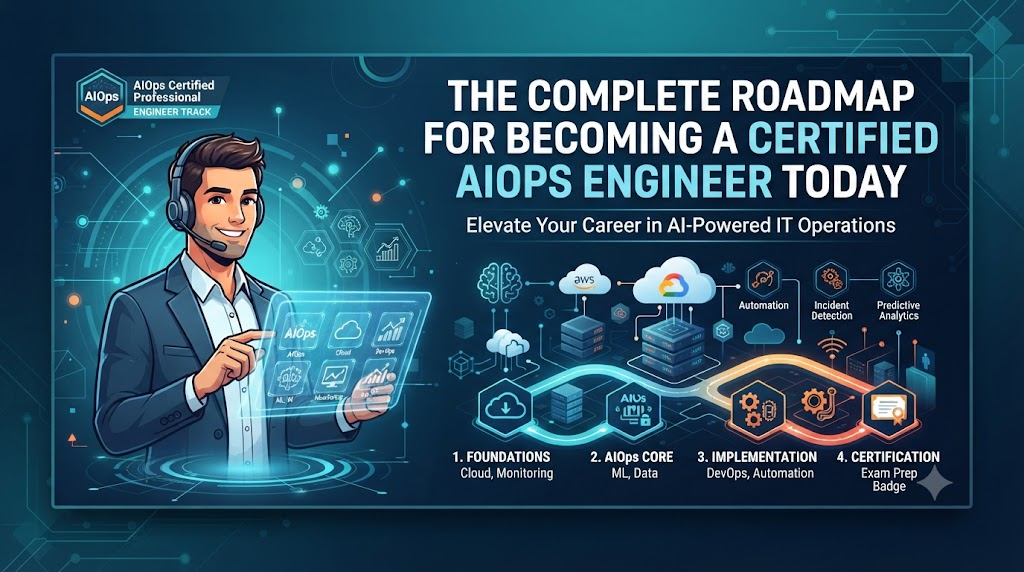
AIOps Engineer Certification Path
In Simple Terms
The path follows a logical progression: start by learning the basics of how systems talk to each other, move to automating the response to that talk, and finish by architecting autonomous systems.
Real-World Example
A Junior Engineer starts by learning to parse logs (Beginner), moves to creating automated correlation rules (Intermediate), and eventually designs an entire self-healing observability architecture for a hybrid cloud environment (Advanced).
Why It Matters
A structured path prevents “tutorial hell.” It provides a clear learning roadmap that builds upon previous knowledge, ensuring mastery at every stage.
Key Takeaways
- Requires a structured progression from monitoring to autonomy.
- Levels reflect professional maturity and responsibility.
- Certification confirms capability at every tier.
| Level | Skills | Outcome |
| Beginner | Basics of Monitoring, Linux, Logs | Understanding Observability Data |
| Intermediate | ML Basics, Alert Correlation, Automation | Designing Automated Workflows |
| Advanced | AIOps Architecture, Predictive Analysis | Architecting Autonomous Systems |
AIOps Engineer Career Roadmap
In Simple Terms
This is the roadmap of “what you need to know to get hired.” You need the foundation (Linux/Networking), the stack (Cloud/K8s/Monitoring), and the “AI” (Automation/Python/Observability).
Real-World Example
A candidate aiming for a Senior SRE role looks at the roadmap. They realize they have the Linux and Cloud skills, but they are weak on Python automation and Observability frameworks. They focus their study, add these skills to their resume, and secure the role.
Why It Matters
A defined roadmap reduces wasted time. It focuses your efforts on the high-impact technologies currently in demand by enterprises.
Key Takeaways
- Strong foundational Linux/Cloud skills are non-negotiable.
- Observability frameworks (OpenTelemetry) are essential.
- Python/Scripting is the glue for automation.
AI Observability Training
In Simple Terms
Observability is knowing why your system is failing, not just that it is failing. AI Observability uses machine learning to analyze the vast streams of telemetry (logs, metrics, traces) to find patterns you wouldn’t see manually.
Real-World Example
During a deployment, a service slows down. Standard monitoring shows “High CPU.” AI Observability shows “High CPU caused by a specific API call pattern originating from a new database index.”
Why It Matters
It reduces MTTR from hours to seconds. It provides the “context” that engineers need to solve problems immediately.
Key Takeaways
- Focuses on understanding internal system states.
- Utilizes logs, metrics, traces, and events.
- Leverages OpenTelemetry as a foundational standard.
| Monitoring | Observability |
| Tells you if the system is up | Tells you why the system is slow |
| Static dashboards | Dynamic exploration |
| Symptom-based | Cause-based |
| Limited by pre-defined metrics | Unlimited by data exploration |
AIOps for SRE and DevOps Engineers
In Simple Terms
For SRE and DevOps teams, AIOps is a force multiplier. It takes the “toil” (manual, repetitive work) out of your day, allowing you to focus on building features rather than resetting servers.
Real-World Example
An SRE team is bombarded with alerts during a deployment. With AIOps, the system suppresses “flap” alerts and automatically creates a Jira ticket with the suspected code commit attached. The SREs solve the issue in 5 minutes instead of 50.
Why It Matters
It supports Continuous Delivery by ensuring that “moving fast” doesn’t “break things” permanently. It enhances reliability by automating the recovery process.
Key Takeaways
- Drastically reduces Alert Fatigue.
- Enables true Continuous Delivery.
- Automates incident response and recovery.
Enterprise AIOps Consulting
In Simple Terms
Consulting is bringing in an expert who has seen these problems at other companies. Instead of guessing which tool to buy or how to structure your team, you get a blueprint that works.
Real-World Example
A mid-sized SaaS firm is drowning in tools. They hire consultants who perform an “Operational Maturity Assessment,” consolidate their tool sprawl, and implement a unified AIOps roadmap. Costs drop by 30% and reliability improves.
Why It Matters
Enterprises often fail at AIOps because they start with tools instead of strategy. Consulting ensures you start with organizational maturity and architecture.
Key Takeaways
- Accelerates adoption and reduces failure risk.
- Ensures technology fits the business strategy.
- Navigates complex organizational change management.
AIOps Implementation Services
In Simple Terms
Implementation is the “doing” phase. It is the process of hooking up your data sources, configuring the machine learning models, and turning on the automation so the system runs itself.
Real-World Example
After the design phase, an implementation team connects the logs from the Cloud platform to the AIOps engine, trains the baseline models on typical traffic patterns, and turns on auto-remediation for memory leaks.
Why It Matters
A well-designed plan is worthless without expert execution. Implementation services ensure the system works as intended in production.
Key Takeaways
- Follows a lifecycle: Assess -> Design -> Select -> Integrate -> Automate.
- Focuses on tangible operational outcomes.
- Requires continuous optimization.
Real-World Enterprise Use Cases
Banking (Fraud Detection)
- Operational Challenge: Detecting fraudulent transactions amidst millions of daily operations.
- AIOps Solution: Implementing predictive analytics that learn user behavior and flag anomalies.
- Business Outcome: Millions saved in potential fraud losses.
Healthcare (System Uptime)
- Operational Challenge: Ensuring 99.999% uptime for patient record systems.
- AIOps Solution: Predictive maintenance on server health to prevent failure.
- Business Outcome: Zero critical downtime during peak medical hours.
E-Commerce (Peak Season Readiness)
- Operational Challenge: Scaling infrastructure to handle Black Friday traffic.
- AIOps Solution: AI-driven capacity planning and automated auto-scaling.
- Business Outcome: No crashes during the most profitable time of the year.
Benefits of AIOps Adoption
In Simple Terms
AIOps is an investment in stability and speed. You get better reliability for your customers and a happier, more productive engineering team.
Real-World Example
A streaming service adopts AIOps and sees “Reduced Downtime” by 40% and “Faster Root Cause Analysis” for video buffering issues. The result is higher subscriber retention.
Why It Matters
In the digital economy, downtime is money. AIOps is a direct contributor to the bottom line.
Key Takeaways
- Directly increases revenue by minimizing downtime.
- Improves developer productivity by reducing toil.
- Provides data-driven confidence for infrastructure changes.
Common Challenges in AIOps Adoption
In Simple Terms
AIOps isn’t a “plug-and-play” solution. It requires clean data, a culture that trusts automation, and a team that understands the tools. The biggest challenges are human and procedural, not just technical.
Real-World Example
A company buys an expensive AIOps platform but dumps “garbage” log data into it. The AI produces “garbage” results. They realize they must fix their data quality first.
Why It Matters
Acknowledging challenges upfront saves millions in failed software investments.
Key Takeaways
- Data quality is the foundation of AI success.
- Organizational resistance to automation is common.
- Strategy must precede tooling.
Common Mistakes Professionals Make
In Simple Terms
Many teams try to solve a human problem with a software tool. They buy the “magic box” and expect it to work without understanding the fundamentals of observability or data hygiene.
Real-World Example
An engineer buys an AIOps tool but skips the “Observability Fundamentals” training. They don’t know how to instrument their code, so the AIOps tool has no data to analyze.
Checklist for Success:
- Do I have clean, centralized log and metric data?
- Have I defined what “normal” looks like for my service?
- Is the team trained on the specific AIOps platform?
- Is there an automation strategy in place before turning on self-healing?
- Are we committed to continuous learning?
Future of AIOps
In Simple Terms
We are moving toward “Self-Healing Infrastructure.” Imagine a network that detects a bad route, reroutes traffic, patches the error, and alerts you after the issue is resolved. That is the trajectory of AIOps.
Real-World Example
Autonomous operations systems will soon automatically manage capacity, security patching, and traffic balancing, leaving engineers to focus entirely on high-level architecture and feature development.
Why It Matters
As systems become too large for humans to control directly, autonomy becomes a safety and efficiency requirement.
Key Takeaways
- Shift toward full autonomy and self-healing.
- AI-powered observability will become the default.
- Predictive reliability will preempt incidents.
19. Why Learn with AIOpsSchool
In Simple Terms
AIOpsSchool isn’t just about selling courses. It’s about building a community of experts. We provide the curriculum, the hands-on labs, and the consulting expertise to guide you from where you are to where the industry is going.
Real-World Example
Students enter our programs as system administrators and leave as AIOps Architects, armed with the certification and practical implementation experience to lead their own teams’ digital transformations.
Why It Matters
Experience is the best teacher. Our programs are designed by practitioners, for practitioners, ensuring you learn real-world skills that apply to production environments immediately.
Key Takeaways
- Industry-focused, practical curriculum.
- Hands-on lab environments.
- Expert consulting background.
FAQ Section
1. What is AIOps Certification?
AIOps Certification validates your knowledge of applying machine learning and data analytics to IT operations, proving you can manage and optimize complex, modern IT environments.
2. Who should learn AIOps?
DevOps Engineers, SREs, Cloud Engineers, Platform Engineers, and IT Managers responsible for maintaining system reliability and uptime.
3. What skills are required for AIOps Engineers?
You need foundational knowledge in Linux, cloud platforms, networking, Python scripting, observability, and a solid understanding of data analysis and machine learning concepts.
4. How does AIOps help DevOps teams?
It helps by reducing alert noise, automating root cause analysis, and accelerating incident response, which allows DevOps teams to focus on delivering features rather than manual troubleshooting.
5. What is AI Observability?
AI Observability is the practice of using AI to analyze high-cardinality data—logs, metrics, and traces—to provide deep, context-rich insights into why distributed systems behave the way they do.
6. What is OpenTelemetry?
OpenTelemetry is an open-source framework and set of tools that standardizes how you collect, generate, and export telemetry data (logs, metrics, traces), which is essential for consistent AIOps data inputs.
7. How long does it take to learn AIOps?
The timeframe varies, but with focused training and hands-on practice, students typically develop functional competency in a few months, with advanced mastery achieved through continuous application.
8. What are AIOps Implementation Services?
These are expert-led services that guide organizations through the assessment, design, tool selection, integration, and automation phases of adopting AIOps within their enterprise.
9. Is AIOps a good career choice?
Yes. As systems become more complex, the demand for professionals who can bridge the gap between AI and IT operations is skyrocketing, offering high job security and growth potential.
10. What is the future of AIOps?
The future lies in autonomous, self-healing infrastructure where AI systems continuously monitor, optimize, and repair the environment with minimal human intervention.
Final Summary
The evolution of IT operations is no longer optional; it is a necessity. As we have explored, AIOps, combined with solid observability and automation, is the primary mechanism for scaling modern digital infrastructure.
By investing in professional training and certification, you are not just learning a new tool—you are mastering a mindset of proactive reliability and engineering excellence. Whether you are an individual engineer looking to advance your career or an enterprise leader seeking to improve system performance, the path forward is clear: prioritize skills, embrace intelligent observability, and leverage expert guidance.
Explore the resources, certification paths, and consulting services available at AIOpsSchool to begin your journey toward mastering the future of AI-powered operations today.

