
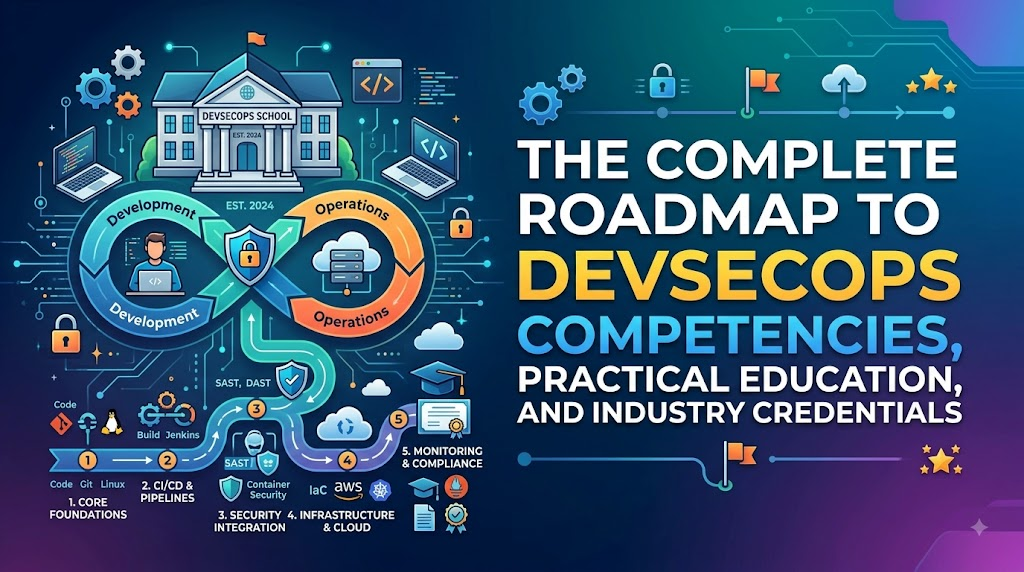
Modern enterprise engineering runs on high-speed delivery. Microservices, container platforms, and continuous deployment engines allow organizations to push updates into production environments around the clock. Yet, this remarkable speed frequently introduces a severe operational challenge: security practices designed for static, multi-month release cycles cannot keep pace with dynamic code deployment. When security checks remain confined to the final stages of a release, delivery pipelines stall, unexpected vulnerabilities slip into production, and development squads face frustrating rework.
The industry’s answer to this challenge is DevSecOps—a collaborative discipline that embeds automated defensive controls, policy governance, and proactive risk assessment directly into the software development lifecycle. For technology professionals aiming to thrive in cloud-native ecosystems, mastering this domain requires blending systems engineering, cloud architecture, and security automation into a cohesive skill set.
This in-depth guide explores the foundations of continuous security, the core competencies required for the field, practical learning roadmaps, certification pathways, and proven strategies for building a rewarding engineering career.
What Is DevSecOps?
At its core, DevSecOps expands the cultural and technical principles of DevOps by making system defense an active, shared responsibility across every phase of software creation. Instead of treating security as a perimeter gate managed exclusively by an external team, it establishes continuous automated verification alongside standard build and deployment routines.
In legacy environments, development, operations, and security functioned as isolated departments. Developers prioritized shipping features, operations focused on uptime and infrastructure stability, and security specialists performed manual assessments right before scheduled go-live dates. Discovering severe flaws at this late stage forced painful compromises between project deadlines and system security.
DevSecOps replaces this friction with Shift-Left Security. By moving vulnerability checks, compliance validations, and configuration reviews into the earliest development phases, engineers receive immediate feedback on their code and infrastructure definitions. This proactive posture allows teams to remediate design flaws and syntax vulnerabilities when changes are easiest, safest, and least expensive to make.
Why DevSecOps Matters in Modern Software Development
The rapid growth of open-source frameworks, public cloud providers, and container environments has created powerful deployment capabilities alongside an expanded attack surface.
- Securing Third-Party Dependencies: Modern applications rely heavily on external open-source packages. Without continuous dependency tracking, vulnerable upstream libraries can quietly compromise internal workloads.
- Hardening Infrastructure Configurations: When provisioning cloud infrastructure via automation, minor template errors can accidentally expose private datastores or open administrative ports to the public internet.
- Maintaining Continuous Verification: Release pipelines that trigger multiple times per day require automated, repeatable validation that scales effortlessly without slowing down development teams.
- Simplifying Regulatory Audits: Regulated industries require continuous proof of compliance, access oversight, and vulnerability tracking across all active environments.
Automating these protective checks within everyday development workflows enables enterprises to maintain high deployment frequency without sacrificing system integrity.
Essential DevSecOps Skills
Succeeding in this technical discipline requires practical competence across several interconnected domains:
Linux and Networking Fundamentals
A solid grasp of operating system fundamentals—including process isolation, user permissions, storage management, and shell scripting—forms the basis of system defense. Engineers must also understand networking essentials such as transport layer security, domain resolution, firewall configurations, and traffic routing to safeguard communications across distributed architectures.
Git and CI/CD
Source repositories act as the single source of truth for modern applications. Practitioners must master branch protection rules, automated pull-request validation, and secure pipeline orchestration. Securing continuous delivery infrastructure also involves managing runner permissions, rotating deployment credentials, and preventing pipeline configuration tampering.
Cloud Security
Navigating major public cloud platforms demands expertise in Identity and Access Management (IAM), role-based delegation, virtual network isolation, encryption key management, and centralized logging. Applying the principle of least privilege across both human operators and machine accounts is essential for cloud defense.
Containers and Kubernetes
Containerized workloads introduce distinct security requirements. Engineers must learn to create minimal container images, run workloads without root privileges, scan parent image layers for vulnerabilities, configure cluster role bindings, and enforce network policies between microservices.
Security Testing
Embedding automated analysis tools into deployment pipelines provides developers with instant feedback:
- Static Application Security Testing (SAST): Inspects raw source code for insecure programming patterns, unvalidated inputs, and injection flaws.
- Software Composition Analysis (SCA): Catalogs open-source libraries to detect known vulnerabilities and monitor open-source license compliance.
- Secrets Detection: Scans commit histories and configuration files to prevent API tokens, cryptographic keys, and database passwords from being published.
- Dynamic Application Security Testing (DAST): Analyzes running staging applications by simulating real-world interaction patterns to uncover runtime vulnerabilities.
Infrastructure as Code Security
As cloud environments are defined in declarative code formats, engineers must implement automated linters to inspect infrastructure templates before provisioning. This prevents misconfigured storage permissions, unencrypted volumes, and overly permissive firewall rules from ever reaching production.
How to Build a DevSecOps Learning Path
Developing well-rounded DevSecOps expertise is an iterative journey. Following a structured progression helps learners build confidence and practical ability:
- Master the Technical Basics: Strengthen your command of Linux command-line utilities, core networking concepts, and foundational scripting in languages such as Python, Bash, or Go.
- Understand Automated Delivery: Learn how continuous integration servers compile code, run test suites, generate build artifacts, and deploy services automatically.
- Adopt Container Technologies: Practice packaging applications into lightweight Docker containers, configuring multi-stage builds, and minimizing container attack surfaces.
- Implement Shift-Left Scanners: Add automated vulnerability scanners, dependency checkers, and secret detectors into personal CI/CD pipelines to understand automated feedback loops.
- Deepen Cloud and Orchestration Skills: Advance into container orchestration platforms, learn cluster hardening techniques, and configure cloud-native identity policies.
- Focus on Runtime Telemetry: Study security logging, operational metrics, and event detection tools to observe how live environments monitor and report suspicious behavior.
What to Look for in DevSecOps Training
Selecting the right educational path is essential for accelerating technical growth. When evaluating a comprehensive DevSecOps Course, prioritize programs that emphasize practical troubleshooting and live scenario execution over theoretical presentations.
Essential elements of a high-value program include:
- Dedicated Lab Environments: The curriculum should reinforce every theoretical concept with hands-on practice in functional cloud and pipeline setups.
- End-to-End Workflow Construction: Training should guide students through securing a complete software delivery pipeline from initial commit to production deployment.
- Realistic Policy Tuning: Instruction should cover how to set practical scan thresholds to eliminate false positives and keep development velocity high.
- Modern Cloud-Native Depth: The syllabus must thoroughly address container lifecycle defense, cluster access controls, and cloud identity architecture.
- Experienced Practitioner Guidance: Look for courses taught by seasoned professionals who bring real-world enterprise engineering experience to the classroom.
Well-structured educational programs, such as those offered by DevSecOps School, provide guided learning modules and practical sandboxes designed to develop these essential industry competencies.
Online DevSecOps Training vs Corporate DevSecOps Training
Depending on whether you are an individual learner or an engineering manager training a team, different delivery formats offer distinct advantages.
DevSecOps Online Training
DevSecOps Online Training provides a flexible, self-directed path for technical professionals seeking to expand their capabilities. Learners can work through hands-on virtual labs, access recorded resources on demand, and experiment with diverse toolsets from anywhere in the world. This format is well-suited for developers, QA professionals, and systems administrators aiming to transition into dedicated security engineering roles.
Corporate DevSecOps Training
Corporate DevSecOps Training is designed for organizations looking to align development, operations, and security departments around a unified operating standard. Instead of training team members in isolation, corporate programs break down functional silos, establish common terminology, and teach engineers how to secure their specific internal pipelines, cloud environments, and deployment workflows.
Understanding DevSecOps Certification
Earning a formal DevSecOps Certification demonstrates that an engineer understands how to embed automated security controls throughout modern software delivery lifecycles. These credentials validate core competencies in pipeline automation, vulnerability assessment, cloud governance, and container security.
It is helpful to keep certifications in perspective:
- The Value of Certification: A recognized credential validates your technical knowledge, provides a structured curriculum for study, and highlights your professional dedication to prospective employers.
- The Need for Hands-On Practice: A certificate alone cannot substitute for live debugging experience, practical architectural design, or day-to-day problem-solving skills.
Pursuing credentials such as a DevSecOps Engineer Certification or qualifying as a Certified DevSecOps Professional offers meaningful professional recognition when supported by practical project experience.
How to Prepare for a DevSecOps Certification
Succeeding in a rigorous DevSecOps Certification Training program requires disciplined theoretical study combined with extensive sandbox practice:
- Analyze the Official Blueprint: Review each exam objective thoroughly and build a dedicated lab exercise around every listed domain.
- Create a Practice Pipeline: Set up a test repository in a version control platform, build a multi-stage CI/CD pipeline, and integrate automated static analysis, dependency scanning, and secret detection tools.
- Practice Interpreting Security Reports: Learn to evaluate scan results, filter out false alarms, and implement code or configuration fixes to resolve identified issues.
- Configure Automated Pipeline Gates: Experiment with setting pipeline rules that halt builds on critical vulnerabilities while allowing minor warnings to pass without disruption.
- Solve Scenario-Based Challenges: Work through timed practical exercises to build speed and confidence in diagnosing misconfigurations, updating pipeline definitions, and securing infrastructure templates.
Career Path for a DevSecOps Engineer
As organizations across financial technology, healthcare, e-commerce, and enterprise software migrate critical workloads to cloud environments, the demand for cross-functional security engineers continues to rise.
Common entry paths into the field include:
- Software Developers who develop expertise in defensive coding, threat modeling, and automated pipeline security checks.
- DevOps and Site Reliability Engineers (SREs) who expand their capabilities into access management, policy automation, and container security.
- Security Analysts who learn scripting, CI/CD automation, and cloud platforms to shift from periodic auditing to proactive platform engineering.
Typical daily responsibilities include building automated security checks for delivery pipelines, writing policy-as-code templates, reviewing vulnerability findings with development teams, hardening Kubernetes clusters, and improving runtime monitoring capabilities.
Importance of Kubernetes Security Training
Because Kubernetes is the primary orchestration engine for modern cloud-native architectures, targeted Kubernetes Security Training has become a vital component of advanced technical education.
Orchestrating microservices at scale introduces several critical layers that require systematic hardening:
- Control Plane Hardening: Securing communication with the API server, encrypting configuration datastores at rest, and auditing administrative actions.
- Workload and Pod Security: Applying Pod Security Standards to restrict privileged containers, enforce read-only filesystems, and drop unnecessary Linux capabilities.
- Granular Role-Based Access Control (RBAC): Setting precise access boundaries for both administrative users and automated service accounts following the principle of least privilege.
- Network Segmentation: Implementing Kubernetes Network Policies to control pod-to-pod communication and limit potential lateral movement within clusters.
- Admission Controllers: Using admission controllers to automatically reject workloads that do not meet organizational security baselines.
Why Hands-On DevSecOps Projects Matter
Building real-world projects in an isolated test environment is one of the most effective ways to solidify theoretical knowledge:
- Project 1: Automated Secure Build PipelineConstruct a continuous delivery workflow that checks out application source code, runs automated static analysis, scans open-source dependencies for known flaws, detects hardcoded secrets, and generates a consolidated summary report.
- Project 2: Infrastructure as Code Security BaselineAuthor declarative infrastructure templates for a virtual private cloud and compute instance. Integrate automated pre-deployment scanning into your version control system to detect open firewall rules or unencrypted storage volumes before provisioning.
- Project 3: Hardened Container Image WorkflowWrite a multi-stage Dockerfile that builds an application binary, copies it to a minimal base image, runs under a non-root user, and scans the final container image for vulnerabilities before pushing it to a registry.
- Project 4: Automated Kubernetes Security GovernanceDeploy a local test cluster and configure policy enforcement rules to automatically block containers attempting to run with elevated root privileges or missing defined resource limits.
Common Challenges When Learning DevSecOps
Mastering pipeline defense involves navigating several practical challenges:
- Tooling Overload: The cloud-native security landscape contains hundreds of commercial and open-source tools. Focus on understanding underlying functional categories—such as SAST, SCA, IaC linting, and access control—rather than trying to learn every tool at once.
- High Alert Volume: Uncalibrated scanners can generate overwhelming numbers of low-severity findings. Practice adjusting rule sets, prioritizing critical vulnerabilities, and setting realistic severity thresholds.
- Bridging the Cultural Divide: Developers, system operators, and security specialists often use different terminology. Focus on learning how technical risks impact operational reliability, and deliver clear, actionable remediation guidance.
- Complex Local Setup: Running complex cloud-native platforms on personal computers can consume substantial system resources. Use lightweight local tools such as Kind or Minikube alongside low-cost cloud sandboxes for efficient experimentation.
Best Practices for Learning DevSecOps
To develop sustainable and effective technical capabilities:
- Anchor Yourself in Fundamentals: Specific tools change over time, but foundational concepts like access control, network routing, process isolation, and cryptography remain constant.
- Integrate Security Incrementally: Start by adding one automated check—such as secret detection—into a pipeline. Once that workflow runs smoothly, introduce dependency scanning, static code analysis, and container inspection.
- Practice Defensive Thinking: When designing or reviewing architecture, actively question assumptions regarding user inputs, network boundaries, and third-party integrations.
- Emphasize Remediation, Not Just Detection: Discovering a security flaw is only the first step. Take time to understand why it occurred and refactor code or infrastructure definitions to prevent similar issues.
- Engage with Technical Communities: Follow open-source cloud-native projects, read security research bulletins, and engage with professional forums to keep up with evolving defensive strategies.
Comparison Table
The following comparison outlines the primary characteristics of different learning and upskilling approaches:
| Learning Approach | Best For | Main Advantage | Key Consideration |
| Online Training | Remote learners, working professionals | Flexible access, self-paced review | Requires consistent personal study habits |
| Corporate Training | Enterprise engineering squads, platform teams | Organization-focused, unified standards | Requires departmental alignment and scheduling |
| Self-Directed Study | Highly independent engineers | Complete freedom over curriculum and pacing | Requires strong discipline and independent troubleshooting |
| Instructor-Led Bootcamps | Structured learners seeking direct mentorship | Real-time feedback, guided lab walkthroughs | Requires adherence to fixed schedule sessions |
Future Trends in DevSecOps
As infrastructure and software architectures evolve, DevSecOps continues to mature:
- Software Bill of Materials (SBOM): Organizations increasingly generate and track machine-readable inventories of every software component, library, and dependency included in production applications to quickly respond to zero-day vulnerabilities.
- AI-Assisted Security and Remediation: Machine learning models are being integrated into developer workflows to automatically suggest contextual security fixes, draft IaC policies, and reduce false-positive rates in code reviews.
- Platform Engineering with Built-In Guardrails: Internal Developer Platforms (IDPs) are incorporating security templates directly into standard deployment workflows, providing developers with pre-approved, compliant infrastructure by default.
- Continuous Cloud Compliance and Runtime Observability: Shift-left security is increasingly paired with real-time runtime detection, ensuring security visibility spans from code commit to running cluster processes.
Frequently Asked Questions
What educational background is helpful before learning DevSecOps?
A foundational background in basic Linux command-line operations, general networking principles, Git version control, and basic scripting logic in Python, Bash, or Go provides an ideal starting point.
How does shift-left security change everyday development?
Shift-left security moves automated testing and configuration checks into the early coding and integration stages. Instead of waiting for pre-release audits, developers receive immediate feedback in their normal workflows, allowing them to fix issues quickly.
What is the difference between static and dynamic application security testing?
Static Application Security Testing (SAST) inspects uncompiled source code to identify structural and syntax-level flaws without running the application. Dynamic Application Security Testing (DAST) evaluates a running application from the outside by sending simulated requests to uncover runtime vulnerabilities.
Can experienced developers transition easily into DevSecOps?
Yes. Software developers already understand source code, version control, and application architecture. By learning cloud platform management, CI/CD pipeline automation, container security, and threat modeling, developers can effectively transition into security engineering roles.
How do admission controllers enhance Kubernetes security?
Admission controllers act as gatekeepers within the Kubernetes API server. They evaluate deployment requests against predefined organizational policies and automatically reject configurations that attempt to run insecure or non-compliant workloads.
Where can engineers find comprehensive DevSecOps training in India?
Engineers seeking structured DevSecOps Training in India or through remote channels can explore curriculum pathways offered by DevSecOps School, which provides hands-on sandbox environments, practical pipeline projects, and instructor-guided courses covering modern cloud and container defense.
Conclusion
DevSecOps is not an isolated tool or a momentary trend; it is a fundamental shift in how resilient, modern software is engineered, deployed, and protected. As organizations accelerate release cadences and expand cloud-native infrastructure, the ability to build automated, secure software delivery pipelines has become an indispensable engineering skill.
Whether you are an individual engineer looking to expand your technical capabilities or an enterprise team modernizing your security operations, developing structured skills across version control, CI/CD security, cloud IAM, and container orchestration is essential. By focusing on practical labs, mastering core defensive principles, and pursuing structured learning paths, you can successfully navigate and excel in the evolving landscape of cloud and application security.

