
Introduction
Austria is rapidly becoming one of the most attractive destinations for skilled international talent. With a booming economy, a focus on innovation, and a growing demand for specialized labor in sectors like technology, medicine, and engineering, the country has opened its doors wide.
But with opportunity comes structure. Austria utilizes a points-based immigration system to ensure that those who move to the country are well-equipped to contribute to its economy and integrate into its society. Whether you are an IT specialist looking to implement your skills in a European hub or a nurse seeking a fulfilling career in a world-class healthcare system, the process begins with understanding your standing.
An Austria PR Points Calculator is not just a tool; it is your immigration roadmap. It allows you to see where you stand, identify your strengths, and highlight areas where you may need improvement before you submit an official application. Checking your eligibility early is the secret weapon of successful applicants. This guide is designed to take you from a curious professional to an informed candidate, ready to make your Austrian dream a reality.
What Is an Austria PR Points Calculator?
At its core, the Austria PR Points Calculator is an evaluation tool that mirrors the criteria used by the Austrian Public Employment Service (AMS) to assess foreign applicants.
Austria uses a merit-based system. Instead of relying on a lottery or a simple “first-come, first-served” basis, the government assigns points for specific attributes: age, education, language proficiency, and professional experience.
Purpose and Functionality
The primary purpose of the calculator is to provide an objective estimate of your potential score. By inputting your qualifications—such as your degree level, years of professional practice, and language certifications—the calculator computes a score. If this score meets or exceeds the threshold for the visa category you are targeting, you are one step closer to eligibility.
Why the Points System Matters
Austria uses this system to maintain a high-quality labor market. By filtering for candidates who are already “job-ready”—meaning they have the skills, language ability, and experience to hit the ground running—Austria ensures that new arrivals integrate seamlessly.
For the applicant, the calculator serves three main functions:
- Self-Assessment: It removes the guesswork. You don’t have to wonder if you qualify; you get a numerical answer.
- Strategy Building: If your score is low, the calculator shows you exactly where you can improve (e.g., “If I get an A2 German certificate, I gain 10 points”).
- Stream Selection: It helps you decide which visa category fits your specific profile best.
How Austria Immigration Points System Works
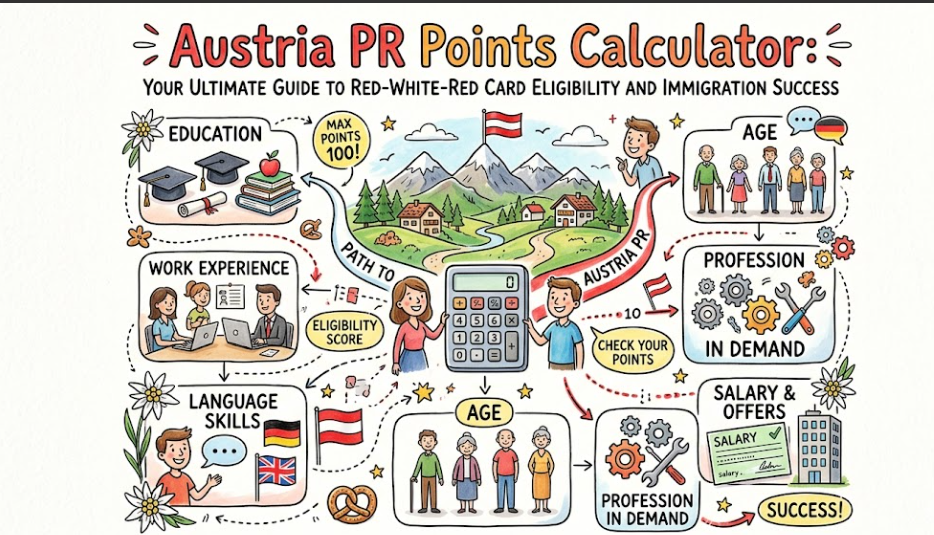
The system is nuanced, but it follows a logical progression. Points are rarely awarded for just one thing; they are an accumulation of your life’s professional and academic achievements.
Age Points
Austria values a demographic balance in its workforce. Generally, younger professionals receive more points, as they are viewed as having a longer career trajectory ahead of them. However, mid-career professionals often compensate for lower age points with higher “work experience” scores.
Education Points
Your academic background is a pillar of your application. The system recognizes:
- Vocational Training: Essential for many technical and craft-based roles.
- Bachelor’s Degrees: The baseline for many professional roles.
- Master’s and PhDs: Highly prized, especially if they are in fields where Austria has a shortage of experts.
Language Skills
This is often the “make or break” factor. While English is common in multinational companies, German is the heartbeat of Austrian society. Achieving even basic levels (A1 or A2) can significantly boost your total score, making you a much stronger candidate.
Work Experience
The system differentiates between general experience and local Austrian experience. While you cannot “fake” experience, you can maximize your points by clearly documenting your career achievements, especially those that align with “shortage occupations.”
Salary & Job Offer
If you already have a job offer, your potential salary becomes a key point-earner. High-salary offers demonstrate that an Austrian company values your expertise, which is a major signal to the immigration authorities.
Austria Red-White-Red Card Explained
The Red-White-Red (RWR) Card is the flagship visa for skilled workers. It is not just a work permit; it is a residency permit that ties your work authorization to a specific employer, at least initially.
Categories of the RWR Card:
- Very Highly Qualified Workers: For those with exceptional academic or professional achievements. These applicants can sometimes apply for a Job Seeker Visa to look for work in Austria without a pre-existing job offer.
- Skilled Workers in Shortage Occupations: For professionals in fields where Austria faces a labor deficit (IT, Engineering, Nursing, etc.). This is currently the most popular route.
- Other Key Workers: For experienced professionals with specific, high-demand skills that don’t necessarily fall into the “shortage” list but are vital to the employer.
- Graduates from Austrian Universities: If you completed your studies in Austria, you have a simplified pathway to transitioning into the workforce.
- Self-Employed Key Workers: For entrepreneurs who can bring innovation or capital to the Austrian market.
Eligibility vs. Approval
Always remember: the points you calculate are a requirement for the application, not an automatic approval. The AMS (Public Employment Service) performs a labor market test for many categories to ensure that no equally qualified Austrian or EU citizen is available for the role.
Austria PR Points Calculator Breakdown
To help you visualize the scoring, here is a breakdown of how the points are generally weighted. Note that these are benchmarks and should be verified against the official government criteria.
| Factor | Max Points Range | Significance |
| Education | 20–30 | Foundation of your application. |
| Work Experience | 10–20 | Demonstrates your professional utility. |
| Language Skills | 10–25 | Vital for social and professional integration. |
| Age | 10–20 | Reflects career longevity. |
| Bonus | 5–30 | Can include job offers, English proficiency, etc. |
Detailed Note: The points vary by visa stream. For example, a “Very Highly Qualified” worker might prioritize academic prestige, while a “Shortage Occupation” worker prioritizes the scarcity of their specific trade.
Step-by-Step Example of Austria PR Score Calculation
Let’s look at three realistic profiles to see how the points system translates to real life.
Example 1: The IT Software Engineer
- Profile: 29 years old, Master’s in Computer Science, 4 years of experience, German A1 level.
- Points Calculation:
- Age: 15 points (under 30).
- Education: 30 points (Master’s level).
- Language: 5 points (German A1).
- Experience: 8 points (calculated by years).
- Outcome: This candidate is a strong fit for the “Skilled Workers in Shortage Occupations” stream and will likely meet the minimum threshold comfortably.
Example 2: The Healthcare Worker (Nurse)
- Profile: 35 years old, Vocational Nursing Degree, 7 years of experience, German A2 level.
- Points Calculation:
- Age: 10 points.
- Education: 20 points (Vocational).
- Language: 10 points (German A2).
- Experience: 14 points.
- Outcome: Strong eligibility, especially given the high demand for nursing professionals.
Example 3: The Student Transitioning to Work
- Profile: 24 years old, recent graduate from an Austrian University, English native speaker.
- Outcome: Graduates from Austrian universities often have a distinct, streamlined pathway that bypasses some of the “points” stress, as their integration is already proven.
Austria PR Eligibility Requirements
Beyond points, you must meet mandatory legal conditions. Even if you have a perfect score, your application will fail if you miss these essentials:
- Valid Job Offer: A binding offer from an Austrian employer that meets local salary thresholds.
- Health Insurance: Proof of adequate coverage.
- Financial Proof: Evidence that you can sustain yourself.
- Verification of Degrees: Your diplomas must be recognized and, in many cases, translated and apostilled.
Think of the points as the “key” to the door, but the legal requirements are the “door itself.” You need both to enter.
Benefits of Using an Austria PR Points Calculator
Why should you spend time with the Austria PR Points Calculator?
- Clarity: It removes the mystery.
- Efficiency: You won’t waste time and money applying for a visa where you have zero chance of selection.
- Goal Setting: If you are 5 points short, you know exactly what to do—take a German class, or gain one more year of experience.
- Risk Mitigation: It helps you avoid rejection by allowing you to self-audit before the authorities do.
Step-by-Step Guide to Calculate Austria PR Points
- Gather Documents: Collect all transcripts, CVs, and certificates.
- Select Your Pathway: Are you a “Very Highly Qualified” candidate or a “Shortage Occupation” expert? Choose the right category.
- Input Data: Use the online calculator carefully. Be honest with your self-assessment.
- Identify Gaps: Look at your final score. Are you at the minimum threshold? If yes, prepare. If no, create a plan to bridge the gap.
- Verify Official Lists: Always cross-reference your occupation with the official Austrian shortage list, which is updated regularly.
How to Increase Austria PR Score
If you are falling short, don’t panic. Here is how you can boost your standing:
- Language Acquisition: This is the easiest way to gain points. An A2 or B1 German certificate can catapult your score.
- Certifications: Sometimes, a short-term professional certification in your field can add “points value” to your academic profile.
- Strategic Job Hunting: Focus your search on employers who are willing to sponsor the RWR card and who value the specific niche skills you possess.
Common Mistakes to Avoid
- Ignoring Language Requirements: Many professionals assume they can survive on English alone. While possible in big firms, immigration points reward German proficiency.
- Using Outdated Information: Immigration policies change. Always ensure you are looking at the current year’s regulations.
- Overestimating Qualifications: Always verify if your degree is officially recognized in Austria (the “nostrification” process).
- Miscalculating Work Experience: Only count relevant, full-time professional experience.
Real-Life Case Studies
1. The IT Professional’s Pivot
- Situation: An IT professional had enough points for an RWR card but kept getting rejected because they didn’t have a job offer.
- Improvement: They switched their focus to applying to companies that specifically hire international talent, eventually securing an offer that pushed their score over the limit.
- Outcome: Successfully moved to Vienna.
2. The Language Boost
- Situation: A candidate was 5 points short of the requirement.
- Improvement: Instead of waiting, they dedicated three months to an intensive German course and passed the A2 exam.
- Outcome: Crossed the threshold and received their visa.
FAQs
1. What is the Austria PR points calculator?
It is a tool used to estimate your eligibility for the Red-White-Red Card based on official Austrian immigration criteria.
2. How many points are needed for Austria PR?
The minimum requirement varies by visa stream (e.g., 55 points for skilled workers, 70 for highly qualified).
3. What is the Red-White-Red Card?
It is a points-based, employer-specific residence and work permit for skilled non-EU workers.
4. Is German language mandatory?
It is not mandatory for all streams, but it is highly beneficial and grants significant points in the calculation.
5. Can I move to Austria without a job offer?
Only under specific categories like the Job Seeker Visa for “Very Highly Qualified” workers.
6. Does age affect eligibility?
Yes, points are awarded based on age, with younger professionals often receiving higher scores.
7. Can students settle permanently in Austria?
Yes, graduates from Austrian universities have a streamlined path to residency.
8. How accurate are online calculators?
They are highly accurate estimates, but official points are always determined by the AMS.
9. What is a “Shortage Occupation”?
It is a job category listed by the Austrian government that has a high demand for labor and cannot be easily filled by locals.
10. How long does the process take?
Processing times vary; always apply as early as possible.
11. Can I change employers?
Initial RWR cards are employer-specific, but you can change employers after the initial period by applying for a change of purpose or a new card.
12. Why check eligibility early?
Checking early allows you to improve your language skills or gain necessary certifications to qualify.
Conclusion
Immigration is a journey of preparation. By using the Austria PR Points Calculator as your foundation, you are already ahead of the majority of applicants who simply hope for the best. Remember, the points system is not a hurdle; it is a ladder. Every point you earn through language learning, professional development, and strategic career moves brings you one step closer to living and working in one of the world’s most beautiful and stable countries. Start your preparation today, be methodical, and treat your application with the professional focus it deserves.

