
Are you dreaming of building a new life in the Great White North? Canada consistently ranks as one of the world’s most desirable destinations for immigrants, and it’s easy to see why. From a stable economy and high quality of life to world-class healthcare, free education for children, and a safe, multicultural environment, Canada offers unparalleled opportunities for personal and professional growth.
For many, the first step toward this goal is understanding the Canada PR CRS Calculator. Whether you are an IT professional looking for a new challenge, a healthcare worker seeking better prospects, or a student planning your future, knowing where you stand in the immigration process is essential. This guide is designed to help you navigate the complex Express Entry points system with ease, clarity, and confidence.
What Is a Canada PR CRS Calculator?
The Canada PR CRS Calculator is a tool used to estimate your score under the Comprehensive Ranking System (CRS). It is the heartbeat of Canada’s immigration process.
Definition and Purpose
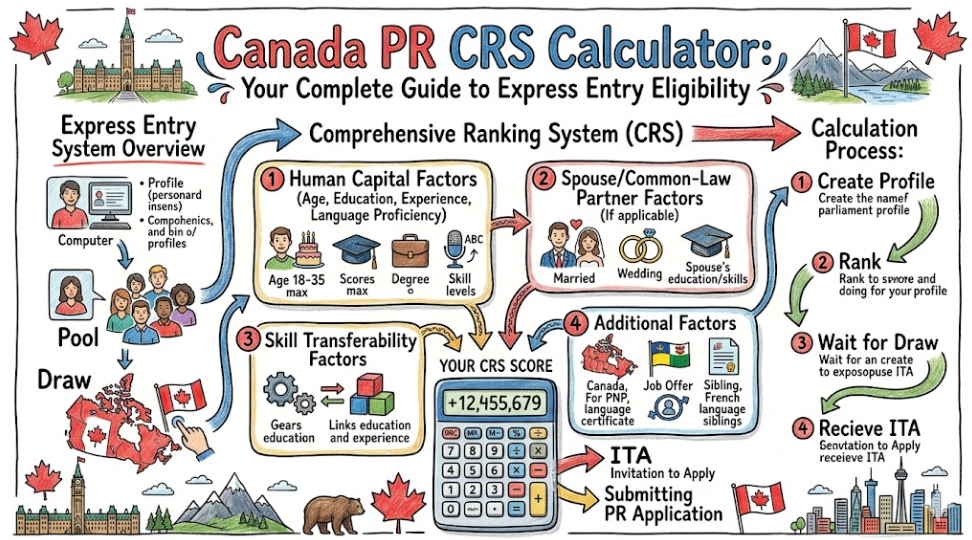
The CRS is a points-based system used by the Canadian government to rank candidates in the Express Entry pool. Think of it as a digital scorecard that measures your “human capital”—the skills and attributes you bring to the Canadian economy. By using a Canada CRS calculator, you can determine your likely standing, identify areas for improvement, and prepare yourself for an Invitation to Apply (ITA) for permanent residency.
How the Canada Immigration Points System Works
Canada uses a competitive selection process. When you create an Express Entry profile, you are placed in a pool with thousands of other applicants. Immigration, Refugees and Citizenship Canada (IRCC) periodically holds “draws” where they invite the highest-ranking candidates to apply for PR.
Why Canada Uses a CRS-Based System
The system is built on data-driven needs:
- Addressing Labor Shortages: Canada identifies specific sectors—like technology, healthcare, and trades—that require skilled talent.
- Economic Growth: The system prioritizes candidates who are most likely to integrate quickly and contribute to the economy.
- Talent-Based Immigration: It moves beyond a “first-come, first-served” model to one that rewards education, language proficiency, and work experience.
How Canada CRS Points System Works
Your CRS score is calculated out of a maximum of 1,200 points based on several core factors.
1. Age Points
Age is a significant factor. You earn the maximum points between the ages of 20 and 29. Starting at age 30, you gradually lose points each year, with your score dropping to zero by age 45.
2. Education Points
Whether you have a diploma, bachelor’s, master’s, or PhD, your level of education is a major contributor to your score. Note that for degrees earned outside Canada, you must obtain an Educational Credential Assessment (ECA) to verify your credentials.
3. Language Skills
Proficiency in English or French is non-negotiable. You’ll need to take an approved test like IELTS (General Training) or CELPIP. Scoring at the Canadian Language Benchmark (CLB) 9 level or higher is a common “sweet spot” for maximizing points.
4. Work Experience
Both Canadian and international work experience are rewarded. The system looks for skilled roles (categorized under NOC/TEER levels). Canadian experience is weighted more heavily than foreign experience.
5. Adaptability & Additional Factors
- Spouse Profile: Including a spouse can change your score; sometimes, having them take a language test can actually increase your total household points.
- Provincial Nomination (PNP): This is the “gold standard,” providing an extra 600 points, which almost guarantees an invitation.
- Siblings: Having a brother or sister living in Canada as a citizen or PR holder grants you additional points.
| Factor | Maximum Points |
| Core/Human Capital (Age, Education, Lang, Work) | 500 |
| Spouse/Common-Law Factors | 40 |
| Skill Transferability | 100 |
| Additional Factors (PNP, Job Offer, Sibling) | 600 |
| Total | 1200 |
Canada Express Entry System: Pathways at a Glance
Express Entry is not a visa itself, but a system that manages applications for three main economic immigration programs:
- Federal Skilled Worker Program (FSWP): For professionals with foreign work experience.
- Canadian Experience Class (CEC): For those who have already gained at least one year of skilled work experience inside Canada.
- Federal Skilled Trades Program (FSTP): Tailored for qualified tradespeople.
- Provincial Nominee Program (PNP): Managed by provinces to address local labor market needs.
Step-by-Step Example of CRS Score Calculation
Example 1: The Software Engineer
- Profile: 29 years old, Master’s degree, 3 years of foreign work experience, CLB 9 in English.
- Outcome: With a strong age score and high language proficiency, this individual is a prime candidate for general draws or STEM-category specific draws.
Example 2: The Healthcare Worker
- Profile: 35 years old, Bachelor’s degree, 5 years of experience, CLB 8.
- Outcome: While age points are lower, healthcare workers often qualify for category-based draws, which IRCC uses to bypass high CRS cut-offs.
How to Increase Your Canada CRS Score
If your score isn’t where you need it to be, don’t lose hope. Here are the most effective strategies:
- Retake the Language Test: Moving from CLB 8 to CLB 9 can add significant points to your total.
- Gain Canadian Work Experience: Even one year of experience in Canada dramatically boosts your profile.
- Obtain a Provincial Nomination (PNP): This is the fastest way to add 600 points to your score.
- French Language Proficiency: If you can demonstrate proficiency in French (CLB 7+), you open doors to French-language category draws.
- Spousal Contribution: Ensure your spouse gets their credentials assessed and takes a language test.
Frequently Asked Questions
1. What is a “good” CRS score?
There is no fixed “good” score. It depends on the cut-off for the specific draw. Historically, scores range from 450 to 510, though category-based draws can be significantly lower.
2. Is IELTS mandatory for Canada PR?
Yes, proof of language proficiency is a core requirement for Express Entry.
3. Does age affect my chances?
Yes. You receive the most points between 20–29. Points decrease annually after age 30.
4. Can I move without a job offer?
Yes, the Federal Skilled Worker Program does not strictly require a job offer, provided your points are high enough.
5. How long does the PR process take?
Once you receive an ITA and submit your full application, most cases are processed within 6 months.
Conclusion
The Canada PR CRS calculator is your best friend in the immigration journey. It provides the clarity needed to plan your move effectively. By understanding your strengths and proactively working on areas like language scores or Provincial Nominations, you can significantly increase your chances of calling Canada home.

