
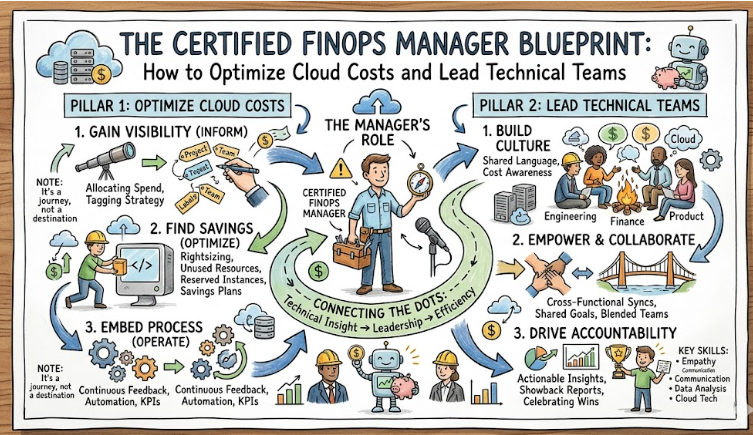
Earning your Certified FinOps Manager is a strategic career move for professionals looking to bridge the critical gap between engineering decisions and cloud financial accountability. This guide is designed for cloud engineers, DevOps practitioners, and technical managers who need to understand how to optimize infrastructure costs while maintaining system performance. Delivered and hosted by finopsschool, this certification equips you with the modern skills required to implement a culture of financial responsibility within technical teams. By the end of this guide, you will have a clear understanding of the certification landscape, helping you make informed decisions about your learning path and long-term career growth in the cloud-native ecosystem.
What is the Certified FinOps Manager?
The Certified FinOps Manager credential validates your ability to manage, optimize, and forecast cloud consumption in complex enterprise environments. It exists because cloud spending has become one of the largest and most unpredictable line items in modern IT budgets. The curriculum focuses heavily on real-world, production-level cost management rather than abstract financial theory.
You will learn how to implement chargebacks, optimize container resources, and negotiate cloud commitments with major providers. This certification aligns directly with modern engineering workflows, ensuring that cost optimization becomes an integral part of the continuous deployment lifecycle. It shifts the conversation from simply cutting costs to maximizing the business value of every cloud dollar spent.
Who Should Pursue Certified FinOps Manager?
This credential is highly beneficial for a diverse range of IT professionals, including DevOps engineers, Site Reliability Engineers (SREs), and cloud architects who are directly responsible for provisioning infrastructure. It is equally valuable for engineering managers and technical leaders who need to justify infrastructure budgets to executive boards.
Beginners in the cloud space can use the foundational concepts to build cost-aware systems from day one, while experienced engineers can leverage it to lead massive cloud optimization initiatives. With the explosive growth of cloud adoption across global enterprises, particularly within the rapidly expanding tech sectors in India, professionals holding this certification are positioned as critical assets to their organizations.
Why Certified FinOps Manager is Valuable Now and Beyond
The demand for cloud financial management expertise is growing exponentially as organizations transition from data centers to massive, distributed cloud architectures. Enterprises are actively seeking professionals who can stop resource sprawl and implement strict governance policies without slowing down engineering velocity.
This certification provides exceptional longevity because the core principles of unit economics and resource optimization remain relevant regardless of which specific tools or cloud providers dominate the market. Investing your time in mastering FinOps delivers a massive return on investment, as companies are highly motivated to compensate professionals who can demonstrably save them millions in cloud waste. It transitions your career from being a technical implementer to a strategic business partner.
Certified FinOps Manager Certification Overview
The program is formally delivered via the official Certified FinOps Manager curriculum and is hosted directly on finopsschool.com. The certification structured is designed to test practical, applied knowledge rather than mere rote memorization. Candidates are evaluated on their ability to solve realistic architectural and financial scenarios.
The structure is broken down into progressive tiers, allowing candidates to build their expertise from fundamental cost awareness up to executive-level financial strategy. The ownership of your cloud financial strategy begins here, with assessments designed to prove you can lead cross-functional teams toward better unit economics.
Certified FinOps Manager Certification Tracks & Levels
The certification journey is divided into foundation, professional, and advanced leadership levels to accommodate professionals at different stages of their careers. The foundation level focuses on basic terminology, cloud billing mechanisms, and understanding the core principles of cost allocation.
The professional level dives deep into specialized tracks, teaching you how to implement FinOps within DevOps pipelines, SRE practices, and large-scale data operations. Finally, the advanced leadership level focuses on enterprise-wide cultural transformation, forecasting, and bridging the communication gap between the CFO and the engineering department. These tiers align perfectly with a natural career progression from individual contributor to engineering director.
Complete Certified FinOps Manager Certification Table
| Track | Level | Who it’s for | Prerequisites | Skills Covered | Recommended Order |
| Core FinOps | Foundation | Cloud beginners, Finance teams | Basic cloud knowledge | Cost allocation, billing analysis | 1 |
| Engineering | Professional | DevOps, Cloud Engineers | Foundation Level | Kubernetes cost optimization, CI/CD integration | 2 |
| Strategy | Advanced | Engineering Managers | Professional Level | Capacity planning, commitment discounts | 3 |
| SRE/FinOps | Professional | Site Reliability Engineers | Foundation Level | Reliability vs. Cost trade-offs, SLOs | 4 |
| DataOps | Professional | Data Engineers, Architects | Foundation Level | Big data cost control, pipeline optimization | 5 |
Detailed Guide for Each Certified FinOps Manager Certification
Certified FinOps Manager – Foundation Level
What it is
This introductory certification validates your understanding of fundamental cloud financial management concepts. It proves you understand the vocabulary and core mechanics of cloud billing.
Who should take it
Junior cloud engineers, finance analysts transitioning to tech, and project managers should take this. It requires no prior coding experience but demands a basic understanding of what cloud computing is.
Skills you’ll gain
- Reading and analyzing raw cloud billing data.
- Understanding resource tagging and allocation strategies.
- Identifying basic cloud waste and orphaned resources.
Real-world projects you should be able to do
- Create a fundamental dashboard for daily cloud spend visibility.
- Implement a mandatory resource tagging policy across a single cloud environment.
- Identify unattached storage volumes and idle compute instances.
Preparation plan
A 7-14 day plan involves reading the core FinOps methodology and reviewing cloud provider billing documentation. A 30-day plan allows for hands-on practice with sample billing exports and dashboard creation. A 60-day plan provides deep immersion into cross-cloud billing nuances and extensive practice exams.
Common mistakes
Candidates often memorize definitions without understanding how cloud resources actually generate costs. Another mistake is ignoring the cultural aspect of FinOps, focusing solely on the technical tools.
Best next certification after this
- Same-track option: Certified FinOps Manager – Professional Level.
- Cross-track option: Cloud Provider Specific Associate Certification.
- Leadership option: Agile Project Management.
Certified FinOps Manager – Professional Level
What it is
This intermediate certification proves your ability to implement advanced cost optimization strategies within complex, production-grade cloud environments. It validates deep technical and financial alignment.
Who should take it
Mid-to-senior DevOps engineers, platform engineers, and cloud architects should pursue this. It requires hands-on experience with infrastructure as code and containerization.
Skills you’ll gain
- Automating cost anomaly detection within CI/CD pipelines.
- Optimizing Kubernetes cluster scaling for maximum financial efficiency.
- Executing complex chargeback and showback models for multiple business units.
Real-world projects you should be able to do
- Build automated scripts that shut down non-production environments during off-hours.
- Restructure application architectures to utilize spot instances fault-tolerantly.
- Negotiate and apply compute savings plans and reserved instances effectively.
Preparation plan
A 7-14 day plan is only suitable for seasoned FinOps practitioners needing a quick refresh on exam domains. A 30-day plan focuses heavily on architectural labs and mastering reservation mathematics. A 60-day plan involves building a complete, cost-optimized infrastructure deployment from scratch to solidify the concepts.
Common mistakes
Many fail by underestimating the complexity of Kubernetes networking costs. Candidates also struggle with the mathematical formulas required for commitment discount strategies.
Best next certification after this
- Same-track option: Certified FinOps Manager – Leadership Level.
- Cross-track option: Certified Kubernetes Administrator (CKA).
- Leadership option: Cloud Architecture Professional.
Certified FinOps Manager – Leadership Level
What it is
This advanced certification validates your ability to design and lead an enterprise-wide cloud financial management practice. It proves you can drive cultural change and align technical operations with corporate finance.
Who should take it
Engineering directors, VP of Engineering, and Chief Technology Officers should target this tier. It requires a deep understanding of organizational dynamics and enterprise finance.
Skills you’ll gain
- Developing accurate, dynamic cloud spend forecasting models.
- Creating KPIs that align engineering velocity with financial efficiency.
- Leading cross-functional teams to adopt a cost-aware engineering culture.
Real-world projects you should be able to do
- Establish a central FinOps capability center within a large enterprise.
- Present a comprehensive cloud unit economics report to the executive board.
- Drive a company-wide initiative that reduces overall cloud spend by twenty percent while maintaining system reliability.
Preparation plan
A 7-14 day plan involves reviewing executive case studies and practicing financial modeling. A 30-day plan requires deep engagement with organizational change management frameworks. A 60-day plan involves shadowing finance teams and applying forecasting models to massive datasets.
Common mistakes
Candidates often focus too much on granular technical solutions rather than strategic organizational enablement. Failing to understand traditional enterprise accounting practices also leads to poor exam performance.
Best next certification after this
- Same-track option: Specialized Industry FinOps strategies.
- Cross-track option: Enterprise Architecture frameworks.
- Leadership option: Executive Business Management programs.
Choose Your Learning Path
DevOps Path
The DevOps path focuses on integrating cost management directly into the continuous integration and continuous deployment pipelines. You will learn to use infrastructure as code tools to estimate costs before resources are even deployed. This path ensures that financial checks and balances are automated, preventing costly misconfigurations from reaching production environments.
DevSecOps Path
The DevSecOps path blends cloud security posture management with financial accountability. Security tools and logging mechanisms can generate massive, unexpected costs if not managed correctly. You will learn how to balance the necessity of comprehensive security monitoring with the financial realities of cloud storage and data transfer fees.
SRE Path
The Site Reliability Engineering path tackles the complex relationship between system availability and infrastructure cost. Achieving high availability requires redundancy, which directly multiplies cloud expenses. You will learn how to use Service Level Objectives (SLOs) to make data-driven decisions about when to spend more for reliability and when it is financially prudent to accept some risk.
AIOps Path
The AIOps path focuses on leveraging artificial intelligence to automate the detection of cloud billing anomalies and operational inefficiencies. You will explore how machine learning models can predict infrastructure scaling needs more accurately than traditional threshold-based alerts. This path is crucial for managing the costs of massive, dynamic environments where human oversight is no longer scalable.
MLOps Path
The MLOps path is dedicated to managing the extraordinary computational costs associated with training and serving machine learning models. You will learn how to optimize GPU utilization, manage vast datasets economically, and choose the right compute instances for inference workloads. This path ensures that artificial intelligence initiatives remain financially viable for the business.
DataOps Path
The DataOps path addresses the financial challenges of managing large-scale data pipelines, data lakes, and analytics platforms. Cloud data warehouses can incur massive query and storage costs if poorly designed. You will learn how to optimize data partitioning, manage data lifecycles, and enforce query optimization to keep analytical infrastructure costs under control.
FinOps Path
The pure FinOps path is designed for professionals who want to dedicate their entire career to cloud financial management. This path dives deepest into vendor negotiations, complex commitment discount modeling, and enterprise accounting integration. It prepares you to lead a dedicated FinOps team and act as the primary liaison between technical operations and the finance department.
Role → Recommended Certified FinOps Manager Certifications
| Role | Recommended Certifications |
| DevOps Engineer | Certified FinOps Manager – Professional, Core FinOps |
| SRE | SRE/FinOps Professional, Core FinOps |
| Platform Engineer | Certified FinOps Manager – Professional, Strategy Advanced |
| Cloud Engineer | Core FinOps, Certified FinOps Manager – Professional |
| Security Engineer | Core FinOps, DevSecOps alignment courses |
| Data Engineer | DataOps Professional, Core FinOps |
| FinOps Practitioner | All Core, Professional, and Advanced FinOps tracks |
| Engineering Manager | Strategy Advanced, Certified FinOps Manager – Professional |
Next Certifications to Take After Certified FinOps Manager
Same Track Progression
Deep specialization within the FinOps domain involves tackling certifications focused on specific cloud providers’ advanced billing mechanisms. Mastering the intricacies of AWS Cost Explorer, Azure Cost Management, or Google Cloud Billing allows you to apply your general FinOps knowledge with absolute precision. This progression makes you an indispensable expert for companies heavily invested in a specific public cloud.
Cross-Track Expansion
Broadening your skill set by pursuing architectural or security certifications enhances your effectiveness as a FinOps manager. Understanding advanced Kubernetes administration or cloud security frameworks allows you to propose cost-saving architectural changes that maintain strict security and performance standards. This cross-training ensures your financial recommendations are technically sound and implementable.
Leadership & Management Track
Transitioning into upper management requires complementing your technical and FinOps skills with traditional business acumen. Pursuing certifications in agile leadership, enterprise architecture, or even formal business administration programs prepares you to lead massive engineering organizations. This track shifts your focus from managing cloud bills to driving overall technical strategy and corporate profitability.
Training & Certification Support Providers for Certified FinOps Manager
DevOpsSchool
DevOpsSchool stands out as a globally recognized institution that focuses heavily on practical, hands-on learning for the modern IT professional. Their approach to teaching emphasizes real-world scenarios, ensuring that students do not just memorize concepts but actually understand how to implement them in production environments. With a vast curriculum covering everything from basic automation to advanced system architecture, they provide an immersive learning experience. Their instructor-led sessions and rigorous project work are designed to bridge the gap between theoretical knowledge and the actual demands of enterprise engineering teams, making them a cornerstone resource for career development.
Cotocus
Cotocus is a premier consulting and training organization dedicated to helping enterprises navigate the complexities of cloud-native transformations. They excel at identifying organizational bottlenecks and providing targeted educational frameworks to overcome them. Their training methodology is deeply rooted in their extensive consulting experience, meaning their curriculum is constantly updated with the latest industry best practices and common pitfalls. They focus strongly on cultural transformation alongside technical implementation, ensuring that teams understand the ‘why’ as well as the ‘how’. This makes Cotocus exceptionally valuable for large organizations looking to upskill entire departments systematically and effectively.
Scmgalaxy
Scmgalaxy has evolved from a thriving community forum into a massive, comprehensive resource for software configuration management and deployment strategies. It provides an incredible wealth of peer-reviewed knowledge, tutorials, and collaborative troubleshooting resources. Their platform encourages a community-driven approach to learning, where professionals share their direct experiences with complex deployment pipelines and automation tools. This organic, crowdsourced intelligence is invaluable for engineers looking for practical solutions to niche problems that official documentation often overlooks. Scmgalaxy remains a vital hub for continuous learning and professional networking within the infrastructure space.
BestDevOps
BestDevOps focuses intensely on the standardization of operational best practices and the streamlining of delivery pipelines. Their training materials are highly structured, aiming to demystify complex automation concepts and make them accessible to a broader engineering audience. They place a strong emphasis on establishing a culture of shared responsibility and continuous improvement within technical teams. By providing clear, step-by-step guides and comprehensive architectural patterns, BestDevOps helps organizations reduce deployment friction and improve overall system reliability. Their resources are particularly useful for teams attempting to mature their operational practices from ad-hoc scripting to robust automation.
devsecopsschool.com
This platform is dedicated entirely to the critical discipline of integrating security seamlessly into the software development lifecycle. They teach the philosophy of shifting security left, ensuring that vulnerabilities are identified and mitigated long before code reaches production. Their curriculum covers advanced topics such as container security, automated compliance scanning, and dynamic application security testing. By focusing exclusively on the intersection of security and operations, devsecopsschool.com equips engineers with the specialized skills needed to protect modern, highly distributed cloud architectures without compromising delivery speed or system performance.
sreschool.com
Focused relentlessly on system reliability and fault tolerance, sreschool.com provides deep technical training on maintaining massive, complex applications. Their curriculum revolves around the practical application of Service Level Indicators (SLIs) and Service Level Objectives (SLOs) to govern engineering decisions. They teach advanced incident management, post-mortem culture, and capacity planning. The resources provided here are essential for engineers who are responsible for ensuring that highly trafficked, mission-critical systems remain available and performant under extreme load, emphasizing a data-driven approach to operational risk management.
aiopsschool.com
This cutting-edge provider focuses on the integration of artificial intelligence and machine learning into everyday IT operations. They teach engineers how to move beyond traditional, static alerting systems toward predictive analytics and automated incident remediation. Their training covers the deployment of intelligent monitoring tools that can establish dynamic baselines and identify anomalous behavior in complex distributed systems. By mastering the concepts taught at aiopsschool.com, professionals can drastically reduce mean time to resolution (MTTR) and prevent system outages before they impact the end user, representing the future of system administration.
dataopsschool.com
Addressing the unique challenges of modern data engineering, dataopsschool.com focuses on applying agile and operational best practices to data analytics pipelines. Their training emphasizes the automation of data integration, rigorous data quality testing, and the implementation of robust data governance frameworks. They help professionals understand how to reduce the cycle time of data analytics, ensuring that businesses can make faster, more reliable decisions. This platform is an indispensable resource for teams struggling to manage the complexity and scale of enterprise data lakes and massive analytical workloads.
finopsschool.com
As the definitive resource for cloud financial management, finopsschool.com focuses entirely on teaching the principles of unit economics and resource optimization in the cloud. They provide the frameworks necessary for engineering teams to collaborate effectively with finance departments, establishing a culture of financial accountability. Their training covers complex topics such as commitment discount modeling, automated chargebacks, and granular cost allocation. By utilizing finopsschool.com, professionals gain the exact skills required to eliminate cloud waste, optimize infrastructure spending, and maximize the business value of every dollar invested in cloud technology.
Frequently Asked Questions (General)
- What is the primary benefit of achieving this certification?
The primary benefit is proving your capability to control and optimize massive cloud budgets, making you a highly valuable asset to any enterprise.
- Do I need to be a finance expert to pass this?
No, you do not need a traditional finance background. The focus is on cloud mechanics, resource optimization, and operational cost management.
- How much programming experience is required?
While coding is not explicitly tested, a solid understanding of infrastructure as code and basic automation scripting is highly recommended.
- Is this certification recognized globally?
Yes, the principles taught are universally applicable and highly respected by massive tech companies and enterprises worldwide.
- How long does it take to prepare for the exams?
Preparation typically takes anywhere from four to eight weeks, depending heavily on your prior exposure to cloud billing and architecture.
- Are there any prerequisites for the foundation level?
There are no formal prerequisites, though a basic conceptual understanding of public cloud computing is necessary for success.
- Does the curriculum cover multiple cloud providers?
Yes, the core principles are cloud-agnostic, though practical examples often utilize AWS, Azure, and Google Cloud for context.
- How often must the certification be renewed?
Certifications typically require renewal every few years to ensure professionals stay current with rapidly evolving cloud pricing models.
- Will this help me transition from a purely technical role to management?
Absolutely. It provides the financial vocabulary and strategic framework necessary to communicate effectively with executive leadership.
- Is hands-on cloud experience necessary?
While the foundation level can be passed with theoretical knowledge, the professional levels require extensive, hands-on architectural experience.
- What is the format of the examination?
The exams generally consist of scenario-based multiple-choice questions that test your ability to apply concepts to real-world infrastructure problems.
- Can my company sponsor this training?
Yes, many organizations happily sponsor this training because the resulting cloud cost savings usually pay for the certification program many times over.
FAQs on Certified FinOps Manager
- What makes the Certified FinOps Manager different from a standard cloud architecture cert?
Standard architecture certifications focus on building scalable and resilient systems, often ignoring the financial implications. The Certified FinOps Manager specifically trains you to balance that architectural excellence with rigorous unit economics and financial accountability.
- How does this certification help with Kubernetes cost management?
It provides specific methodologies for allocating shared cluster costs back to individual application teams. You will learn how to analyze pod resource requests versus actual usage, enabling precise right-sizing of your containerized environments.
- Is the Certified FinOps Manager useful for data engineers?
Yes, data pipelines and data warehouses are notorious for generating unexpected costs. This certification teaches data professionals how to optimize queries, manage storage lifecycles, and partition data efficiently to control analytics spending.
- How does this credential impact salary negotiations?
Holding this certification gives you immense leverage in salary discussions because you can directly correlate your skills to corporate savings. Companies are willing to pay a premium for engineers who actively protect the bottom line.
- Does the curriculum cover negotiating with cloud vendors?
Yes, the advanced levels cover strategies for enterprise discount programs, understanding custom pricing agreements, and maximizing the value of long-term compute commitments with major public cloud providers.
- Can I apply these principles to on-premise infrastructure?
While designed primarily for variable cloud spending, the core concepts of cost allocation, showback reporting, and resource optimization can certainly be adapted to improve efficiency in traditional data centers.
- What is the most difficult concept to master in this program?
Many find the mathematical modeling for commitment discounts (like Savings Plans or Reserved Instances) challenging, as it requires balancing financial commitment with the risk of future architectural changes.
- How quickly can I expect to see ROI after implementing these practices?
Organizations often see significant return on investment within the first thirty days by identifying and eliminating orphaned resources and implementing basic scheduling automation for non-production environments.
Final Thoughts: Is Certified FinOps Manager Worth It?
Investing your time in the Certified FinOps Manager is one of the most practical decisions you can make for your engineering career today. The era of unlimited cloud budgets is over, and companies are strictly prioritizing professionals who understand how to build efficient, cost-aware systems. This certification does not just add another badge to your resume; it fundamentally changes how you approach architecture and operations. By mastering these skills, you elevate yourself from a traditional builder to a strategic asset who actively contributes to the financial health of the organization, ensuring long-term career stability and growth.

