
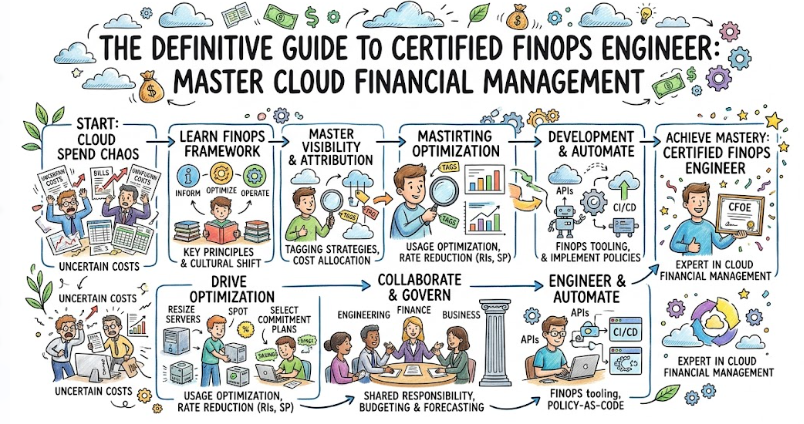
The cloud has fundamentally changed how businesses consume and pay for technology, shifting from fixed capital expenses to variable operational costs. However, without proper governance, these costs can spiral out of control, leading to “bill shock” and inefficient resource utilization. This is where the Certified FinOps Engineer comes into play. This guide is designed for cloud engineers, SREs, and finance professionals who want to bridge the gap between engineering and finance. By understanding the principles taught at finopsschool, professionals can ensure that every dollar spent in the cloud drives maximum business value.
What is the Certified FinOps Engineer?
The Certified FinOps Engineer is a professional designation that validates an individual’s ability to implement financial accountability in the variable spend model of the cloud. It is not just about cost-cutting; it is about “cloud value management”—ensuring that engineering teams can move faster while maintaining financial visibility.
The program focuses on the three core phases of the FinOps lifecycle: Inform, Optimize, and Operate. It emphasizes real-world application, teaching engineers how to build automated guardrails, rightsizing strategies, and unit economic models that align with modern CI/CD and DevOps workflows.
Who Should Pursue Certified FinOps Engineer?
This certification is ideal for DevOps engineers, SREs, and Platform engineers who find themselves managing massive cloud footprints and need a structured way to handle cost optimization. It is equally valuable for Cloud Architects who must design cost-efficient systems from the ground up.
Beyond technical roles, Engineering Managers and IT Finance professionals will benefit from the shared language and framework provided by the certification. In the Indian market and global tech hubs, companies are increasingly looking for “FinOps-aware” engineers who can justify infrastructure spend against product revenue.
Why Certified FinOps Engineer is Valuable in the Future
As enterprises migrate more mission-critical workloads to the cloud, FinOps is transitioning from a “nice-to-have” skill to a core engineering requirement. The demand for professionals who can navigate the complexity of multi-cloud billing and discount programs (like RIs and Savings Plans) is at an all-time high.
Earning this certification ensures longevity in your career because it addresses a fundamental business problem: profitability. Even as specific cloud tools evolve, the principles of financial accountability and resource efficiency remain constant, making you a vital asset to any leadership team looking to scale sustainably.
Certified FinOps Engineer Certification Overview
The program is delivered via the official training portal and is hosted on the finopsschool.com platform. It utilizes a practical, assessment-based approach that tests a candidate’s ability to solve complex financial scenarios within AWS, Azure, and Google Cloud environments.
The certification is structured to move candidates from foundational knowledge to advanced engineering implementation. It covers technical debt, cost allocation, tagging strategies, and the cultural shift required to make FinOps a collaborative effort between engineering, finance, and business units.
Certified FinOps Engineer Certification Tracks & Levels
The certification path is divided into progressive tiers to match career growth. The Foundation level introduces the core terminology and the FinOps framework. The Professional level dives deep into the engineering aspects of automation and cost-allocation logic.
The Advanced or Specialist levels focus on specific domains such as FinOps for Containers/Kubernetes or FinOps for Machine Learning (MLOps). These tracks allow professionals to align their financial expertise with their specific technical stack, facilitating a clear progression from a junior contributor to a senior FinOps Lead.
Complete Certified FinOps Engineer Certification Table
| Track | Level | Who it’s for | Prerequisites | Skills Covered | Recommended Order |
| Core FinOps | Foundation | Beginners, Finance | Basic Cloud Knowledge | Terminology, Lifecycle | 1st |
| Engineering | Professional | SREs, DevOps | Foundation Cert | Automation, Rightsizing | 2nd |
| Specialized | Advanced | Architects, Tech Leads | Professional Cert | Unit Economics, Governance | 3rd |
| K8s FinOps | Specialist | Platform Engineers | CKA/Professional | Container Cost Allocation | Optional |
Detailed Guide for Each Certified FinOps Engineer Certification
Certified FinOps Engineer – Foundation
What it is
This certification validates a foundational understanding of the FinOps principles and the cultural shift required to manage cloud spend effectively across an organization.
Who should take it
It is suitable for entry-level cloud engineers, finance analysts, and project managers who need to speak the language of cloud financial management.
Skills you’ll gain
- Understanding the FinOps Lifecycle (Inform, Optimize, Operate).
- Knowledge of cloud billing models and cost drivers.
- Ability to identify different types of cloud waste.
Real-world projects you should be able to do
- Create a basic cloud cost visibility dashboard.
- Map cloud resources to specific business units using tagging.
- Conduct a monthly cloud spend review for a small team.
Preparation plan
- 7-14 Days: Focus on the official FinOps framework documentation and core terminology.
- 30 Days: Review case studies of companies that successfully implemented FinOps.
- 60 Days: Participate in community forums and practice exams to solidify the cultural concepts.
Common mistakes
- Treating FinOps as a one-time cost-cutting exercise rather than a continuous culture.
- Ignoring the “Inform” phase and jumping straight into resource deletion.
Best next certification after this
- Same-track option: Certified FinOps Engineer – Professional.
- Cross-track option: Cloud Digital Leader (GCP) or Cloud Practitioner (AWS).
- Leadership option: Engineering Management Fundamentals.
Certified FinOps Engineer – Professional
What it is
This level focuses on the technical implementation of FinOps, including building automation scripts and integrating cost data into engineering pipelines.
Who should take it
Experienced DevOps engineers and SREs who are responsible for the actual optimization of production environments and infrastructure-as-code.
Skills you’ll gain
- Advanced automation for resource scheduling and rightsizing.
- Implementing automated guardrails using policy-as-code.
- Analyzing and managing Reserved Instances and Savings Plans.
Real-world projects you should be able to do
- Build a Lambda script to auto-stop non-production instances after hours.
- Integrate cloud cost estimates into Terraform or Jenkins pipelines.
- Develop a custom dashboard for Kubernetes pod-level cost allocation.
Preparation plan
- 7-14 Days: Deep dive into cloud provider-specific billing APIs and CLI tools.
- 30 Days: Practice writing scripts for automated cost reporting and anomaly detection.
- 60 Days: Implement a mock FinOps governance strategy on a personal cloud account.
Common mistakes
- Over-automating without consulting application owners, leading to performance issues.
- Failing to account for shared costs in a multi-tenant environment.
Best next certification after this
- Same-track option: FinOps Certified Specialist (Advanced).
- Cross-track option: Certified Kubernetes Administrator (CKA).
- Leadership option: Director of Platform Engineering Path.
Choose Your Learning Path
DevOps Path
In the DevOps world, FinOps is integrated into the “You build it, you run it” philosophy. Engineers on this path focus on making cost a first-class citizen in the CI/CD pipeline. By learning FinOps, DevOps professionals ensure that their deployments are not only stable and fast but also cost-efficient, preventing budget overruns during rapid scaling.
DevSecOps Path
Financial governance is closely tied to security governance. On this path, the focus is on “Cost Security”—ensuring that unauthorized or inefficient resource usage is flagged as a risk. DevSecOps professionals use FinOps to implement policy-as-code that prevents the creation of expensive, insecure, or non-compliant cloud resources.
SRE Path
Site Reliability Engineers use FinOps to balance the cost of reliability against the risk of downtime. This path involves defining “Error Budgets” that include financial constraints. SREs learn to optimize the performance of high-scale systems while ensuring that the cost of maintaining 99.9% availability is justifiable to the business.
AIOps Path
AIOps professionals leverage machine learning to automate the FinOps lifecycle. This involves building models that can predict cloud spend anomalies and automatically adjust resource allocation based on historical trends. The focus here is on moving away from manual spreadsheets toward intelligent, data-driven financial decision-making for infrastructure.
MLOps Path
Machine Learning workloads are notoriously expensive due to GPU requirements. The MLOps FinOps path focuses on optimizing model training and inference costs. Professionals learn how to choose the right instance types for training and how to use spot instances effectively to reduce the high cost of data science experiments.
DataOps Path
Data pipelines involve massive amounts of storage and compute. The DataOps path for FinOps focuses on data lifecycle management and query optimization. Professionals learn how to minimize data egress charges and how to architect data lakes in a way that balances query speed with long-term storage costs.
FinOps Path
The pure FinOps path is for those who want to lead a FinOps Center of Excellence (CoE). It focuses on the intersection of finance, procurement, and engineering. Professionals on this path master the art of negotiation with cloud vendors, unit economics, and driving organizational change across different departments.
Role → Recommended Certified FinOps Engineer Certifications
| Role | Recommended Certifications |
| DevOps Engineer | FinOps Foundation, Professional |
| SRE | FinOps Professional, K8s Specialist |
| Platform Engineer | Professional, Advanced Governance |
| Cloud Engineer | FinOps Foundation, Professional |
| Security Engineer | FinOps Foundation, DevSecOps Specialist |
| Data Engineer | FinOps Foundation, DataOps Specialist |
| FinOps Practitioner | Foundation, Professional, Advanced |
| Engineering Manager | FinOps Foundation, Leadership Track |
Next Certifications to Take After Certified FinOps Engineer
Same Track Progression
Once you have mastered the Professional level, the next step is deep specialization. This involves looking into niche areas like FinOps for SaaS or becoming a FinOps Certified Professional. Deepening your knowledge in advanced cloud financial modeling and unit economics will prepare you for a role as a Principal FinOps Engineer.
Cross-Track Expansion
To be a truly effective FinOps professional, you need to understand the underlying technology you are optimizing. Pursuing certifications in Kubernetes (CKA) or specific cloud architecture (AWS Solutions Architect) allows you to speak with authority when asking engineering teams to make technical changes for financial reasons.
Leadership & Management Track
For those looking to move into executive roles, the next step is combining technical FinOps knowledge with business leadership. Certifications in ITIL, PMP, or specialized engineering management courses can help you transition into a Head of Cloud Operations or Chief Technology Officer (CTO) role where you manage large-scale budgets.
Training & Certification Support Providers
DevOpsSchool
This provider offers extensive resources for engineers looking to integrate financial management into their DevOps workflows. Their training focus is on the practical implementation of tools and automation that bridge the gap between development and operations teams globally.
Cotocus
A technical training organization known for its hands-on labs and real-world scenarios. They provide specialized support for professionals aiming to master cloud-native technologies and the financial governance required to manage them at scale in enterprise environments.
Scmgalaxy
This community-driven platform provides a wealth of knowledge on configuration management and continuous integration. Their support for FinOps learners includes deep dives into how supply chain management principles can be applied to cloud resource procurement and lifecycle management.
BestDevOps
Focusing on elite engineering practices, this provider helps professionals achieve top-tier certifications by focusing on the latest industry trends. Their FinOps curriculum is designed for those who want to stay ahead of the curve in cloud financial engineering.
devsecopsschool.com
This institution specializes in the intersection of security and operations. Their FinOps support highlights the importance of cost-governance as a security measure, teaching students how to build secure, compliant, and cost-effective cloud infrastructures.
sreschool.com
Dedicated to the principles of Site Reliability Engineering, this school provides training that treats cost as a key metric of system health. Their approach to FinOps is rooted in maintaining high availability and performance without exceeding financial budgets.
aiopsschool.com
As a leader in AIOps education, they focus on using artificial intelligence to solve complex operational challenges. Their FinOps training includes using machine learning for predictive billing, anomaly detection, and automated cost optimization strategies.
dataopsschool.com
This provider focuses on the unique challenges of data engineering. Their FinOps support covers the costs associated with big data, helping engineers manage the financial impact of data storage, processing, and movement across multi-cloud environments.
finopsschool.com
The primary hosting site and certification provider for these programs. They offer the most direct and updated curriculum for the Certified FinOps Engineer, ensuring that students have access to the latest frameworks, tools, and community best practices.
Frequently Asked Questions (General)
- How difficult is the Certified FinOps Engineer exam?
The difficulty depends on your cloud experience. It is moderately challenging as it requires both technical knowledge of cloud billing and an understanding of financial accounting principles. - How long does it take to prepare for the certification?
Most professionals with cloud experience can prepare in 30 to 60 days, depending on the level of certification they are pursuing. - Are there any prerequisites for the Professional level?
Yes, it is highly recommended to complete the Foundation level first to ensure a solid grasp of the FinOps terminology and lifecycle. - What is the ROI of getting a FinOps certification?
Professionals often see immediate career growth, as FinOps is currently one of the highest-paying and most sought-after skills in the cloud industry. - Does the certification focus on one specific cloud provider?
No, the principles are cloud-agnostic and apply to AWS, Azure, Google Cloud, and even on-premise private cloud environments. - Can finance professionals take this certification?
Absolutely. The Foundation level is particularly helpful for finance teams who need to understand how cloud engineering works to manage budgets better. - How does FinOps differ from traditional cost management?
FinOps focuses on real-time, decentralized decision-making and engineering accountability, whereas traditional management is often centralized and retrospective. - Is the exam proctored online?
Yes, most certifications under this program are available through online proctored environments for global accessibility. - Do I need to know how to code?
For the Professional level, basic scripting skills (Python, Bash) and knowledge of Infrastructure-as-Code (Terraform) are very beneficial. - How often do I need to recertify?
Certifications are typically valid for two years, reflecting the rapid changes in cloud pricing models and FinOps best practices. - Are there hands-on labs in the training?
Yes, the program emphasizes practical learning, including labs on cost allocation, tagging, and building dashboards. - Is this certification recognized globally?
Yes, the framework taught is the industry standard used by major tech companies and enterprises worldwide.
FAQs on Certified FinOps Engineer
- What specific tools are covered in the Certified FinOps Engineer program?
The program covers native tools like AWS Cost Explorer, Azure Cost Management, and GCP Billing, along with third-party optimization platforms. - Does this certification cover Kubernetes cost management?
While the core program covers general cloud, specialized tracks and advanced modules dive deep into container-level cost allocation and optimization. - How does this help in a multi-cloud environment?
It provides a unified framework and language to manage costs across different providers, making it easier to consolidate financial reporting. - What is the focus on “Unit Economics” in the exam?
The exam tests your ability to relate cloud spend to business outcomes, such as the cost of cloud per customer or per transaction. - Is there a focus on automated rightsizing?
Yes, the Professional level focuses heavily on the logic and safety measures required to automate the rightsizing of compute and storage. - How does the program handle “Reserved Instances”?
It teaches the strategy behind commitment-based discounts, helping you decide when to buy RIs versus Savings Plans or Spot instances. - Can I use this for my local Indian business cloud needs?
Yes, the principles of cost efficiency and resource governance are universal and apply to any business regardless of geographic location. - What is the passing score for the exam?
The passing score varies by level but generally requires a 70% or higher to demonstrate professional competency in the subject.
Final Thoughts: Is Certified FinOps Engineer Worth It?
If you are looking to advance your career in the cloud space, the answer is a resounding yes. We have moved past the era where engineers could ignore the bill. Today, the most successful engineers are those who understand that efficiency is a technical requirement, not just a financial one.
This certification provides you with a structured path to mastering a skill that is in high demand and low supply. It isn’t about learning a specific tool; it’s about learning a mindset that aligns engineering speed with business value. For any professional serious about their growth in DevOps, SRE, or cloud architecture, becoming a Certified FinOps Engineer is a strategic career move.

