
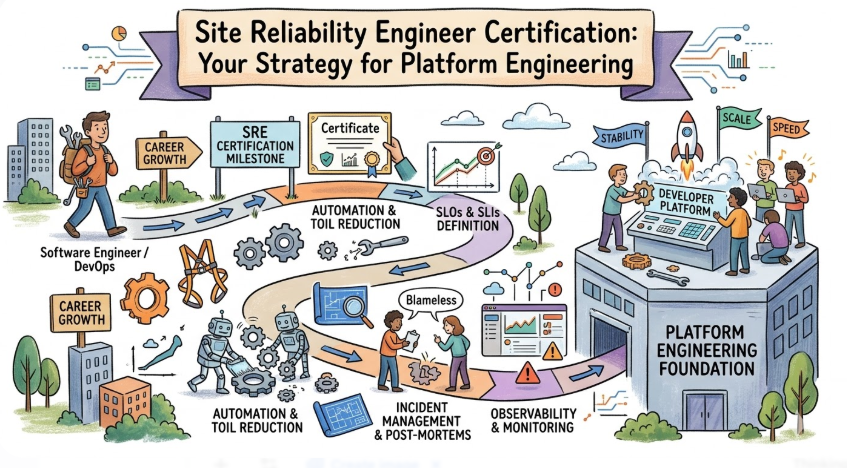
The role of a Site Reliability Engineer has evolved from a niche Google- centric concept into the backbone of modern digital operations. This guide is designed for engineers and technical leaders who are looking to move beyond traditional administrative tasks and embrace a data-driven, automated approach to system availability. As organizations scale their cloud-native footprints, the need for standardized reliability practices has never been higher. By pursuing the Certified Site Reliability Engineer designation, professionals can validate their ability to balance the velocity of feature delivery with the absolute necessity of platform stability. This roadmap provides a clear, experience-driven perspective to help you decide if this path aligns with your long-term career goals in DevOps, platform engineering, or cloud operations.
What is the Certified Site Reliability Engineer?
The Certified Site Reliability Engineer program is a professional validation of an engineer’s ability to apply software engineering principles to solve operational problems. Unlike traditional certifications that focus on memorizing CLI commands for a specific vendor tool, this program emphasizes the core pillars of SRE: Service Level Objectives (SLOs), error budgets, toil reduction, and incident management. It represents a shift from “reactive” firefighting to “proactive” engineering, where reliability is treated as a software problem.
This certification exists because the industry needs a common language for reliability. It provides a structured framework for understanding how to measure the “health” of a distributed system and how to automate the response to failures. For the modern enterprise, having certified staff means moving toward a culture where data, not gut feelings, dictates when a service is stable enough for a new deployment. It bridges the gap between development speed and operational excellence in high-stakes environments.
Who Should Pursue Certified Site Reliability Engineer?
This certification is primarily built for software engineers who find themselves managing infrastructure and DevOps practitioners looking to deepen their expertise in observability and reliability. It is also highly relevant for Cloud Architects and Systems Administrators who need to modernize their skill sets for Kubernetes and microservices environments. In the current market, transition from a “SysAdmin” to an “SRE” role often requires a formal validation of these specific architectural mindsets.
Beyond individual contributors, Engineering Managers and technical leads will find significant value here. Understanding SRE principles allows leadership to set realistic expectations for uptime and build better team structures around “You Build It, You Run It” philosophies. In both the Indian tech hubs and the global market, this certification serves as a signal to recruiters that the candidate understands the financial and operational impact of downtime and possesses the technical discipline to prevent it.
Why Certified Site Reliability Engineer is Valuable in the Future
As systems become more complex and distributed, the “human-to-server” ratio must improve through automation. The demand for SREs is consistently outpacing supply because the role requires a unique blend of coding skills and operational empathy. Holding this certification demonstrates that you are prepared for a future where manual intervention is considered a failure of design. It positions you as a high-value asset capable of managing massive scale without a corresponding increase in headcount.
Furthermore, enterprise adoption of SRE practices is no longer limited to “Big Tech” firms; it is now standard in banking, retail, and healthcare. This longevity is rooted in the fact that SRE principles are tool-agnostic. While specific cloud providers or monitoring tools may change, the fundamental logic of managing error budgets and toil remains constant. Investing time in this certification offers a high return on career investment by making you a versatile engineer who can thrive in any organization running mission-critical software.
Certified Site Reliability Engineer Certification Overview
The program is delivered via the official course page and is hosted on the sreschool.com platform. It is structured to provide a logical progression from foundational concepts to advanced architectural strategies. The assessment approach moves away from simple multiple-choice questions toward scenario-based evaluations that reflect the actual challenges faced during a production outage or a capacity planning session.
The certification is owned and managed by industry veterans who understand the nuances of production-grade environments. The structure is practical, focusing on the lifecycle of a service from initial design through deployment and long-term maintenance. By maintaining a focus on industry standards, the program ensures that the skills learned are immediately applicable to any professional environment, whether you are working in a startup or a Fortune 500 enterprise.
Certified Site Reliability Engineer Certification Tracks & Levels
The certification structure is divided into levels that mirror the natural progression of an SRE career. The Foundation level introduces the terminology and core philosophies, ensuring everyone on a team is aligned on what “reliability” actually means. It covers the basics of monitoring, alerting, and the cultural shifts required to implement SRE practices successfully within a legacy organization.
As professionals move to the Professional and Advanced levels, the focus shifts toward specialization and leadership. This includes deep dives into advanced observability, automated incident response, and the integration of SRE with other disciplines like DevSecOps and FinOps. These levels are designed to align with career milestones, moving from an individual contributor managing a single service to a Lead SRE or Architect overseeing global platform reliability across multiple business units.
Complete Certified Site Reliability Engineer Certification Table
| Track | Level | Who it’s for | Prerequisites | Skills Covered | Recommended Order |
| SRE Core | Foundation | New SREs, DevOps Engineers | Basic Linux & Networking | SLOs, SLIs, Error Budgets, Toil | 1 |
| SRE Ops | Professional | Experienced SREs, Admins | Foundation Level | Incident Management, On-call | 2 |
| SRE Arch | Advanced | Architects, Team Leads | Professional Level | Capacity Planning, Scaling | 3 |
| SRE Security | Specialist | Security Engineers | Foundation Level | DevSecOps, Chaos Engineering | 4 |
Detailed Guide for Each Certified Site Reliability Engineer Certification
What it is
This certification validates a professional’s understanding of the core SRE framework. it ensures that the candidate can differentiate between traditional operations and the engineering-led approach to reliability defined by modern industry standards.
Who should take it
This is suitable for junior to mid-level DevOps engineers, system administrators, and software developers who want to understand how their code behaves in production. It is also an excellent entry point for managers who oversee SRE teams.
Skills you’ll gain
- Defining and calculating SLIs, SLOs, and SLAs.
- Identifying and eliminating operational toil through automation.
- Understanding the principles of observability vs. traditional monitoring.
- Implementing a “blameless” post-mortem culture.
Real-world projects you should be able to do
- Draft a Service Level Objective for a web application based on business requirements.
- Analyze a manual workflow and write a script to automate the process.
- Conduct a mock post-mortem after a simulated service failure.
Preparation plan
- 7–14 days: Focused review of the SRE Handbook and core terminology; completing the official Foundation module.
- 30 days: Practical application of SLO definitions to a personal project and participation in study groups.
- 60 days: In-depth study of case studies, multiple practice assessments, and implementing basic monitoring dashboards.
Common mistakes
- Treating SLOs as rigid targets rather than tools for making informed data-driven decisions.
- Confusing “Monitoring” (knowing something is wrong) with “Observability” (understanding why it is wrong).
Best next certification after this
- Same-track option: Certified Site Reliability Engineer – Professional
- Cross-track option: DevSecOps Foundation
- Leadership option: Engineering Management for SREs
Choose Your Learning Path
DevOps Path
The DevOps path focuses on the seamless integration of development and operations through CI/CD pipelines. For an SRE, this means ensuring that every stage of the pipeline is resilient and that deployments do not compromise system stability. Engineers on this path will learn how to build “guardrails” that automatically roll back failing code before it impacts a significant number of users.
DevSecOps Path
Security is an integral part of reliability; a compromised system is an unreliable one. This path focuses on integrating security scanning and compliance checks into the SRE workflow. Professionals learn how to treat security vulnerabilities with the same urgency as production bugs, using automation to identify and remediate risks without slowing down the development lifecycle.
SRE Path
The pure SRE path is for those who want to specialize deeply in platform stability and performance. It emphasizes the “engineering” side of operations, focusing on distributed systems architecture, advanced observability, and high-scale traffic management. This path is ideal for those who want to become the primary gatekeepers of production excellence in a cloud-native environment.
AIOps Path
As data volumes grow, manual analysis becomes impossible. The AIOps path teaches engineers how to use machine learning models to predict failures before they happen and automate root cause analysis. This path is essential for organizations managing thousands of microservices where traditional threshold-based alerting leads to excessive “alert fatigue” and missed incidents.
MLOps Path
MLOps is the application of SRE principles to the lifecycle of machine learning models. This path addresses the unique challenges of model drift, data quality, and retraining pipelines. SREs in this space ensure that AI/ML services are not only “up” but are also providing accurate, high-quality inferences in a production environment at scale.
DataOps Path
DataOps focuses on the reliability and speed of data pipelines. SREs following this path ensure that data warehouses and real-time processing engines are performant and consistent. It involves applying SRE metrics to data quality, ensuring that downstream analytics and business intelligence tools are receiving reliable information without significant latency.
FinOps Path
Reliability must be balanced with cost-efficiency. The FinOps path teaches SREs how to optimize cloud spending while maintaining high performance. It covers techniques for right-sizing resources, managing spot instances, and creating transparency around the “cost per request,” ensuring that the platform remains financially sustainable as it scales.
Role → Recommended Certified Site Reliability Engineer Certifications
| Role | Recommended Certifications |
| DevOps Engineer | SRE Foundation, SRE Professional |
| SRE | SRE Foundation, SRE Professional, SRE Advanced |
| Platform Engineer | SRE Foundation, SRE Advanced |
| Cloud Engineer | SRE Foundation, SRE Ops |
| Security Engineer | SRE Foundation, SRE Security Specialist |
| Data Engineer | SRE Foundation, DataOps Specialist |
| FinOps Practitioner | SRE Foundation, FinOps Specialist |
| Engineering Manager | SRE Foundation |
Next Certifications to Take After Certified Site Reliability Engineer
Same Track Progression
Once you have mastered the SRE Foundation, the natural step is to pursue Professional and Advanced designations. These levels move into the specifics of large-scale incident management and architectural design for global resilience. Deep specialization ensures you can handle complex, multi-region outages and lead the reliability strategy for an entire organization.
Cross-Track Expansion
An SRE benefits greatly from understanding adjacent fields like DevSecOps or DataOps. Broadening your skills allows you to act as a bridge between different technical departments. For example, understanding DevSecOps enables you to build reliability into the security layer, while DataOps helps you manage the massive telemetry databases that power SRE observability tools.
Leadership & Management Track
For those looking to move into people management, certifications in technical leadership and engineering management are the logical next steps. Transitioning from an SRE to an SRE Manager requires a shift from technical troubleshooting to cultural transformation. You will focus on hiring, team structure, and negotiating error budgets with executive stakeholders to drive business value.
Training & Certification Support Providers for Certified Site Reliability Engineer
DevOpsSchool
DevOpsSchool provides comprehensive training programs that bridge the gap between theoretical knowledge and industrial application. Their courses are designed by practitioners who have spent years in the field, ensuring that students learn not just the “how” but the “why” behind SRE practices. They offer extensive laboratory environments where students can practice incident response and automation in real-world scenarios.
Cotocus
Cotocus focuses on delivering high-end technical training for specialized cloud and DevOps roles. Their approach to SRE training is highly modular, allowing professionals to focus on specific areas like observability or Kubernetes reliability. They are known for their hands-on workshops and their ability to help corporate teams transition to modern engineering workflows through structured learning paths.
Scmgalaxy
Scmgalaxy is a prominent community and training hub for professionals in the software configuration management and DevOps space. They provide a wealth of resources, including blogs, forums, and specialized courses that cover the entire lifecycle of a service. Their training for SRE candidates is grounded in years of experience managing complex build and release pipelines.
BestDevOps
BestDevOps offers a streamlined and highly focused approach to DevOps and SRE certifications. Their programs are tailored for busy professionals who need to gain high-impact skills in a short amount of time. They emphasize the most critical tools and methodologies used in the industry today, making them a preferred choice for career-oriented engineers.
devsecopsschool.com
This platform specializes in the intersection of security and operations. For SREs, their training provides critical insights into how to make systems not just reliable, but also resilient against cyber threats. Their curriculum covers automated security testing, compliance as code, and integrated threat modeling within the SRE framework.
sreschool.com
As the primary host for the certification, sreschool.com is the definitive source for SRE-specific education. The site offers a curated curriculum that follows the official certification standards. Their content is updated regularly to reflect the changing landscape of cloud-native technologies and distributed systems architecture.
aiopsschool.com
Aiopsschool.com addresses the future of operations by focusing on artificial intelligence and machine learning in the SRE space. They provide specialized training on how to implement AIOps tools to manage scale and complexity. This is the go-to resource for engineers looking to automate the “human” element of monitoring and incident response.
dataopsschool.com
Dataopsschool.com provides specialized training for managing the reliability of data-heavy environments. Their courses apply SRE principles to data engineering, focusing on pipeline stability, data integrity, and high-throughput processing. They help engineers ensure that the “data platform” is as reliable as the “application platform.”
finopsschool.com
Finopsschool.com focuses on the critical intersection of cloud architecture and financial management. Their training helps SREs and Architects understand how to build systems that are both reliable and cost-effective. They provide the frameworks necessary for implementing cloud financial accountability across engineering teams.
Frequently Asked Questions (General)
- How difficult is the SRE certification exam?
The difficulty is moderate to high, as it requires a conceptual shift from traditional operations to engineering. It focuses on problem-solving rather than rote memorization of tool features. - What is the typical time commitment for preparation?
Most professionals spend between 30 to 60 days preparing, depending on their existing experience with Linux, coding, and cloud-native environments. - Are there any hard prerequisites?
While there are no strict barriers, a fundamental understanding of networking, Linux systems, and at least one programming language (like Python or Go) is highly recommended. - What is the Return on Investment (ROI) for this certification?
The ROI is significant; SREs are among the highest-paid professionals in the technology sector due to the critical nature of their work and the scarcity of talent. - In what order should I take these certifications?
It is always recommended to start with the Foundation level to ensure a solid grasp of SRE terminology before moving into Professional or specialist tracks. - Does the certification focus on a specific cloud provider like AWS or Azure?
No, the certification is tool-agnostic and cloud-neutral, focusing on the principles and methodologies that apply to any infrastructure environment. - How long is the certification valid?
Typically, certifications are valid for two to three years, after which a renewal or advancement to a higher level is required to ensure skills remain current. - Is this certification recognized globally?
Yes, SRE principles are a global standard, and this certification is recognized by enterprises and startups worldwide as a mark of professional competence. - Can a project manager benefit from this certification?
Yes, technical project managers can gain a better understanding of why certain tasks take time and how to better plan for reliability in the software lifecycle. - Does it cover Kubernetes and Containers?
While not a “Kubernetes certification,” it covers the reliability challenges inherent in containerized and orchestrated environments. - Are there hands-on labs included in the training?
Most accredited training providers include hands-on labs where you can practice building dashboards, setting SLOs, and handling simulated incidents. - Is there a community for certified professionals?
Yes, becoming certified often gives you access to exclusive forums and alumni groups where you can share knowledge and find career opportunities.
FAQs on Certified Site Reliability Engineer
- What specifically does “Certified Site Reliability Engineer” validate?
It validates that you understand the mathematical and cultural aspects of reliability, specifically the ability to define SLIs and SLOs and manage error budgets effectively. - How does this differ from a standard DevOps certification?
While DevOps focuses on the “how” of delivery, SRE focuses on the “how” of operations and stability. SRE is essentially a specific way of implementing DevOps. - Can I pass this if I don’t know how to code?
It is very difficult. SRE is an engineering role; you need to understand logic and automation scripts to successfully implement the principles taught. - Why is the “Foundation” level necessary for experienced admins?
Experienced admins often have “reactive” habits. The Foundation level helps unlearn those and adopt the “proactive” engineering mindset required for SRE. - Is the exam proctored?
Yes, to maintain the integrity of the designation, the certification exams are proctored and require a secure environment for completion. - What is the passing score for the certification?
The passing score varies slightly by level but generally requires a 70% or higher to demonstrate a strong grasp of the material. - Are there retake options if I fail?
Yes, most programs offer a retake policy, though there is usually a mandatory waiting period between attempts to allow for further study. - How do I list this on my resume?
You should list it under your professional certifications section, highlighting the specific level (e.g., Foundation) and the skills validated.
Conclusion: Is Certified Site Reliability Engineer Worth It?
If your goal is to stay at the forefront of modern infrastructure, then pursuing the Certified Site Reliability Engineer designation is a highly practical move. The industry has clearly shifted away from manual, ticket-based operations toward automated, observable platforms. This certification provides the roadmap you need to make that transition successfully.
As a mentor, my advice is to look past the badge and focus on the mindset. The real value isn’t just in the certificate; it’s in your ability to walk into a room and explain to a stakeholder why an error budget is more important than 100% uptime. If you are ready to stop firefighting and start engineering, this is the right path for you.

