
Introduction
The modern engineering landscape is shifting rapidly toward the integration of artificial intelligence and machine learning into production environments. The Certified MLOps Architect serves as a vital bridge between data science and operational excellence. This guide is designed for professionals who want to move beyond experimental notebooks and into the world of scalable, automated, and reliable machine learning systems.
Whether you are coming from a DevOps background or a data engineering role, understanding the architectural requirements of machine learning is essential. This guide helps you navigate the complexities of model deployment, monitoring, and lifecycle management. By following this roadmap at AIOps School, you can transition from a traditional software role into a high-demand architectural position.
As organizations scale their AI initiatives, the need for standardized practices becomes critical. This certification guide provides the clarity needed to make informed decisions about your professional development. It maps out the necessary skills and provides a clear perspective on how to achieve mastery in the field of MLOps.
What is the Certified MLOps Architect?
The Certified MLOps Architect is a professional designation that focuses on the design, implementation, and management of machine learning pipelines. It represents a shift from manual model management to automated, repeatable workflows that mirror the best practices of DevOps and Site Reliability Engineering. It exists to solve the “last mile” problem in machine learning, ensuring models actually deliver business value in production.
This certification is built on the foundation of real-world production requirements rather than purely theoretical data science concepts. It emphasizes the importance of infrastructure as code, continuous integration, and continuous delivery within the context of data and models. Professionals learning this discipline focus on building resilient systems that can handle the unique challenges of model drift and data versioning.
By aligning with modern engineering workflows, the program ensures that practitioners can integrate ML workloads into existing enterprise cloud environments. It covers the entire lifecycle from data ingestion to model serving and monitoring. The goal is to create architects who can lead teams in building scalable platforms that support high-velocity machine learning development.
Who Should Pursue Certified MLOps Architect?
This certification is primarily intended for software engineers and DevOps practitioners who are moving into the machine learning space. It is also highly beneficial for SREs and Cloud Architects who need to support data science teams with robust infrastructure. Professionals in security and data roles will find the governance and compliance aspects of the certification particularly relevant to their daily work.
Experienced engineers looking to pivot their careers into AI-driven operations will find this path structured and rewarding. It provides the necessary technical depth for senior individual contributors while offering the strategic oversight required by technical leads. Managers who oversee cross-functional teams will gain the vocabulary and conceptual understanding needed to direct MLOps initiatives effectively.
From a global perspective, the demand for these skills is surging across North America, Europe, and especially in India’s growing tech hubs. Organizations in finance, healthcare, and retail are actively seeking architects who can bridge the gap between “science projects” and “software products.” This certification serves as a standardized proof of competence in a competitive international job market.
Why Certified MLOps Architect is Valuable and Beyond
The value of the Certified MLOps Architect lies in its focus on longevity and enterprise-grade stability. As tools come and go, the underlying architectural principles of automation, observability, and scalability remain constant. This certification prepares you to handle the next generation of enterprise AI adoption, where efficiency and cost-management are as important as model accuracy.
Enterprises are moving away from ad-hoc scripts toward centralized MLOps platforms to reduce technical debt and improve speed to market. By holding this certification, you demonstrate that you can help organizations avoid the common pitfalls of fragmented AI development. It ensures you remain relevant in a market that is increasingly prioritizing operational maturity over simple experimentation.
Furthermore, the return on investment for this certification is reflected in the high demand for specialized architects. It enables professionals to command higher salaries and take on more significant leadership responsibilities. By mastering the intersection of data and operations, you position yourself as a rare talent capable of solving the most complex challenges in modern software engineering.
Certified MLOps Architect Certification Overview
The program is delivered via the Certified MLOps Architect program at AIOps School. This hosting site provides a comprehensive ecosystem for learning, testing, and professional validation. The certification is structured to guide a learner from fundamental concepts to complex architectural designs, ensuring a logical progression of skills.
The assessment approach is practical and rigorous, often involving hands-on scenarios that reflect actual production challenges. It is not just about passing a multiple-choice exam; it is about demonstrating the ability to design a system that works under pressure. The ownership of the program lies with industry experts who have spent years managing large-scale distributed systems.
The structure is divided into distinct phases, each focusing on a specific part of the machine learning lifecycle. This modular approach allows professionals to focus on their areas of interest while building a broad, holistic understanding of the field. It is designed to be accessible to working professionals while maintaining a high standard of technical excellence.
Certified MLOps Architect Certification Tracks & Levels
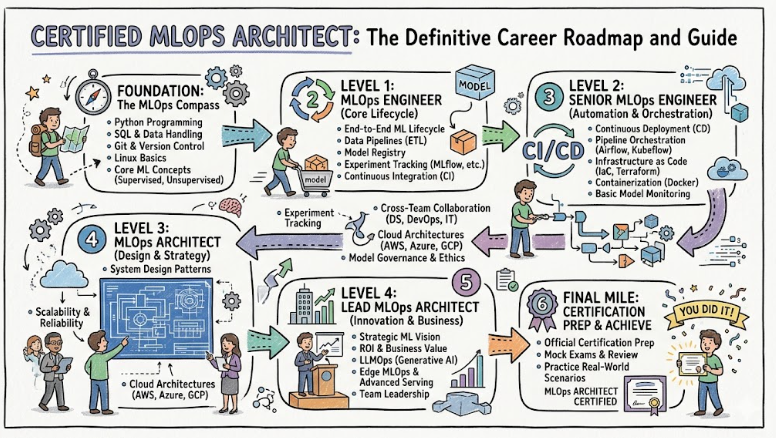
The certification is organized into three primary levels: Foundation, Professional, and Advanced. The Foundation level introduces the core concepts of MLOps, focusing on terminology and basic pipeline construction. It is the starting point for those new to the field, ensuring everyone has a shared understanding of the operational challenges inherent in machine learning.
The Professional level dives deeper into automation, orchestration, and monitoring. This is where practitioners learn to use tools like Kubernetes, Kubeflow, and specialized CI/CD tools for ML. It is designed for engineers who are actively building and maintaining ML platforms. This track emphasizes the implementation of repeatable patterns for model training and deployment.
The Advanced level focuses on high-level architecture, governance, and enterprise strategy. Architects at this level are expected to design multi-cloud environments and ensure that ML systems meet strict security and compliance standards. This level aligns with senior leadership roles and strategic planning, preparing candidates to lead large-scale digital transformation projects.
Complete Certified MLOps Architect Certification Table
| Track | Level | Who it’s for | Prerequisites | Skills Covered | Recommended Order |
| MLOps Core | Foundation | Beginners, Junior Engineers | Basic Linux, Python | ML Lifecycle, DevOps Basics | 1 |
| MLOps Core | Professional | DevOps/Data Engineers | Foundation Cert, K8s | CI/CD for ML, Feature Stores | 2 |
| MLOps Core | Advanced | Principal Engineers, Architects | Professional Cert, Experience | Scalability, Governance, Security | 3 |
| Specialized | SRE Focus | Site Reliability Engineers | Professional Cert | Monitoring, Drift, Latency | 4 |
| Specialized | DataOps Focus | Data Engineers | Professional Cert | Data Versioning, Lineage | 5 |
Detailed Guide for Each Certified MLOps Architect Certification
Certified MLOps Architect – Foundation
What it is
This certification validates a foundational understanding of the machine learning lifecycle and the core principles of MLOps. It ensures that the candidate understands how MLOps differs from traditional DevOps and why specialized tools are necessary.
Who should take it
It is suitable for junior developers, system administrators, and technical managers who need a clear overview of the MLOps landscape. It serves as an entry point for those wanting to establish a career in AI operations.
Skills you’ll gain
- Understanding the ML pipeline stages.
- Basic version control for data and models.
- Knowledge of containerization basics for ML.
- Awareness of model deployment strategies.
Real-world projects you should be able to do
- Create a basic automated pipeline for a simple regression model.
- Containerize a machine learning application using Docker.
- Set up a version-controlled repository for a data science project.
Preparation plan
- 7-14 days: Intensive study of the official syllabus and core MLOps terminology.
- 30 days: Reviewing case studies and practicing basic containerization tasks.
- 60 days: Thoroughly exploring the interaction between data scientists and operations teams.
Common mistakes
- Focusing too much on ML algorithms rather than the operational lifecycle.
- Underestimating the importance of data versioning.
- Ignoring the cultural shifts required for successful MLOps implementation.
Best next certification after this
- Same-track option: Professional Certified MLOps Architect
- Cross-track option: Certified DataOps Associate
- Leadership option: Technical Team Lead Certification
Certified MLOps Architect – Professional
What it is
This certification validates the ability to build and manage production-grade MLOps pipelines using industry-standard tools. It focuses on automation, scalability, and the integration of machine learning into continuous delivery workflows.
Who should take it
This is for mid-level engineers, DevOps practitioners, and Data Engineers who are responsible for maintaining ML infrastructure. It requires a solid understanding of cloud-native technologies and container orchestration.
Skills you’ll gain
- Advanced orchestration with Kubernetes and Kubeflow.
- Implementation of feature stores and model registries.
- Automated testing for data quality and model performance.
- Continuous deployment of ML models.
Real-world projects you should be able to do
- Deploy a multi-stage ML pipeline on a Kubernetes cluster.
- Implement a model monitoring system to detect drift in production.
- Set up an automated retrain loop based on performance triggers.
Preparation plan
- 7-14 days: Focusing on specific orchestration tools and cloud providers.
- 30 days: Hands-on lab work building end-to-end pipelines.
- 60 days: Deep dive into monitoring frameworks and troubleshooting production failures.
Common mistakes
- Neglecting the monitoring and feedback loops after deployment.
- Building overly complex pipelines that are difficult to maintain.
- Failing to account for security in the data ingestion phase.
Best next certification after this
- Same-track option: Advanced Certified MLOps Architect
- Cross-track option: Certified SRE Specialist
- Leadership option: Engineering Manager Certification
Certified MLOps Architect – Advanced
What it is
This level validates the expertise required to design complex, enterprise-wide MLOps strategies and architectures. It emphasizes high availability, regulatory compliance, and cost-efficient scaling across diverse environments.
Who should take it
Senior architects, principal engineers, and technical directors should pursue this level. It is intended for those who have significant experience in managing distributed systems and machine learning workloads at scale.
Skills you’ll gain
- Designing multi-cloud and hybrid MLOps architectures.
- Implementing enterprise-grade security and governance for AI.
- Optimizing infrastructure costs for large-scale model training.
- Strategic planning for long-term ML platform maturity.
Real-world projects you should be able to do
- Design a globally distributed model serving architecture.
- Implement a comprehensive governance framework for data privacy in ML.
- Lead a migration of legacy ML workloads to a modern MLOps platform.
Preparation plan
- 7-14 days: Reviewing enterprise architecture patterns and high-level strategy documents.
- 30 days: Analyzing complex case studies involving security and compliance audits.
- 60 days: Drafting architectural blueprints for large-scale, cross-functional ML initiatives.
Common mistakes
- Ignoring the financial implications of high-performance computing resources.
- Overlooking regional data residency and compliance laws.
- Failing to align technical architecture with business objectives.
Best next certification after this
- Same-track option: Specialized ML Security Architect
- Cross-track option: FinOps Certified Practitioner
- Leadership option: Chief Technology Officer (CTO) Program
Choose Your Learning Path
DevOps Path
For those in DevOps, the transition involves applying existing CI/CD knowledge to the unique challenges of machine learning. You will focus on how “Data” and “Models” become first-class citizens in your deployment pipelines. This path emphasizes the automation of environment provisioning for data scientists. You will learn to treat ML models as artifacts that require rigorous testing and versioning.
DevSecOps Path
The security-focused path ensures that machine learning systems are protected from adversarial attacks and data leaks. You will learn how to integrate security scanning into the model development lifecycle. This involves securing the supply chain of open-source libraries and protecting the integrity of training datasets. It is a critical path for those working in highly regulated industries like finance or healthcare.
SRE Path
Site Reliability Engineers will focus on the observability and reliability of machine learning models in production. This path covers the implementation of Service Level Objectives (SLOs) for ML inference services. You will learn how to handle model drift as a production incident and build self-healing systems. The focus is on maintaining high availability even when model performance fluctuates.
AIOps Path
This path explores the use of artificial intelligence to improve traditional IT operations and infrastructure management. You will learn how to apply machine learning models to log analysis, anomaly detection, and capacity planning. The goal is to build automated systems that can predict and resolve infrastructure issues before they impact users. It is an ideal path for those looking to modernize traditional IT operations teams.
MLOps Path
The MLOps specific path is the core journey of building platforms that enable data scientists to deploy their work seamlessly. You will spend your time mastering the intersection of software engineering and data science workflows. This includes managing experiment tracking, model registries, and metadata stores. It is designed to produce a dedicated architect who can handle the entire model lifecycle.
DataOps Path
DataOps practitioners focus on the reliability and quality of the data that feeds the machine learning models. This path emphasizes the automation of data pipelines and the implementation of data contracts. You will learn how to reduce the cycle time of data delivery while ensuring high data integrity. It is the perfect path for those who believe that high-quality models start with high-quality data.
FinOps Path
The FinOps path is essential for managing the high costs associated with GPU resources and large-scale cloud training. You will learn how to implement cost-tracking for individual ML experiments and optimize resource allocation. This path focuses on ensuring that machine learning initiatives remain financially sustainable for the organization. It is a vital skill set for architects working with massive datasets and complex deep learning models.
Role Recommended Certified MLOps Architect Certifications
| Role | Recommended Certifications |
| DevOps Engineer | Certified MLOps Architect Foundation & Professional |
| SRE | Certified MLOps Architect Professional & SRE Specialist |
| Platform Engineer | Certified MLOps Architect Professional & Advanced |
| Cloud Engineer | Certified MLOps Architect Foundation & Cloud Specialization |
| Security Engineer | Certified MLOps Architect Foundation & DevSecOps Focus |
| Data Engineer | Certified MLOps Architect Professional & DataOps Focus |
| FinOps Practitioner | Certified MLOps Architect Foundation & FinOps Specialist |
| Engineering Manager | Certified MLOps Architect Foundation & Advanced Strategy |
Next Certifications to Take After Certified MLOps Architect
Same Track Progression
After completing the core levels, a professional should look toward deep specialization in specific ML frameworks or cloud providers. This might include becoming an expert in specific tools like Ray for distributed computing or advanced Vertex AI/SageMaker integrations. Deepening your knowledge in specialized areas ensures you are the go-to person for complex technical troubleshooting.
Cross-Track Expansion
Broadening your skills by moving into SRE or DataOps provides a more holistic view of the engineering ecosystem. Understanding how data quality affects model performance, or how infrastructure reliability impacts user experience, makes you a more versatile architect. Cross-training allows you to lead multi-disciplinary teams and solve problems that span across different departments.
Leadership & Management Track
For those looking to move into management, certifications in technical leadership or engineering management are the logical next steps. These programs focus on team building, strategic planning, and stakeholder management. Transitioning into leadership requires a shift from doing the work to enabling others to do the work effectively while maintaining technical oversight.
Training & Certification Support Providers for Certified MLOps Architect
DevOpsSchool
This provider offers extensive training programs focused on the practical application of DevOps and MLOps tools. They provide a hands-on environment where students can experiment with real-world scenarios and production-grade pipelines. Their curriculum is updated frequently to reflect the latest changes in the technology landscape, ensuring that learners are always working with current tools. They emphasize the cultural aspects of engineering, helping teams collaborate more effectively across departments.
Cotocus
This organization specializes in professional consulting and training for modern cloud-native technologies. They provide deep-dive sessions into container orchestration and automation, which are essential for any MLOps architect. Their instructors are industry practitioners who bring real-world experience into the classroom. They offer customized training programs that can be tailored to the specific needs of an enterprise team, making them a popular choice for corporate upskilling.
Scmgalaxy
Known for its massive community and extensive resource library, this provider is a hub for configuration management and DevOps knowledge. They offer targeted training that helps professionals master the complexities of software supply chains. Their focus on automation and version control is highly relevant to the “Ops” part of MLOps. They provide a wealth of documentation, videos, and tutorials that support learners throughout their certification journey.
BestDevOps
This site focuses on providing high-quality, curated content for DevOps and SRE professionals. They offer training paths that are designed to be efficient and results-oriented, helping engineers gain the skills they need in a short amount of time. Their programs are well-regarded for their clarity and focus on the most important aspects of production engineering. They offer a range of certifications and workshops that cater to different skill levels.
devsecopsschool.com
As the name suggests, this provider focuses heavily on the integration of security into the modern software lifecycle. Their training programs are essential for MLOps architects who need to build secure and compliant machine learning systems. They cover topics like automated security testing, vulnerability management, and infrastructure hardening. Their goal is to make security a shared responsibility across the entire engineering team.
sreschool.com
This platform is dedicated to the principles of Site Reliability Engineering and how they apply to modern distributed systems. Their curriculum is invaluable for MLOps professionals who are responsible for the stability and performance of models in production. They teach concepts like error budgets, toil reduction, and incident management. Their training helps engineers build systems that are not just functional but also resilient and scalable.
aiopsschool.com
This is the primary host for the Certified MLOps Architect program and specializes in the intersection of AI and IT operations. They provide a comprehensive learning ecosystem that covers everything from data ingestion to model monitoring. Their focus is specifically on the challenges of operationalizing AI at scale. They offer a range of certifications that are recognized globally as a standard for excellence in AIOps and MLOps.
dataopsschool.com
This provider focuses on the “Data” side of the equation, teaching engineers how to build reliable and automated data pipelines. Their training is critical for ensuring that machine learning models have access to high-quality, timely data. They cover topics like data lineage, data quality testing, and automated data orchestration. Their programs help bridge the gap between traditional data warehousing and modern machine learning requirements.
finopsschool.com
This site addresses the growing need for financial management in cloud and AI operations. Their training helps architects understand the cost drivers of their systems and how to optimize resource usage. This is particularly important for MLOps, where training large models can be extremely expensive. They provide frameworks for cloud cost allocation, forecasting, and optimization, ensuring that AI initiatives are economically viable.
Frequently Asked Questions (General)
- How difficult is the certification exam?
The exam is designed to be challenging but fair. It focuses on practical application rather than just memorizing facts. If you have hands-on experience and have studied the core principles, you will be well-prepared. - How much time is required for preparation?
For most professionals, 30 to 60 days is a realistic timeframe. This allows for a deep dive into the syllabus and enough hands-on practice to feel comfortable with the technical requirements. - Are there any prerequisites for the Foundation level?
There are no formal certification prerequisites, but a basic understanding of Linux and Python is highly recommended. Familiarity with general DevOps concepts will also be beneficial. - What is the ROI of becoming a Certified MLOps Architect?
The ROI is significant, as it opens doors to higher-paying roles and senior leadership positions. It also provides the specialized skills that are currently in high demand across the global tech industry. - Is the certification recognized globally?
Yes, the certification is recognized by major enterprises and startups worldwide. It follows industry standards that are applicable regardless of your geographic location. - Can I take the exam online?
Yes, the certification exams are typically offered online through a proctored platform, making it accessible to professionals everywhere. - How long is the certification valid?
The certification is generally valid for two to three years, after which recertification or moving to a higher level is required to ensure your skills stay current. - Does this certification cover specific cloud providers like AWS or Azure?
While the principles are universal, the training often includes examples and labs on major cloud platforms to ensure real-world applicability. - What is the difference between MLOps and DataOps certifications?
MLOps focuses on the model lifecycle, while DataOps focuses on the data pipeline. Both are related but cover different technical domains within the engineering ecosystem. - How does this certification help an Engineering Manager?
It provides the technical foundation needed to lead MLOps teams and make informed decisions about infrastructure and tool selection. - Are there community forums for students?
Yes, most of the support providers have active communities where students can ask questions and share their experiences. - What happens if I fail the exam on my first attempt?
Most programs offer a retake policy. It is recommended to review the feedback from your first attempt and focus your studies on the areas where you were weakest.
FAQs on Certified MLOps Architect
- What exactly does a Certified MLOps Architect do on a daily basis?
They design and maintain the infrastructure that supports the machine learning lifecycle. This includes building CI/CD pipelines, managing Kubernetes clusters, and ensuring model monitoring is effective. - Why is Kubernetes so important in this certification?
Kubernetes is the industry standard for container orchestration. It provides the scalability and portability required to run machine learning workloads across different environments efficiently. - Do I need to be a Data Scientist to pass this?
No, you do not need to be a data scientist. This is an engineering and architecture certification. You need to understand how models work and how they are deployed, but you don’t need to build the models yourself. - Is Python the only language used?
Python is the primary language for machine learning, but knowledge of Shell scripting and Go can be very helpful for the operational and automation tasks. - How does this certification address model drift?
The program teaches you how to implement monitoring systems that compare live data to training data. You will learn how to trigger automated alerts and retrain loops when drift is detected. - What role does Git play in MLOps architecture?
Git is essential for versioning not just code, but also infrastructure as code and, in some cases, model metadata. It is the foundation of the GitOps approach to MLOps. - Is a feature store covered in the professional level?
Yes, the concept and implementation of feature stores are key components of the professional level, as they are critical for maintaining consistency between training and inference. - How does this certification help with career progression in India?
India has a massive ecosystem of service providers and product companies investing in AI. Having this certification makes you a top candidate for high-level architect roles in these organizations.
Final Thoughts: Is Certified MLOps Architect Worth It?
As an industry veteran, I have seen many trends come and go. However, the operationalization of machine learning is not a trend; it is a fundamental shift in how we build software. Organizations are no longer satisfied with models that only work on a data scientist’s laptop. They need systems that are reliable, scalable, and secure.
The Certified MLOps Architect provides a structured path to mastering these essential skills. It moves you away from the “magic” of AI and into the “reality” of production engineering. It is a rigorous journey, but the knowledge you gain will serve as a strong foundation for the rest of your career.
If you are looking to stay relevant and move into a high-impact role, this certification is a sound investment of your time. It provides the clarity, vocabulary, and technical depth needed to lead in the age of artificial intelligence. Focus on the principles, do the hands-on work, and the career growth will follow naturally.

