
Introduction
The transition from a successful laboratory experiment to a scalable, production-grade machine learning system is one of the most significant challenges in modern technology. The Certified MLOps Engineer designation is designed to bridge this gap, providing professionals with the framework to manage the entire machine learning lifecycle. This guide is curated for engineers and managers who recognize that building a model is only 10% of the journey, while the remaining 90% involves infrastructure, monitoring, and automation.
As a practitioner with over two decades in the industry, I have seen the evolution from manual server racking to automated cloud-native platforms. Today, the integration of Machine Learning (ML) into DevOps practices is the next logical step for SREs and platform engineers. This guide, hosted by AIOps School, helps you navigate the complexities of MLOps, ensuring your career remains at the forefront of the artificial intelligence revolution.
What is the Certified MLOps Engineer?
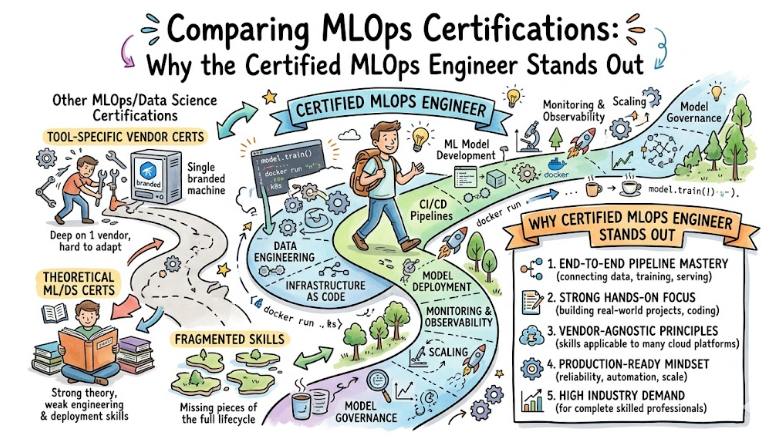
The Certified MLOps Engineer program is a professional validation that focuses on the intersection of data science and traditional DevOps. It exists because the industry has realized that “throwing a model over the wall” to operations simply does not work for large-scale systems. This certification represents a commitment to the principles of reproducibility, scalability, and continuous delivery in the context of machine learning.
Unlike purely theoretical courses, this program emphasizes real-world, production-focused learning. It aligns with modern engineering workflows by treating model code, data, and configuration as first-class citizens in a CI/CD pipeline. For an enterprise, having certified professionals means reduced “time-to-value” for ML projects and a significant reduction in technical debt associated with fragmented ML systems.
Who Should Pursue Certified MLOps Engineer?
This certification is ideal for individuals who occupy the space between data science and system engineering. Software engineers looking to specialize in ML infrastructure, SREs tasked with maintaining high-availability ML services, and Cloud professionals managing GPU-intensive workloads will find this program indispensable. It is also highly beneficial for Data Engineers who want to automate their pipelines beyond simple ETL tasks.
From a management perspective, technical leaders and engineering managers should pursue this to understand the resource and cultural requirements of an MLOps transformation. Whether you are a beginner in India looking to break into the global tech market or an experienced engineer in a Tier-1 tech hub, this certification provides the standardized vocabulary and skill set required to lead ML initiatives effectively.
Why Certified MLOps Engineer is Valuable in Current and Future Markets
The demand for MLOps expertise is skyrocketing as enterprises move beyond the “experimental” phase of AI. Organizations now require longevity and stability in their ML deployments, which requires a shift from artisanally crafted models to industrial-scale pipelines. This certification helps professionals stay relevant by focusing on architectural principles rather than just specific, fleeting tools.
The return on time and career investment is substantial. By mastering MLOps, you are not just learning a tool; you are learning a methodology that handles data drift, model decay, and resource orchestration. As companies increasingly adopt cloud-native and platform engineering practices, the ability to manage the ML lifecycle becomes a core requirement for high-compensation roles in the modern economy.
Certified MLOps Engineer Certification Overview
The program is delivered via the official curriculum and is hosted on the AIOps School platform. The certification is structured into distinct levels that cater to different stages of professional growth, moving from fundamental concepts to advanced architectural design. It uses a practical, assessment-driven approach where candidates must prove their ability to solve real-world problems.
The ownership of the certification lies with an organization dedicated to the convergence of AI and operations. The structure is designed to be modular, allowing engineers to specialize in areas that most reflect their day-to-day responsibilities. This ensures that the learning is not a “one-size-fits-all” approach but a tailored path toward professional mastery.
Certified MLOps Engineer Certification Tracks & Levels
The certification is categorized into three primary levels: Foundation, Professional, and Advanced. Each level is built to progress the candidate from understanding the “what” to mastering the “how” and “why” of MLOps. The tracks are further divided to accommodate different career paths such as Platform Engineering, Data Science, and Site Reliability Engineering.
The Foundation level focuses on the core principles of CI/CD, data versioning, and the ML lifecycle. The Professional level dives into automated retraining, feature stores, and model monitoring. Finally, the Advanced level is for architects who need to design multi-cloud, secure, and compliant ML systems at an enterprise scale. This progression ensures a logical and sustainable career growth trajectory.
Complete Certified MLOps Engineer Certification Table
| Track | Level | Who it’s for | Prerequisites | Skills Covered | Recommended Order |
| Foundational Track | Associate | Junior Engineers, Managers | Basic Python, DevOps Basics | GitOps, Data Versioning, CI/CD | 1st |
| Engineering Track | Professional | SREs, Data Engineers | Foundation Cert, Kubernetes | Feature Stores, Model Registry | 2nd |
| Architect Track | Advanced | Senior Architects, Leads | Professional Cert, Experience | Multi-cloud ML, Security, Compliance | 3rd |
| Specialist Track | Expert | Platform Engineers | Advanced Cert | Infrastructure as Code for ML | Optional |
Detailed Guide for Each Certified MLOps Engineer Certification
Certified MLOps Engineer – Foundation Level
What it is
This certification validates a professional’s understanding of the basic components required to build an MLOps pipeline. It covers the terminology and the conceptual shift required to move from DevOps to MLOps.
Who should take it
It is suitable for junior developers, data scientists who want to understand operations, and managers who need to oversee MLOps teams. No deep operational experience is required.
Skills you’ll gain
- Understanding the ML Lifecycle (MLLC).
- Version control for both code and datasets.
- Basic CI/CD concepts applied to machine learning.
- Fundamentals of model packaging and containerization.
Real-world projects you should be able to do
- Set up a GitHub repository that triggers a model build on every commit.
- Implement a basic DVC (Data Version Control) flow for a small dataset.
- Containerize a Flask or FastAPI model for deployment.
Preparation plan
- 7-14 Days: Focus on terminology, MLOps manifestos, and basic GitOps principles.
- 30 Days: Practice with tools like DVC and basic Docker for ML models.
- 60 Days: Deep dive into the integration of MLflow and automated testing.
Common mistakes
- Ignoring data versioning and focusing only on code.
- Underestimating the importance of reproducible environments.
Best next certification after this
- Same-track option: Certified MLOps Engineer – Professional.
- Cross-track option: Certified DataOps Professional.
- Leadership option: Technical Product Manager for AI.
Certified MLOps Engineer – Professional Level
What it is
This level validates the ability to build and maintain production-grade ML pipelines. It focuses on automation, monitoring, and the scalability of ML services within a Kubernetes ecosystem.
Who should take it
Mid-level engineers, SREs, and Data Professionals who are actively involved in deploying models to production and managing their uptime.
Skills you’ll gain
- Orchestrating ML workflows using tools like Kubeflow or Airflow.
- Managing Feature Stores for consistent data access.
- Implementing automated model retraining and validation.
- Advanced monitoring for data drift and model performance.
Real-world projects you should be able to do
- Build an end-to-end automated pipeline that retrains a model when performance drops.
- Deploy a feature store that serves data to both training and inference tasks.
- Configure a Prometheus/Grafana dashboard for model latency and drift.
Preparation plan
- 7-14 Days: Study Kubernetes fundamentals and ML workflow orchestration.
- 30 Days: Build a local lab using Minikube and Kubeflow to test pipelines.
- 60 Days: Implement a full CI/CD/CT (Continuous Training) loop for a complex project.
Common mistakes
- Over-engineering the infrastructure for simple use cases.
- Failing to account for the costs of running GPU workloads in the cloud.
Best next certification after this
- Same-track option: Certified MLOps Engineer – Advanced.
- Cross-track option: Certified SRE Professional.
- Leadership option: MLOps Team Lead.
Certified MLOps Engineer – Advanced Level
What it is
This certification is for those designing the architectural blueprint of ML platforms. It covers security, compliance, multi-tenancy, and global scale operations.
Who should take it
Senior Architects, Principal Engineers, and Technical Leads responsible for enterprise-wide AI strategy and infrastructure.
Skills you’ll gain
- Designing multi-cloud and hybrid-cloud ML architectures.
- Implementing DevSecOps within the ML lifecycle.
- Handling large-scale distributed training and low-latency inference.
- Compliance and governance for AI (GDPR, AI Act, etc.).
Real-world projects you should be able to do
- Design a secure, air-gapped ML environment for sensitive financial data.
- Implement a global model serving architecture with sub-100ms latency.
- Create a cost-optimization framework for multi-tenant ML platforms.
Preparation plan
- 7-14 Days: Focus on cloud-native design patterns and security frameworks.
- 30 Days: Review case studies of large-scale ML deployments at companies like Uber or Netflix.
- 60 Days: Design and document a full enterprise ML platform architecture.
Common mistakes
- Ignoring the regulatory landscape which can halt production deployments.
- Not designing for disaster recovery in ML systems.
Best next certification after this
- Same-track option: Expert Specialization in Generative AI Ops.
- Cross-track option: Certified FinOps Professional.
- Leadership option: Chief Technology Officer (CTO) / Head of AI.
Choose Your Learning Path
DevOps Path
The DevOps path focuses on the extension of existing CI/CD pipelines to include machine learning artifacts. Engineers on this path will learn how to treat ML models as software packages, ensuring that they can be tested, versioned, and deployed with the same rigor as traditional code. This involves mastering Jenkins, GitLab CI, or GitHub Actions in the context of Python-based ML environments.
DevSecOps Path
In this path, the focus is on the security of the ML supply chain. You will learn to scan model weights for vulnerabilities, protect training data from poisoning attacks, and ensure that inference endpoints are secure. It is a critical path for those working in highly regulated industries like banking or healthcare where AI security is paramount.
SRE Path
The SRE path for MLOps is about reliability and observability. These professionals focus on “Model Reliability Engineering,” ensuring that ML services meet their Service Level Objectives (SLOs). They build systems to detect when a model is failing silently due to changes in input data and automate the recovery or rollback processes.
AIOps Path
The AIOps path focuses on using artificial intelligence to improve IT operations. Here, the engineer learns to deploy models that predict system failures, automate root cause analysis, and manage logs through machine learning. It is about applying the MLOps lifecycle specifically to the tools that keep the lights on in a data center or cloud environment.
MLOps Path
This is the core path dedicated to the operationalization of machine learning models. It covers the entire spectrum from data ingestion to model serving and monitoring. Engineers here are the “glue” that holds the data science and IT teams together, ensuring that the transition from a notebook to a production API is seamless and repeatable.
DataOps Path
The DataOps path focuses on the “Data” part of MLOps. It ensures that the data pipelines feeding the ML models are robust, high-quality, and versioned. This path is essential for ensuring that the data used for training matches the data seen in production, which is the number one cause of model failure in the real world.
FinOps Path
The FinOps path addresses the massive costs associated with machine learning. Professionals learn how to optimize GPU usage, manage cloud spot instances for training, and implement “showback” or “chargeback” mechanisms for different business units. It ensures that the AI initiative remains profitable and sustainable from a financial perspective.
Role → Recommended Certified MLOps Engineer Certifications
| Role | Recommended Certifications |
| DevOps Engineer | Foundation + Professional (Engineering Track) |
| SRE | Professional + Specialist (Reliability Track) |
| Platform Engineer | Professional + Advanced (Architect Track) |
| Cloud Engineer | Foundation + Specialist (Cloud-Native Track) |
| Security Engineer | Foundation + Specialist (DevSecOps Track) |
| Data Engineer | Foundation + DataOps Track |
| FinOps Practitioner | Foundation + FinOps Specialist |
| Engineering Manager | Foundation + Advanced (Strategy focus) |
Next Certifications to Take After Certified MLOps Engineer
Same Track Progression
Once you have mastered the Certified MLOps Engineer curriculum, the logical next step is deep specialization. This might involve moving into niche areas like Edge AI Ops for IoT devices or Generative AI Ops (LLMOps) for managing large language models. These specializations allow you to become a high-value expert in specific vertical markets.
Cross-Track Expansion
Broadening your skills is essential for a well-rounded career. After MLOps, a transition into SRE or DevSecOps provides a holistic view of the software ecosystem. Understanding how ML systems interact with legacy databases or front-end services makes you a more versatile engineer capable of leading cross-functional teams.
Leadership & Management Track
For those looking to move away from hands-on keyboard roles, transitioning into management requires a different set of certifications. Pursuing a Technical Product Management or a Certified Agile Leadership program allows you to leverage your MLOps knowledge to drive business strategy and lead large-scale digital transformations.
Training & Certification Support Providers for Certified MLOps Engineer
DevOpsSchool
DevOpsSchool is a leading provider of technical training that focuses on the practical application of MLOps and DevOps tools. They offer comprehensive bootcamps and instructor-led sessions that are particularly popular in the Indian market. Their curriculum is designed to take a student from a beginner level to a job-ready professional by focusing on lab-based learning. They provide extensive documentation and support for candidates preparing for the Certified MLOps Engineer exams.
Cotocus
Cotocus specializes in providing high-end consulting and training for modern engineering practices. They focus on delivering customized training programs for corporate clients who need to upskill their entire engineering workforce. Their approach to MLOps training is heavily influenced by their consulting experience, meaning they teach what actually works in large-scale production environments. They are a great choice for professionals looking for a more personalized or corporate-focused learning experience.
Scmgalaxy
Scmgalaxy is a vast community and knowledge hub for professionals in the Software Configuration Management and DevOps space. They provide a wealth of free resources, tutorials, and certification guides that help engineers navigate the complex landscape of MLOps. Their focus is on building a strong community of practitioners who share real-world problems and solutions. For someone preparing for the Certified MLOps Engineer, Scmgalaxy offers a treasure trove of community-vetted information.
BestDevOps
BestDevOps focuses on providing curated learning paths and certification prep for the most in-demand roles in the industry. They emphasize quality over quantity, ensuring that their training materials are updated frequently to reflect the latest changes in tools like Kubernetes and MLflow. Their platform is designed for busy professionals who need efficient and focused study materials to pass their certifications on the first attempt without wasting time on outdated content.
devsecopsschool.com
DevSecOpsSchool.com is the primary destination for engineers who want to integrate security into their MLOps pipelines. They offer specialized courses that cover model security, data privacy, and compliance automation. As security becomes a top priority for AI initiatives, this provider helps Certified MLOps Engineer candidates add a critical layer of expertise to their resume. Their labs often focus on real-world threat modeling for machine learning systems.
sreschool.com
SRESchool.com focuses on the “Operations” and “Reliability” aspects of the engineering world. For MLOps professionals, this site provides the tools and techniques needed to ensure that ML models are highly available and performant. They teach the metrics, monitoring, and incident response strategies that are specific to AI systems. Their content is essential for anyone aiming for the Professional or Advanced levels of the MLOps certification.
aiopsschool.com
AIOpsSchool.com is the central hub for the Certified MLOps Engineer program and other AI-centric operational certifications. They provide the official curriculum, assessment platforms, and a direct path to certification. Their focus is strictly on the intersection of AI and Operations, making them the most authoritative source for this specific certification. The site offers a blend of theoretical knowledge and hands-on laboratory exercises designed to simulate real-world production challenges.
dataopsschool.com
DataOpsSchool.com addresses the critical need for data engineering excellence within the MLOps lifecycle. They provide training on how to build scalable, reproducible, and automated data pipelines. Since MLOps is heavily dependent on the quality of data, the resources here are invaluable for candidates who want to master the data versioning and data quality components of the certification. Their courses bridge the gap between traditional data warehousing and modern ML data needs.
finopsschool.com
FinOpsSchool.com is dedicated to the financial management of cloud and AI infrastructure. With the rising costs of model training and inference, understanding the economics of MLOps is vital. This provider offers training on how to track, manage, and optimize the costs associated with machine learning projects. For senior engineers and managers, the insights gained here are crucial for proving the ROI of their MLOps initiatives to stakeholders.
Frequently Asked Questions (General)
- What is the difficulty level of the MLOps certification?
The difficulty ranges from moderate for the Foundation level to very high for the Advanced level, requiring significant hands-on experience with cloud and automation tools. - How long does it take to get certified?
Depending on your background, it typically takes between 30 to 90 days of focused study to complete a level. - Are there any prerequisites for the Foundation level?
No formal prerequisites exist, but a basic understanding of Python and the Linux command line is highly recommended. - What is the ROI of this certification?
Certified professionals often see a 20-30% increase in salary and have access to higher-tier roles in platform engineering and AI operations. - Is the exam theoretical or practical?
The assessment is heavily focused on practical scenarios and lab-based challenges that simulate real-world production issues. - Do I need to be a Data Scientist to take this?
No, this is an engineering-first certification. While you need to understand the ML lifecycle, you do not need to be an expert in building complex algorithms. - How often does the certification need to be renewed?
The certification is typically valid for two years, after which a recertification or a higher-level achievement is required to stay current. - Can I take the exam online?
Yes, the certification is designed to be accessible globally through a secure online proctoring system. - Does the program cover specific cloud providers like AWS or Azure?
The core principles are cloud-agnostic, but the practical labs often allow you to use major cloud providers to demonstrate your skills. - Is there a community for certified engineers?
Yes, AIOps School maintains a private community for certified professionals to network and share insights. - Are there group discounts for corporate teams?
Most training providers like DevOpsSchool and Cotocus offer group rates for enterprise teams looking to upskill. - What tools are covered in the curriculum?
The curriculum covers industry standards like Kubernetes, Docker, MLflow, DVC, Airflow, and various monitoring stacks.
FAQs on Certified MLOps Engineer
- What specifically does the Certified MLOps Engineer validate?
This certification validates that an engineer understands how to bridge the gap between model development and production. It proves you can automate the training, deployment, and monitoring of models using CI/CD/CT pipelines. It focuses on the ability to handle data drift, model decay, and infrastructure scaling, ensuring that machine learning projects are not just successful in a lab but remain reliable and cost-effective in a live environment. - How does this certification differ from a standard DevOps certification?
Standard DevOps focuses on code and application deployment. MLOps adds two more dimensions: Data and Models. This certification tests your ability to version datasets (not just code) and monitor model performance metrics (like accuracy or F1-score) which are not present in traditional software. It requires understanding of specific ML-related infrastructure needs, such as GPU scheduling and specialized hardware for inference, making it more specialized than a general DevOps role. - Is this certification recognized globally?
Yes, the curriculum is designed to meet international standards for cloud-native and AI operations. It is recognized by major tech firms in India, the US, and Europe. Because it focuses on open-source tools and platform-agnostic principles, the skills you gain are transferable across different industries and geographical regions, making it a valuable asset for engineers looking to move into international roles or work for global enterprises. - What is the role of Kubernetes in this certification?
Kubernetes is a core component of the MLOps ecosystem. The certification expects you to understand how to containerize ML models and orchestrate them using Kubernetes. You will learn about CRDs (Custom Resource Definitions) for ML, such as those used in Kubeflow, and how to manage resource-intensive pods. Proficiency in Kubernetes is often what separates a junior MLOps enthusiast from a professional certified engineer who can manage scale. - How does the certification handle the concept of “Continuous Training”?
Continuous Training (CT) is a unique pillar of MLOps. The certification teaches you how to design systems that automatically trigger a retraining pipeline when data drift is detected or when new ground-truth data becomes available. This involves integrating the model registry with the CI/CD pipeline, a concept that is deeply explored in the Professional level of the certification to ensure the system is self-healing and adaptive. - Can I transition from a Data Science role to MLOps using this program?
Absolutely. Many Data Scientists find that their models never make it to production because they lack operational skills. This program provides the “missing link.” It teaches Data Scientists the engineering rigor required to make their work impactful at scale. By completing this certification, a Data Scientist can transition into a “Machine Learning Engineer” or “MLOps Architect” role, which often commands higher responsibility and pay. - Does the certification cover LLMOps or Generative AI?
The Foundation and Professional levels focus on general MLOps principles applicable to all models. However, the Advanced and Specialist tracks increasingly cover the specific challenges of Large Language Models (LLMs), such as fine-tuning pipelines, vector database management, and the high-cost optimization of LLM inference. This ensures that the certification remains at the cutting edge of the current AI wave while maintaining a solid foundation in traditional ML. - What kind of support is available for those who fail the first attempt?
Most providers offer a second attempt or “retake” policy. Additionally, the training support providers listed in this guide offer extensive practice exams and laboratory walkthroughs to help students identify their weak points. The community forums at AIOps School also provide a place for students to ask questions and get clarification on complex topics from mentors and previously certified engineers, ensuring a high eventual success rate.
Final Thoughts: Is Certified MLOps Engineer Worth It?
From the perspective of a mentor who has watched tech trends come and go, MLOps is not a “fad”—it is the industrialization of AI. If you are an engineer today, you are likely feeling the pressure to incorporate ML into your stacks. This certification provides a structured, high-signal way to prove you have the skills to do it properly.
It is worth it if you are looking to move beyond manual work and into the world of high-scale automation. It is worth it if you want to be the person who solves the “it worked on my machine” problem for data science teams. Don’t just collect badges; use this program as a roadmap to master the most complex and rewarding engineering discipline of our current era. Use the resources wisely, spend time in the labs, and focus on the architectural “why” behind every tool.

