
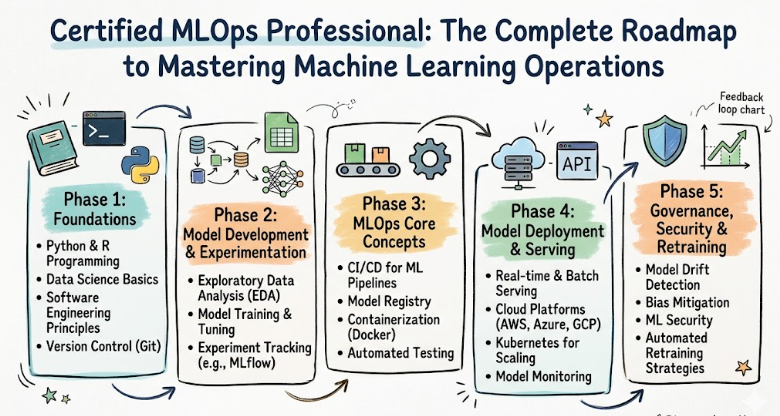
Introduction
The Certified MLOps Professional is a comprehensive validation of an engineer’s ability to bridge the gap between data science and production-grade operations. As organizations move beyond experimental machine learning toward large-scale deployment, the need for standardized operational practices becomes critical for stability and ROI. This guide is designed for professionals who want to understand the strategic and technical depth of the program hosted on AIOps School. We will explore how this certification fits into the broader ecosystem of DevOps, SRE, and platform engineering to help you make an informed decision for your career trajectory.
What is the Certified MLOps Professional?
The Certified MLOps Professional program represents a rigorous standard for implementing, managing, and scaling machine learning workflows in enterprise environments. Unlike theoretical data science courses, this certification focuses on the operational side of the house, emphasizing automation, monitoring, and governance of models in production. It exists to solve the “last mile” problem where models fail to move from a Jupyter notebook into a reliable, scalable service. By aligning with modern engineering workflows, the program ensures that practitioners can treat ML models as first-class citizens within a standard CI/CD pipeline.
Who Should Pursue Certified MLOps Professional?
This certification is specifically designed for DevOps engineers, Site Reliability Engineers (SREs), and cloud architects who are increasingly tasked with supporting data science workloads. It is equally valuable for data engineers and machine learning professionals who want to adopt a “production-first” mindset to ensure their work survives the rigors of real-world traffic. Beginners looking to enter a high-growth niche and experienced managers overseeing cross-functional engineering teams will find the curriculum highly relevant. For the global audience, particularly in the rapidly maturing tech markets of India, this credential serves as a vital differentiator in a competitive landscape.
Why Certified MLOps Professional is Valuable Today and Beyond
The demand for MLOps talent is skyrocketing as enterprise adoption of artificial intelligence moves from a luxury to a business necessity. Organizations are no longer looking for just model builders; they need professionals who can ensure those models are reliable, cost-effective, and secure over the long term. This certification provides longevity because it teaches core principles of operational excellence that remain relevant even as specific tooling evolves. Investing time in this track offers a high return on career investment by positioning you at the intersection of two high-demand fields: infrastructure engineering and data science.
Certified MLOps Professional Certification Overview
The program is delivered via the official training portal at Certified MLOps Professional and is formally hosted on the aiopsschool.com platform. The certification is structured to guide candidates through various levels of competency, moving from core concepts to complex architectural patterns. Its assessment approach is practical, requiring candidates to demonstrate knowledge of real-world bottlenecks, such as data drift and resource orchestration. Ownership of the program is maintained by industry experts who regularly update the content to reflect current enterprise practices in MLOps and AIOps.
Certified MLOps Professional Certification Tracks & Levels
The certification hierarchy is divided into three primary levels: Foundation, Professional, and Advanced, ensuring a clear path for professional growth. The Foundation level introduces the core vocabulary and concepts, while the Professional level—the core of this guide—focuses on the end-to-end implementation of ML pipelines. Advanced levels dive into specialized domains such as edge computing, high-performance computing (HPC), and complex security frameworks. These levels align with standard career progression, allowing an engineer to move from a junior contributor to a principal architect or leadership role over time.
Complete Certified MLOps Professional Certification Table
| Track | Level | Who it’s for | Prerequisites | Skills Covered | Recommended Order |
| MLOps Core | Foundation | Beginners, Managers | Basic Linux, Python | ML Lifecycle, Core DevOps | 1 |
| MLOps Core | Professional | DevOps, Data Engineers | Foundation Level | CI/CD for ML, Drift, Monitoring | 2 |
| MLOps Core | Advanced | Architects, SREs | Professional Level | Scaling, Security, Governance | 3 |
| Specialization | Leadership | Team Leads, VPs | Professional Level | Strategy, ROI, Team Building | 4 |
Detailed Guide for Each Certified MLOps Professional Certification
Certified MLOps Professional – Foundation
What it is
The Foundation certification validates a basic understanding of the Machine Learning lifecycle and how it integrates with traditional IT operations. It ensures that the candidate can speak the language of both data scientists and system administrators effectively.
Who should take it
This is suitable for junior engineers, non-technical project managers, and recruiters who need to understand the fundamental mechanics of MLOps. It is an ideal entry point for those pivoting from traditional IT roles into the data space.
Skills you’ll gain
- Understanding the difference between DevOps and MLOps.
- Mastery of the ML lifecycle phases: Data preparation, Training, and Deployment.
- Basic knowledge of versioning for both code and datasets.
- Familiarity with containerization basics for ML models.
Real-world projects you should be able to do
- Document a basic MLOps workflow for a small startup team.
- Identify the necessary stakeholders for a machine learning project.
- Set up a basic version control repository for a data science experiment.
Preparation plan
- 7-14 Days: Focus on terminology, the history of MLOps, and basic cloud concepts.
- 30 Days: Review case studies of ML failures in production and study the 12-factor app principles.
- 60 Days: Not typically required for Foundation, but good for deep-diving into specific cloud provider tools.
Common mistakes
- Over-focusing on the math behind algorithms instead of the infrastructure.
- Ignoring the importance of data quality at the ingestion phase.
Best next certification after this
- Same-track option: Certified MLOps Professional (Core).
- Cross-track option: Certified SRE Professional.
- Leadership option: Technical Product Manager for ML.
Certified MLOps Professional – Professional (Core)
What it is
This is the flagship certification that validates an engineer’s ability to build and maintain production-ready pipelines. It covers the automation of model training, validation, and deployment using enterprise-grade tools and practices.
Who should take it
Experienced DevOps engineers, SREs, and Data Engineers who are responsible for the uptime and performance of ML-based services. It is designed for those who work in the trenches of production environments.
Skills you’ll gain
- Building automated CI/CD pipelines specifically for ML (CT – Continuous Training).
- Implementing advanced monitoring for data drift and model decay.
- Managing Feature Stores and Model Registries at scale.
- Orchestrating resources using Kubernetes and specialized ML operators.
Real-world projects you should be able to do
- Build a pipeline that automatically triggers model retraining when performance drops.
- Implement a blue-green deployment strategy for a high-traffic prediction service.
- Configure a centralized logging and monitoring system for distributed ML workloads.
Preparation plan
- 7-14 Days: Intensive review of Kubernetes, Docker, and CI/CD tools like Jenkins or GitLab.
- 30 Days: Hands-on lab work with MLflow, Kubeflow, or cloud-native ML services.
- 60 Days: Full simulation of an end-to-end production environment including security and scaling.
Common mistakes
- Neglecting the security of the model artifacts and data access.
- Failing to account for the cost of GPU/CPU resources during training.
Best next certification after this
- Same-track option: Advanced MLOps Architect.
- Cross-track option: Certified AIOps Professional.
- Leadership option: Engineering Manager for AI/ML Platforms.
Choose Your Learning Path
DevOps Path
The DevOps path focuses on the seamless integration of machine learning into existing software delivery frameworks. Engineers on this path prioritize the automation of testing and deployment, ensuring that ML code follows the same rigorous standards as application code. You will learn to treat models as deployable artifacts and manage their lifecycle through standard versioning and release management practices. This path is essential for organizations looking to break down silos between data science and traditional engineering departments.
DevSecOps Path
In the DevSecOps path, the primary focus is on the security and compliance of the machine learning pipeline. This involves securing data supply chains, ensuring the privacy of training sets, and protecting models from adversarial attacks or unauthorized access. Professionals here learn to implement automated security scanning within the MLOps pipeline and manage identity and access control for complex data environments. This is a critical path for regulated industries like finance, healthcare, and government services.
SRE Path
The Site Reliability Engineering (SRE) path emphasizes the availability, performance, and latency of machine learning models in production. SREs in the MLOps space focus on defining and maintaining Service Level Objectives (SLOs) for prediction services and building automated self-healing systems. You will learn how to handle the unique failure modes of ML, such as silent failures caused by data drift rather than code crashes. This path ensures that AI-driven features meet the same high reliability standards as the rest of the platform.
AIOps Path
The AIOps path is distinct from MLOps as it focuses on using machine learning to improve IT operations themselves. Professionals on this path learn how to implement ML models to analyze vast amounts of log, metric, and trace data to predict outages or automate incident response. You will gain skills in anomaly detection, event correlation, and root cause analysis powered by AI. This path is ideal for those who want to build the “self-driving” data centers and platforms of the future.
MLOps Path
The MLOps path is the core journey for those specializing in the lifecycle management of machine learning models for business applications. It covers everything from experimental reproducibility to large-scale distributed training and high-performance inference. This path focuses on the technical architecture required to support data scientists, including feature stores, model registries, and specialized hardware orchestration. It is the definitive path for anyone aiming to become an MLOps Engineer or ML Architect.
DataOps Path
DataOps focuses on the delivery of high-quality data to the machine learning pipeline, emphasizing agility and collaboration between data providers and consumers. This path teaches how to apply DevOps principles to data pipelines, including automated data testing, versioning, and continuous integration of data sources. You will learn to manage data quality as a code-driven process, ensuring that the input to ML models is always reliable and timely. This is the foundation upon which successful MLOps strategies are built.
FinOps Path
The FinOps path addresses the economic side of machine learning, focusing on the high costs associated with training and serving models. Professionals on this path learn to monitor cloud spend, optimize resource utilization (like GPU right-sizing), and implement tagging and allocation strategies for ML projects. You will gain the skills to bridge the gap between engineering and finance, ensuring that AI initiatives remain profitable and within budget. This path is vital for organizations scaling their ML footprints in the public cloud.
Role → Recommended Certified MLOps Professional Certifications
| Role | Recommended Certifications |
| DevOps Engineer | Certified MLOps Professional, Kubernetes Administrator |
| SRE | Certified MLOps Professional, Certified SRE Professional |
| Platform Engineer | Certified MLOps Professional, Cloud Architect |
| Cloud Engineer | Certified MLOps Professional, FinOps Practitioner |
| Security Engineer | Certified MLOps Professional, Certified DevSecOps Professional |
| Data Engineer | Certified MLOps Professional, DataOps Specialist |
| FinOps Practitioner | Certified MLOps Professional, FinOps Certified Professional |
| Engineering Manager | Certified MLOps Professional, Technical Leadership |
Next Certifications to Take After Certified MLOps Professional
Same Track Progression
Once you have mastered the Professional level, the natural progression is to move toward the Advanced or Expert tiers within the MLOps ecosystem. These advanced tracks typically involve deep-diving into specific niches such as Edge AI, where models are deployed on low-power devices, or High-Performance Computing (HPC) for massive-scale training. This deep specialization makes you an invaluable asset for complex, large-scale infrastructure projects that go beyond standard cloud deployments.
Cross-Track Expansion
To become a truly versatile platform expert, expanding into adjacent tracks like AIOps or DevSecOps is highly recommended. Understanding how to use AI to manage operations (AIOps) or how to secure the entire pipeline (DevSecOps) provides a holistic view of modern engineering. This cross-training allows you to solve problems that span multiple departments and makes you a prime candidate for “Staff” or “Principal” engineer roles where broad system knowledge is required.
Leadership & Management Track
For those looking to transition out of individual contributor roles, the next step involves certifications in Technical Product Management or Engineering Leadership. These tracks focus on the strategic implementation of MLOps, including team structure, ROI calculation, and stakeholder management. You will learn how to build a culture of operational excellence and how to align technical AI capabilities with the broader goals of the business.
Training & Certification Support Providers for Certified MLOps Professional
DevOpsSchool
DevOpsSchool is a leading provider of technical training that offers a deep catalog of courses designed for the modern engineer. Their approach combines theoretical knowledge with intense practical labs, ensuring that students can apply what they learn immediately in a production environment. With a faculty composed of industry veterans, they provide mentorship that goes beyond the standard curriculum, helping students navigate the complexities of career transitions. They are particularly known for their robust community support and post-training guidance, making them a preferred choice for many professionals in India and globally.
Cotocus
Cotocus specializes in high-end consulting and training for specialized IT niches, including MLOps, SRE, and cloud-native technologies. They focus on delivering customized training solutions that meet the specific needs of enterprises and individual professionals looking for high-impact skills. Their curriculum is designed to be highly practical, focusing on the actual tools and workflows used by top-tier tech companies. By providing access to real-world scenarios and expert-led workshops, Cotocus helps candidates master the nuances of complex operational frameworks.
Scmgalaxy
Scmgalaxy has established itself as a premier community and knowledge hub for Software Configuration Management and DevOps professionals. They offer a wealth of free and paid resources, including tutorials, webinars, and certification bootcamps that cover the entire spectrum of modern IT operations. Their focus is on building a strong foundation of best practices, ensuring that engineers understand the “why” behind the tools they use. This community-driven approach makes them an excellent resource for staying updated with the latest trends and finding peer support during the learning process.
BestDevOps
BestDevOps focuses on providing streamlined, efficient learning paths for professionals who need to gain new skills quickly without sacrificing depth. Their training programs are designed to be outcome-oriented, with a heavy emphasis on certification success and job readiness. They offer a range of specialized tracks that cater to different skill levels, from beginners to advanced architects. By focusing on the most relevant tools and practices, BestDevOps ensures that their students remain competitive in a rapidly evolving job market.
devsecopsschool.com
This provider is the go-to resource for engineers who want to specialize in the intersection of security and operations. They provide comprehensive training on how to integrate security into every stage of the software development lifecycle, with a specific focus on automated compliance and threat modeling. Their courses are designed to turn traditional security professionals into agile engineers and vice-versa. In the context of MLOps, they provide vital knowledge on securing the data supply chain and protecting sensitive AI assets.
sreschool.com
Sreschool.com is dedicated to the discipline of Site Reliability Engineering, offering deep-dives into availability, performance, and incident management. Their training programs are modeled after the SRE practices pioneered by industry leaders, providing students with a blueprint for building reliable systems at scale. They emphasize the importance of monitoring, automation, and the reduction of toil, which are critical components of any successful MLOps strategy. For engineers looking to master the art of production excellence, this is an essential training partner.
aiopsschool.com
AIOps School is the primary host and delivery platform for the Certified MLOps Professional program, specializing in the intersection of AI and IT operations. They provide a cutting-edge curriculum that addresses the unique challenges of managing machine learning in production. Their focus is on enabling organizations to become more proactive and automated through the use of AI-driven insights. By offering specialized certifications, they help define the standards for this emerging and highly influential field.
dataopsschool.com
DataOps School focuses on the agile management of data, providing training on how to build robust, automated data pipelines. They teach the principles of continuous integration and continuous delivery as they apply to data, ensuring that machine learning models have access to high-quality, timely information. Their courses cover everything from data versioning to automated quality testing and governance. For professionals who want to master the “data” part of MLOps, this provider offers the most specialized and practical curriculum available.
finopsschool.com
FinOps School addresses the critical need for cloud financial management, teaching engineers and managers how to optimize the cost of their infrastructure. Their training programs provide a framework for bringing financial accountability to the variable spend of the cloud, which is especially important for resource-heavy AI and ML projects. They offer certifications that help professionals bridge the gap between engineering, finance, and business teams. Mastering FinOps ensures that your MLOps initiatives are not just technically successful but also economically sustainable.
Frequently Asked Questions (General)
- What is the typical difficulty level of this certification?
The Professional level is considered moderate to high difficulty, as it requires a strong understanding of both software engineering and data concepts. It is not just about memorization; it requires the ability to design and troubleshoot complex architectures. - How much time should I dedicate to studying?
Most professionals find that 30 to 60 days of consistent study is sufficient, depending on their prior experience with DevOps and cloud-native tools. Hands-on practice is essential and often takes up the majority of this time. - Are there any mandatory prerequisites?
While not strictly mandatory for all, having a basic understanding of Linux, Python, and containerization (like Docker) is highly recommended. Some tracks may suggest completing a Foundation level first. - What is the return on investment (ROI) for this certification?
Professionals with specialized MLOps skills often see significant salary increases and access to more senior roles. It differentiates you from generalist engineers in a crowded market. - Is the exam more theoretical or practical?
The exam is designed to be highly practical, focusing on scenarios you would encounter in a real production environment. You will be expected to solve architectural problems and identify operational bottlenecks. - How long does the certification remain valid?
Most certifications in this field are valid for two to three years, after which recertification or moving to a higher level is required to ensure your skills stay current with evolving technology. - Does this certification help in getting a job in India?
Yes, the demand for MLOps talent in the Indian tech hubs like Bengaluru, Hyderabad, and Pune is massive. Global companies with engineering centers in India specifically look for standardized certifications to vet candidates. - Can I take the exam online?
Yes, the program is designed to be accessible globally through an online proctored environment, allowing you to take the assessment from anywhere with a stable internet connection. - What tools are covered in the curriculum?
The curriculum is designed to be tool-agnostic in principle but covers industry standards like Kubernetes, MLflow, Kubeflow, Jenkins, and major cloud service providers (AWS, Azure, GCP). - Is there a community for certified professionals?
Yes, holders of the certification gain access to exclusive forums and alumni networks where they can share knowledge, find job opportunities, and collaborate on projects. - How does this differ from a Data Science certification?
Data science certifications focus on building models and algorithms. This certification focuses on the infrastructure, automation, and reliability required to run those models in a business environment. - Can I skip the Foundation level?
If you have significant experience in DevOps or Data Engineering, you may be able to jump straight to the Professional level, but reviewing the Foundation material is always recommended for consistency.
FAQs on Certified MLOps Professional
- Does the program cover Generative AI and LLMops?
Yes, the modern curriculum includes sections on managing large language models, including fine-tuning pipelines and the specific infrastructure needs of generative AI applications. - How is “Continuous Training” (CT) handled in the course?
The course teaches you how to build automated triggers based on performance metrics that initiate new training runs without manual intervention, a key pillar of mature MLOps. - Does it include cost optimization for GPUs?
Yes, integrating FinOps principles specifically for ML workloads is a core part of the professional track, helping you manage expensive compute resources efficiently. - Is monitoring for “Data Drift” a major topic?
Absolutely. You will learn how to detect when the statistical properties of production data change, which can cause model accuracy to plummet even if the code is fine. - Does the certification cover governance and ethics?
The program includes modules on model lineage and auditability, ensuring that you can track which data and code produced a specific model version for compliance purposes. - Are cloud-specific tools like SageMaker or Vertex AI covered?
While the certification emphasizes open-source and agnostic patterns, it provides guidance on how to implement these patterns using the major cloud provider services. - How does the program handle model serving?
You will learn various serving strategies, including REST APIs, gRPC, and batch processing, along with how to scale these services using Kubernetes. - What is the role of Kubernetes in the certification?
Kubernetes is treated as the primary orchestration layer. You will learn about CRDs and operators that are specifically designed to manage ML workflows.
Final Thoughts: Is Certified MLOps Professional Worth It?
From the perspective of a mentor who has seen the industry evolve over two decades, the Certified MLOps Professional is a highly strategic investment. We have moved past the era where simply “making the model work” was enough. Today, the value lies in making the model work reliably, securely, and cost-effectively at scale. This certification doesn’t just add a badge to your profile; it provides the mental framework and technical toolkit required to lead AI initiatives in a professional capacity. If you are looking to future-proof your career and move into the most exciting intersection of modern technology, this path is unequivocally worth the effort. There is no hype here—only the practical reality that the future of engineering is AI-driven, and those who can operate that future will be the ones who lead it.

