
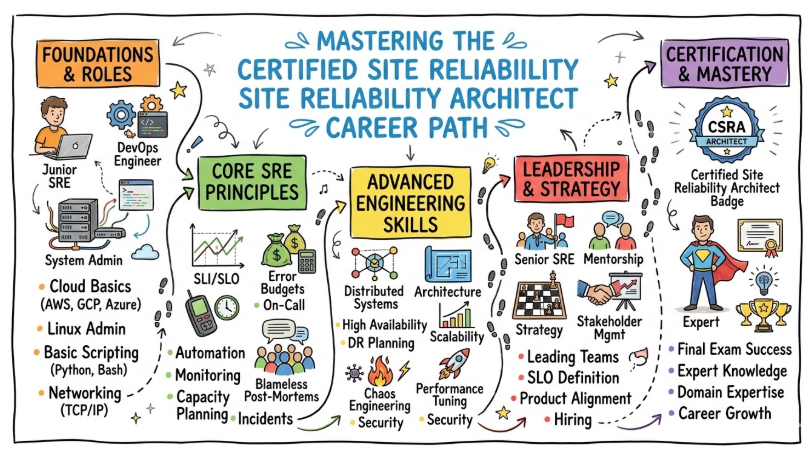
The evolution of modern infrastructure has moved beyond simple automation to complex, self-healing architectural patterns. As a professional navigating the cloud-native ecosystem, understanding the role of a Certified Site Reliability Architect is essential for anyone aiming to bridge the gap between high-level design and operational stability. This guide is designed for engineers and technical leaders who need to move beyond “keeping the lights on” and start building systems that are resilient by design. By exploring the curriculum offered through SREschool, you will gain a clear roadmap for advancing your career in DevOps, Platform Engineering, and Site Reliability. Deciding on the right certification is about more than just a badge; it is about ensuring your technical trajectory aligns with the needs of global enterprises.
What is the Certified Site Reliability Architect?
The Certified Site Reliability Architect designation represents a shift from tactical firefighting to strategic system design. It exists because modern distributed systems are too complex to be managed by traditional manual methods or basic scripting alone. This program focuses on the high-level orchestration of reliability, teaching professionals how to build frameworks that handle failure gracefully at scale. Instead of focusing on a single tool, it emphasizes the architectural principles of observability, error budgets, and toil reduction within a production-focused environment. It aligns perfectly with enterprise needs where uptime is directly tied to revenue and customer trust.
Who Should Pursue Certified Site Reliability Architect?
This path is primarily built for mid-to-senior level software engineers, SREs, and Cloud Architects who are responsible for the long-term health of their platforms. Security and data professionals will also find immense value here, as reliability is a prerequisite for both data integrity and security posture. In the context of the global market, including the booming tech hubs in India, there is a massive demand for architects who can scale systems without scaling headcount. Even engineering managers who want to understand the technical constraints of their teams will benefit from this rigorous, architecture-first approach to reliability engineering.
Why Certified Site Reliability Architect is Valuable and Beyond
The longevity of a career in tech depends on mastering principles rather than just chasing the latest JavaScript framework or CLI tool. The Certified Site Reliability Architect program provides a foundation in reliability theory that remains relevant regardless of which cloud provider or container orchestrator wins the market share. As enterprises adopt increasingly complex multi-cloud and hybrid-cloud strategies, the ability to architect for “failure as a first-class citizen” becomes a rare and highly compensated skill. Investing time in this certification offers a high return on effort because it transforms an engineer from a practitioner into a strategic asset who can lead large-scale digital transformations.
Certified Site Reliability Architect Certification Overview
The program is delivered via the official SREschool.com portal and is designed to validate a candidate’s ability to design, implement, and lead SRE initiatives. Unlike theoretical exams, the assessment approach here focuses on practical application and the ability to solve architectural bottlenecks in simulated production environments. The certification structure is tiered to allow professionals to enter at a level that matches their current experience while providing a clear path toward mastery. It is owned and curated by industry practitioners who ensure the content reflects the actual challenges faced by modern platform teams.
Certified Site Reliability Architect Certification Tracks & Levels
The curriculum is divided into foundation, professional, and advanced levels to cater to different stages of professional growth. The foundation level introduces the core vocabulary and metrics like SLIs, SLOs, and SLAs, while the professional and advanced levels dive deep into disaster recovery, capacity planning, and automated incident response. Specialization tracks allow engineers to lean into specific domains such as SRE-led DevOps or FinOps-aligned reliability. These levels are designed to mirror a typical career progression, moving from individual contributor tasks to high-level organizational leadership.
Complete Certified Site Reliability Architect Certification Table
| Track | Level | Who it’s for | Prerequisites | Skills Covered | Recommended Order |
| Core SRE | Foundation | Junior Engineers | Basic Linux/Cloud | SLIs, SLOs, Error Budgets | 1 |
| Architecture | Professional | Senior SREs | Foundation Level | Distributed Systems, Scalability | 2 |
| Strategic | Advanced | Lead Architects | Professional Level | Organizational SRE, Governance | 3 |
| Operations | Specialty | DevOps Engineers | CI/CD knowledge | Incident Management, Toil | 2 (Parallel) |
Detailed Guide for Each Certified Site Reliability Architect Certification
What it is
This certification validates a professional’s understanding of the fundamental SRE principles and the common language used by reliability teams globally. It ensures that the candidate can effectively communicate and implement basic reliability metrics within a squad.
Who should take it
It is ideal for DevOps engineers, system administrators, and software developers who are new to the SRE discipline but have a basic understanding of cloud infrastructure and deployment pipelines.
Skills you’ll gain
- Defining and measuring Service Level Indicators (SLIs).
- Establishing meaningful Service Level Objectives (SLOs).
- Calculating and managing Error Budgets to balance speed and stability.
- Identifying and reducing operational toil through automation.
Real-world projects you should be able to do
- Designing a basic dashboard that tracks service health based on user-centric metrics.
- Implementing a basic automated alerting system that triggers based on SLO breaches.
Preparation plan
- 7–14 days: Intense review of SRE books and documentation of core terminology.
- 30 days: Hands-on practice with monitoring tools and creating SLI reports.
- 60 days: Full immersion in architectural theory and mock exam scenarios.
Common mistakes
- Focusing too much on specific tools rather than the underlying principles of reliability.
- Confusing SLAs (legal) with SLOs (technical/internal targets).
Best next certification after this
- Same-track option: Certified Site Reliability Architect – Professional.
- Cross-track option: DevSecOps Professional.
- Leadership option: SRE Lead / Manager Certification.
Choose Your Learning Path
DevOps Path
The DevOps path focuses on the seamless integration of development and operations through the lens of reliability. It emphasizes the importance of “shifting left” where reliability is considered during the initial coding phase rather than as an afterthought during deployment. Engineers on this path learn how to build robust CI/CD pipelines that incorporate automated testing and canary releases to minimize risk. It is a journey from being a build engineer to becoming a delivery specialist who ensures that every code change is sustainable and stable.
DevSecOps Path
The DevSecOps path integrates security directly into the reliability framework, treating security vulnerabilities as a form of “technical debt” that impacts uptime. Professionals here learn to automate security checks within the pipeline, ensuring that compliance and protection are part of the system’s architecture. This path is essential for those working in regulated industries like finance or healthcare where a security breach is the ultimate reliability failure. It transforms a traditional security auditor into an engineer who builds self-defending systems.
SRE Path
The pure SRE path is for those who want to specialize deeply in the science of system uptime and performance at massive scale. It focuses on the mathematical and engineering aspects of reliability, such as advanced statistical analysis of system behavior and chaos engineering. Engineers learn how to manage complex microservices architectures and how to conduct blameless post-mortems that actually lead to system improvements. This is the path for those who enjoy solving deep technical mysteries and building “vessel-like” infrastructure that can survive any storm.
AIOps Path
The AIOps path is designed for engineers looking to leverage machine learning and artificial intelligence to automate complex operational tasks. This involves using data-driven insights to predict potential system failures before they occur and automating the remediation process. As systems generate more telemetry than humans can process, AIOps becomes the only way to maintain visibility and control. This path is perfect for those with an interest in data science who want to apply those skills to infrastructure management.
MLOps Path
The MLOps path bridges the gap between data science and production engineering, focusing on the reliable deployment and monitoring of machine learning models. Unlike traditional software, ML models require constant retraining and monitoring for “drift” to remain effective. This path teaches how to build pipelines that treat models as living code, ensuring that the AI components of an application are as reliable as the web server. It is a critical path for organizations moving toward AI-driven products.
DataOps Path
The DataOps path applies the principles of SRE to data engineering and data pipelines, ensuring that data is delivered accurately and on time. Reliability in this context means data quality, low latency in processing, and high availability of data warehouses. Engineers learn how to build automated testing for data sets and how to monitor the health of complex ETL processes. It is the ideal path for data engineers who want to bring the rigor of software engineering to the world of big data.
FinOps Path
The FinOps path aligns cloud spending with business value, treating cloud costs as a technical metric that must be optimized for reliability. It teaches engineers how to architect systems that are not only performant but also cost-efficient, preventing “bill shock” in highly scaled environments. This path is becoming vital as companies look to maximize their return on cloud investment without sacrificing performance. It turns a cloud engineer into a business-aligned architect who understands the financial impact of technical decisions.
Role → Recommended Certified Site Reliability Architect Certifications
| Role | Recommended Certifications |
| DevOps Engineer | Certified Site Reliability Engineer – Foundation |
| SRE | Certified Site Reliability Architect |
| Platform Engineer | Advanced SRE Architecture |
| Cloud Engineer | Cloud Reliability Specialist |
| Security Engineer | DevSecOps Architect |
| Data Engineer | DataOps Reliability Professional |
| FinOps Practitioner | FinOps & Cloud Cost Architect |
| Engineering Manager | SRE Strategic Leadership |
Next Certifications to Take After Certified Site Reliability Architect
Same Track Progression
Once you have mastered the foundational levels, deep specialization into advanced architectural patterns is the logical next step. This involves exploring high-level distributed systems design, multi-region failover strategies, and advanced observability frameworks. This progression ensures you remain the top-tier technical authority within your organization regarding how systems should be built for 99.999% availability.
Cross-Track Expansion
For those who wish to become versatile leaders, expanding into adjacent fields like DevSecOps or FinOps provides a broader perspective. Understanding how reliability interacts with security and cost allows an architect to make more balanced decisions that benefit the entire business. This cross-pollination of skills is what distinguishes a senior architect from a principal-level leader who can influence multiple departments.
Leadership & Management Track
If your goal is to transition into engineering management or a Director of SRE role, focusing on the human and organizational aspects of reliability is key. This track covers how to build a culture of reliability, how to manage incident response teams, and how to negotiate SLOs with business stakeholders. It prepares you to lead technical teams through high-pressure situations while maintaining a focus on long-term strategic goals.
Training & Certification Support Providers for Certified Site Reliability Architect
DevOpsSchool
This provider is a major player in the technical training space, offering deep dives into the practical tools that support SRE and DevOps workflows. They focus on hands-on labs and real-world scenarios to ensure students can apply what they learn immediately.
Cotocus
Known for its consulting-led approach, this organization provides training that is heavily influenced by current industry trends and enterprise challenges. Their curriculum is often updated to reflect the most recent shifts in cloud-native technologies and architectural best practices.
Scmgalaxy
This community-driven platform serves as a massive repository of knowledge for configuration management and automation. It supports certification seekers with extensive documentation and community forums where practitioners share their experiences and solutions.
BestDevOps
Focusing on elite-level training, this provider offers structured courses that target high-performance engineering teams. Their content is designed to push experienced engineers to the next level of technical and operational excellence.
devsecopsschool.com
This specialized portal focuses entirely on the intersection of security and operations. It is the go-to resource for SREs who want to integrate robust security protocols into their reliability frameworks without slowing down the development cycle.
sreschool.com
As the primary host for the Site Reliability Architect programs, this site provides the official curriculum and assessment for these certifications. It is the central hub for all things related to SRE education and professional validation.
aiopsschool.com
This platform focuses on the future of operations, teaching engineers how to use artificial intelligence to manage scale. It is an essential resource for those looking to stay ahead of the curve in automated infrastructure management.
dataopsschool.com
Dedicated to the reliability of data systems, this provider offers specialized training for data engineers and architects. They bridge the gap between traditional SRE and the specific needs of modern data platforms and analytics.
finopsschool.com
This provider addresses the critical need for cloud financial management within the SRE discipline. They offer training that helps engineers understand and control the costs associated with building and maintaining high-availability systems.
Frequently Asked Questions (General)
- How difficult is the Certified Site Reliability Architect exam?
The exam is designed to be challenging and requires a solid understanding of both theory and practical application. It is meant to separate those with superficial knowledge from true practitioners. - How much time is required to prepare for this certification?
For a working professional, a period of 30 to 60 days is usually sufficient, depending on your prior experience with SRE concepts and cloud infrastructure. - Are there any prerequisites for the foundation level?
There are no formal prerequisites, but a basic understanding of Linux, cloud computing, and at least one programming language will be extremely helpful. - What is the return on investment (ROI) for this certification?
The ROI is typically seen through higher salary potential, better job security, and the ability to take on more senior, strategic roles within an organization. - In what order should I take these certifications?
It is highly recommended to start with the Foundation level to build a solid base before moving into Professional or Advanced architectural tracks. - Does this certification expire?
Like most technical certifications, it is recommended to refresh your credentials every two to three years to ensure you remain current with evolving industry standards. - Is this certification recognized globally?
Yes, the principles taught are universal and are recognized by major technology firms and enterprises across the globe, including North America, Europe, and Asia. - Can I take the exam online?
Yes, the certification process is designed to be accessible globally through online proctored environments provided by the hosting site. - Does the program include hands-on labs?
Most training tracks associated with this certification include practical labs to ensure you can implement the architectural patterns you are learning. - How does this differ from a standard DevOps certification?
While DevOps focuses on the entire lifecycle, this certification focuses specifically on the “architecting for reliability” aspect of that lifecycle. - Is there a community for certified professionals?
Yes, becoming certified usually grants access to exclusive forums and groups where you can network with other SRE architects. - Will this help me move into a management role?
Absolutely, as it provides the technical authority and strategic oversight required to lead engineering departments effectively.
FAQs on Certified Site Reliability Architect
- What specific architectural patterns are covered?
The course covers patterns such as circuit breakers, bulkheads, sidecars, and various failover mechanisms essential for distributed system stability. - Does it cover multi-cloud reliability?
Yes, a core component of the architect level is designing systems that can remain resilient across different cloud providers or hybrid environments. - How is observability addressed?
It moves beyond simple monitoring to teach deep observability, including tracing, structured logging, and advanced telemetry analysis for root cause identification. - Is chaos engineering part of the curriculum?
The professional and advanced levels introduce chaos engineering as a proactive way to test and verify the reliability of an architecture. - Does the certification focus on a specific cloud provider?
No, it is designed to be cloud-agnostic, focusing on principles that can be applied to AWS, Azure, Google Cloud, or on-premises Kubernetes. - How does it address “Toil”?
It provides frameworks for identifying what constitutes toil and architectural strategies for automating those tasks away permanently. - What is the focus on Error Budgets?
It teaches how to use error budgets as a decision-making tool to negotiate between the need for new features and the need for stability. - Is performance tuning included?
Yes, as performance is a key pillar of reliability, the program covers how to identify and resolve latency bottlenecks at the architectural level.
Final Thoughts: Is Certified Site Reliability Architect Worth It?
From the perspective of a mentor who has seen the industry transition from physical servers to serverless, I can confidently say that the Certified Site Reliability Architect is a worthy investment. We are in an era where “good enough” is no longer acceptable for production systems. This certification provides you with the mental models and technical rigor needed to build systems that don’t just work, but thrive under pressure. If you are tired of being reactive and want to start being the person who designs the solutions that prevent the fires in the first place, this is your path. It is a challenging journey, but the clarity and authority it brings to your professional life are well worth the effort.

