
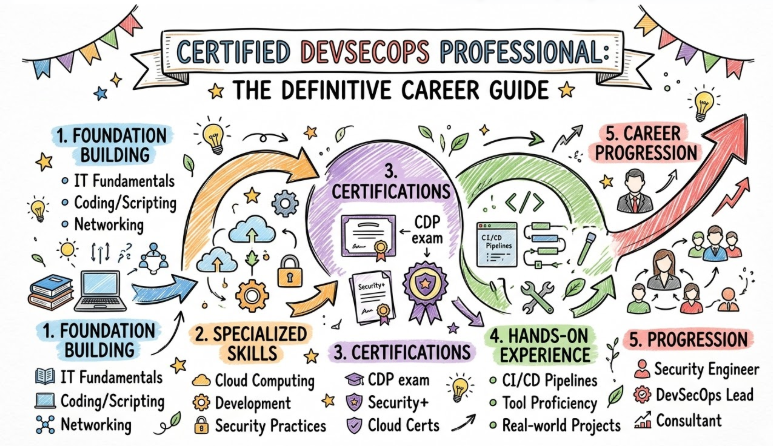
Modern software teams can no longer treat security as a final checkpoint. Today, security has to move with code, pipelines, containers, cloud, and release speed. That is exactly why the Certified DevSecOps Professional program matters. It is designed for engineers and managers who want to build secure delivery pipelines, automate security checks, and make security part of daily engineering work instead of a last-minute delay. The official program positions this certification as a professional-level credential, delivered through a testing center or online proctored exam, with a 180-minute exam, multilingual availability, and a practical focus on integrating security into DevOps culture and CI/CD workflows.
If you are a working engineer in India or anywhere globally, this certification can help you move from “I know DevOps tools” to “I can design and run secure DevOps systems.” The official curriculum emphasizes CI/CD security automation, source code and dependency scanning, container and Kubernetes security, Infrastructure as Code security, cloud security basics, and compliance or policy-as-code. That makes it useful not only for DevSecOps roles, but also for DevOps engineers, cloud engineers, SREs, QA professionals, and security teams that need stronger automation.
Why DevSecOps is Your New Career Foundation
Modern software delivery is a race against time, but a race without a shield is a disaster waiting to happen. Enterprises globally are pivoting toward a “Shift Left” philosophy, where security is treated as a first-class citizen from the very first line of code. This isn’t just a corporate mandate; it is a fundamental restructuring of how high-performing teams operate.
For the individual professional, DevSecOps represents a move toward “Technical Sovereignty.” It allows you to step out of the silo of a single role and become a cross-functional expert who can architect, deploy, and defend. According to recent industry trends analyzed DevSecOps is the fastest-growing specialization in the infrastructure world.
Global Certification Landscape: The Master Comparison
To navigate your professional growth, you need to understand where each milestone fits within the broader ecosystem. Below is the master mapping for the most influential certifications in the current engineering landscape.
| Track | Level | Who it’s for | Prerequisites | Skills Covered | Recommended Order |
| DevSecOps | Professional | Engineers/Managers | Linux & Git | SAST, DAST, SCA, CI/CD | 1st (Active Defense) |
| Observability | Master | Senior Engineers | 2+ Years Exp. | Tracing, SLOs, Metrics | 2nd (Full Visibility) |
| SRE | Professional | Ops & SREs | Cloud Basics | Reliability, Error Budgets | 1st (Stability) |
| AIOps | Professional | Data/Ops Eng. | Python/ML | Anomaly Detection | 3rd (Intelligent Ops) |
| FinOps | Associate | Mgrs/Architects | Cloud Basics | Cost Governance | 2nd (Economic Efficiency) |
Certified DevSecOps Professional: The Definitive Blueprint
The Certified DevSecOps Professional (CDP) is more than a credential; it is a validation of your ability to manage security as an automated, living service within the software delivery pipeline.
What it is
The Certified DevSecOps Professional (CDP) is a technical mastery program that bridges the gap between rapid delivery and ironclad security. It is a performance-based certification where you learn to physically implement “Security as Code.” The curriculum focuses on automating security testing within CI/CD pipelines, ensuring that every piece of software is scanned, verified, and compliant before it reaches the end user.
Who should take it
- Software Engineers: Who want to take full responsibility for the security posture of their applications.
- DevOps & Platform Engineers: Looking to add a sophisticated defense layer to their automation toolkits.
- SRE Professionals: Who recognize that security is a core component of overall system reliability.
- Traditional Security Analysts: Aiming to modernize their skills and learn how to write security scripts and automation.
- Engineering Managers: Who must oversee the implementation of secure SDLC frameworks across global teams.
Skills you’ll gain
This program shifts your perspective from manual auditing to automated engineering. You will develop a deep command of:
- Secure Pipeline Orchestration: Learn to embed automated security gates within Jenkins, GitLab, and GitHub Actions.
- Automated Code Review (SAST): Identifying vulnerabilities in source code during the build phase.
- Runtime Security Testing (DAST): Detecting flaws in running applications that static scanners might miss.
- Dependency Risk Management (SCA): Mastering the security of third-party libraries and the open-source supply chain.
- Container & Orchestration Security: Hardening Docker images and securing Kubernetes clusters at scale.
- Cloud Governance & IaC Scanning: Automatically auditing Terraform and Ansible scripts to prevent misconfigured cloud infrastructure.
- Secrets Management Architecture: Implementing centralized vaults (like HashiCorp Vault) to eliminate the risk of exposed credentials.
Real-world projects you should be able to do after it
The ultimate goal of the CDP is to enable you to execute high-impact technical projects that provide immediate business value:
- Build a Zero-Trust Delivery Pipeline: Architect a workflow where code cannot move to production unless it passes a multi-layered security gauntlet.
- Automate Compliance-as-Code: Create scripts that automatically generate audit evidence for standards like ISO 27001 or SOC2 directly from your pipeline.
- Develop a Self-Healing Container Registry: Implement a system that automatically identifies, patches, and rebuilds vulnerable base images.
- Migrate to a Dynamic Secrets System: Lead the transition from hardcoded API keys to a system where applications fetch credentials on demand.
Preparation plan
Success in this program requires a structured approach. Choose the timeline that aligns with your current technical maturity:
- 7–14 Days (The Specialist Sprint): Ideal for those already working in DevOps roles. Focus 100% on tool-chain integration and perfecting your execution in the lab environment.
- 30 Days (The Standard Path): Spend the first two weeks on the logic of SAST, DAST, and SCA. Spend the final two weeks on integrated pipeline projects and container security.
- 60 Days (The Career Transformer): For those moving from traditional dev or ops. Spend the first month mastering Linux, Git, and Docker basics. Use the second month to focus exclusively on the CDP curriculum.
Common mistakes
As a mentor, I have noticed several common pitfalls that can hinder your progress:
- Treating the Tool as the Strategy: A tool like SonarQube is only as good as the policy you write for it. Focus on the “why,” not just the “how.”
- Building “High-Friction” Security: If you build security gates that frustrate developers, they will find ways to bypass them. Learn to build “frictionless” security that aids speed.
- Skipping the Hardened Lab Practice: This is a performance-based exam. You must be able to write the YAML and fix the broken pipeline in real-time under pressure.
Choose Your Path: 6 Specialized Career Journeys
The modern engineering landscape allows you to specialize based on your natural technical inclinations:
- The DevOps Path: Focus on speed, infrastructure automation, and the efficiency of the delivery lifecycle.
- The DevSecOps Path: Focus on the “Guardian” role—automated defense, compliance-as-code, and pipeline protection.
- The SRE Path: Focus on the “Science of Reliability”—error budgets, scalability, and 24/7 high availability.
- The AIOps/MLOps Path: Focus on the future—using machine learning to manage massive infrastructure and predict failures.
- The DataOps Path: Focus on the custodian role—ensuring the secure and efficient flow of high-volume data pipelines.
- The FinOps Path: Focus on the business—bridging the gap between engineering performance and cloud financial accountability.
Role → Recommended Certifications Mapping
Align your technical growth with your current or target role to maximize your professional impact:
- DevOps Engineer: DevOps Professional → Certified DevSecOps Professional.
- SRE: SRE Professional → Master in Observability Engineering.
- Platform Engineer: Kubernetes Specialist (CKA) → Certified DevSecOps Professional.
- Cloud Engineer: Cloud Solutions Architect → Certified DevSecOps Professional.
- Security Engineer: Penetration Testing → Certified DevSecOps Professional.
- Data Engineer: DataOps Professional → Master in Observability Engineering.
- FinOps Practitioner: FinOps Associate → Master in Observability Engineering.
- Engineering Manager: DevSecOps Manager → Master in Observability Engineering.
Leading Institutions for Training & Certification
Selecting the right partner is critical for mastering the practical aspects of DevSecOps. These institutions are recognized for their commitment to engineering excellence:
DevOpsSchool
DevOpsSchool is a global leader in high-intensity, mentor-led training. Their curriculum is built on real-world production scenarios, ensuring that you don’t just learn the theory but gain the muscle memory needed to lead complex enterprise pipelines.
Cotocus
Cotocus is highly regarded for its focus on corporate readiness and advanced cloud-native architectures. They provide a practical bridge between academic learning and the high-pressure environment of top-tier tech firms, emphasizing “Job-Ready” skills.
Scmgalaxy
Scmgalaxy is a massive community-driven platform and knowledge hub for automation professionals. They provide specialized training that covers the intricate details of software configuration management, build automation, and integrated security.
BestDevOps
BestDevOps focuses on practical, accelerated learning paths. Their training is designed for the working professional who needs to acquire high-value skills quickly and effectively, with a heavy emphasis on tool-chain mastery.
This institution is dedicated specifically to the intersection of security and development. By focusing exclusively on “Security as Code,” they provide a level of depth in automated defense that is essential for modern, compliance-heavy tech environments.
sreschool
SRESchool is the definitive resource for mastering the art of reliability. Their programs teach the specific mindsets and tools needed to maintain massive, distributed systems at a 99.99% uptime standard, mirroring the practices of global tech giants.
aiopsschool
As infrastructure grows beyond human management capabilities, AIOpsSchool provides the training needed to use AI for operational excellence. They focus on the future of self-healing systems and predictive infrastructure maintenance.
dataopsschool
DataOpsSchool addresses the critical need for reliability and security in data engineering. They teach engineers how to apply the rigor of DevOps to data pipelines, ensuring that your organization’s most valuable assets are delivered securely.
finopsschool
FinOpsSchool focuses on the financial governance of the cloud. They provide engineers and managers with the skills to balance technical innovation with financial responsibility, a skill set that is increasingly vital as cloud budgets expand globally.
Next-Step Learning Options:
- Same Track (Expert): Certified DevSecOps Expert – for those aiming for the pinnacle of technical defense.
- Cross-Track (Visibility): Master in Observability Engineering – to gain total transparency into production systems.
- Leadership Track: Engineering Management Masterclass – for those transitioning from hands-on engineering to strategic leadership.
FAQs – Career & Strategic Growth
- Is DevSecOps just a trend? No, it is a permanent shift in engineering culture driven by the increasing complexity of cloud-native systems and global regulations.
- How do these certifications impact salary? In India and global markets, specialists in DevSecOps and SRE are currently among the top 5% of earners in the engineering sector.
- Can I jump straight into the Master in Observability? It is possible, but we recommend securing the pipeline first (CDP) to understand the context of the data you are observing.
- Are these certifications recognized by global SaaS companies? Yes, the skills taught (SAST, DAST, SCA) are the exact standards used by companies like Meta, Netflix, and Amazon.
- How much coding is involved in the CDP? You should be comfortable with YAML and basic scripting (Python or Bash). You don’t need to be a senior developer.
- Can a manager benefit from a technical certification? Absolutely. It provides the technical literacy needed to lead high-performing teams and make better budget decisions.
- Is the CDP exam practical or theoretical? It is a practical, performance-based exam where you fix real-world security challenges in a live lab environment.
- How do I choose between SRE and DevSecOps? Choose SRE if you love performance and high availability; choose DevSecOps if you love defense and security automation.
- What if I have no cloud experience? Start with a 60-day foundation plan from a provider like DevOpsSchool to build your infrastructure basics first.
- Is there a community for networking? Yes, platforms like Scmgalaxy offer massive communities of like-minded professionals for support and knowledge sharing.
- How long should I study each day? For the 30-day track, we recommend 1.5 to 2 hours of focused study and lab practice to ensure retention.
- Do these certifications expire? Industry standards recommend a refresh every 2–3 years to stay aligned with the rapid pace of technology shifts.
FAQs – Certified DevSecOps Professional (CDP) Specifics
- What is the core focus of the CDP? Automating the security of the software delivery pipeline from code commit to production.
- Does it cover Kubernetes? Yes, hardening container clusters and securing the orchestration layer is a major component of the curriculum.
- What tools will I learn? You will work with industry leaders like Snyk, SonarQube, OWASP ZAP, HashiCorp Vault, and various open-source security tools.
- What is “Security as Code”? It is the practice of defining security policies in machine-readable files that can be automatically enforced by your pipeline.
- Is the training available online? Yes, most authorized providers offer both live instructor-led and self-paced online options globally.
- Does CDP help with SOC2 or ISO compliance? Yes, it teaches you how to automate the evidence collection needed for these security audits.
- Is the exam proctored? Yes, to ensure global standards, the CDP exam is proctored and performance-based.
- Can I take the training as a group? Yes, institutions like DevOpsSchool offer corporate batches specifically for team-wide upskilling in DevSecOps.
Conclusion
Stepping into the domain of a Certified DevSecOps Professional is more than a technical upgrade; it is a complete reimagining of your professional purpose. You are evolving from a contributor who delivers features into a strategic architect who builds the very foundations of trust. In an era where digital resilience dictates market survival, the mastery of automated security is the ultimate career multiplier. By aligning this path with the deep visibility of Master in Observability Engineering, you ensure your expertise remains at the forefront of the industry for decades to come. The next generation of engineering excellence belongs to those who can maintain high-velocity innovation without compromising system integrity.

