
Introduction
The transition from a university classroom to the professional workforce is one of the most challenging phases in an engineer’s life. If you are exploring the technology sector today, you have undoubtedly encountered the term DevOps. It has become a cornerstone of modern software development, bridging the gap between writing code and keeping that code running reliably for users.
Many students feel overwhelmed by the sheer volume of tools associated with this field—Docker, Kubernetes, Jenkins, Terraform, AWS, and more. This confusion often leads to “tool hopping,” where learners spend time collecting certificates without understanding the actual engineering principles behind the operations. The reality is that a successful career in this domain is built on fundamentals, not just tool proficiency.
The demand for professionals who can bridge the gap between development and operations continues to rise as companies move toward cloud-native architectures. To navigate this path effectively, you need more than just a list of technologies; you need a structured learning approach. For those looking for structured guidance, hands-on lab environments, and industry-aligned training, you can explore resources at DevOpsSchool.
This guide aims to cut through the noise, providing a realistic, step-by-step roadmap for students and graduates to build a meaningful and sustainable career in this field.
What Is a DevOps Career?
A DevOps career is not a single job title; it is a way of working. At its core, DevOps represents the union of software development (Dev) and IT operations (Ops).
In a traditional setup, developers would write code, “throw it over the wall” to the operations team, and hope it worked. If it broke, the two teams often blamed each other. DevOps eliminates this wall. A DevOps professional works to automate the delivery process, manage infrastructure, ensure system stability, and foster a culture of shared responsibility.
For a graduate, this means your role is to ensure that code moves from a developer’s laptop to the production environment smoothly, reliably, and securely. You are the engineer who builds the “factory” that produces software.
Why DevOps Is a Good Career for Students and Graduates
If you are a student or a recent graduate, focusing on this domain offers several strategic advantages:
- Universal Relevance: Every tech company, from small startups to massive enterprises like Netflix or Google, needs someone to manage their infrastructure and deployment pipelines.
- Skill Transferability: The core skills—Linux, networking, automation, and cloud—are universal. Even if you decide to pivot to pure development or pure security later, these skills remain foundational.
- Constant Intellectual Stimulation: The field evolves rapidly. You will never stop learning, which keeps the work engaging.
- High Impact: When you automate a deployment process or fix a production outage, the results are immediate and visible, giving you a strong sense of accomplishment.
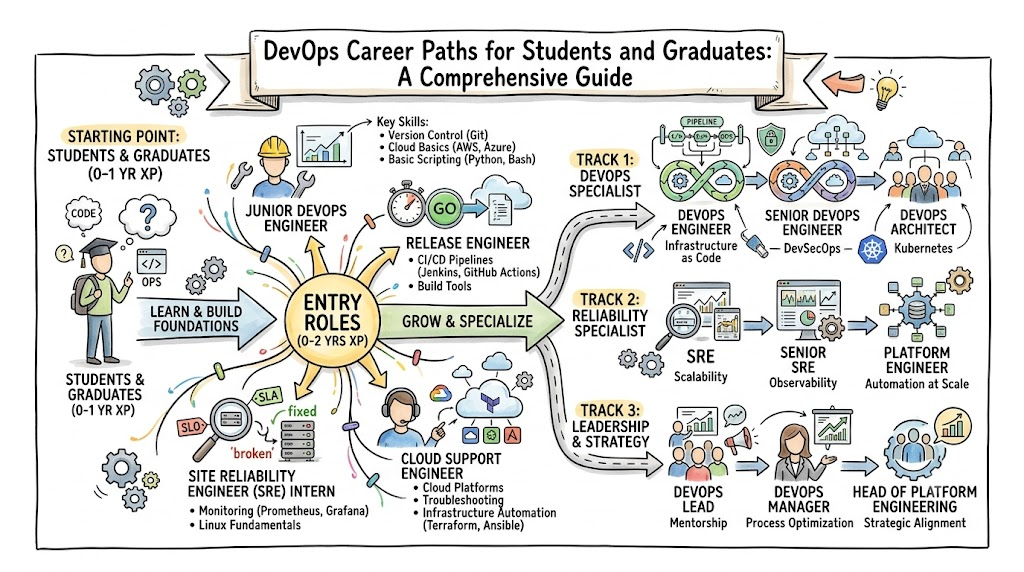
Overview Table: DevOps Career Paths
| Career Path | Primary Focus Area |
| Junior DevOps Engineer | CI/CD pipelines, scripting, and general support. |
| Cloud Engineer | Architecture, provisioning, and cloud resource management. |
| SRE (Site Reliability Engineer) | System reliability, monitoring, and incident response. |
| Platform Engineer | Building internal tools and self-service platforms for developers. |
| DevSecOps Engineer | Integrating security checkpoints into the deployment cycle. |
| Automation Engineer | Writing code to reduce manual toil and repeatable tasks. |
| CI/CD Engineer | Building and maintaining automated build/test/deploy pipelines. |
Career Path #1: Junior DevOps Engineer
This is the most common entry point for graduates. As a Junior DevOps Engineer, you are typically embedded within a team to support the day-to-day operations of the software delivery process.
Responsibilities:
- Managing access controls for various environments.
- Assisting with basic CI/CD pipeline troubleshooting.
- Monitoring system health and reporting anomalies.
- Automating small, repetitive tasks using shell scripts.
Workplace Example: Imagine a developer team pushes code, but the build fails. As a junior engineer, you investigate the logs, identify a missing dependency in the build environment, update the configuration, and get the pipeline running again. You learn how the software is built and what breaks in the process.
Career Path #2: Cloud Engineer
If you enjoy architecture, networking, and designing scalable systems, the Cloud Engineer path is an excellent choice. You focus on how the infrastructure lives in the cloud rather than the software delivery process itself.
Responsibilities:
- Provisioning cloud resources (AWS, Azure, or GCP).
- Managing virtual networks, subnets, and firewalls.
- Optimizing cloud costs.
- Ensuring high availability and disaster recovery.
Example: A company wants to host a new application. A cloud engineer designs the VPC (Virtual Private Cloud), sets up the databases, configures the load balancers, and ensures the whole environment is secure and cost-efficient.
Career Path #3: Site Reliability Engineer (SRE)
SRE is a role coined by Google. It takes the “DevOps philosophy” and applies it to systems engineering. SREs are the “firefighters” and “architects” of reliability.
Responsibilities:
- Defining Service Level Objectives (SLOs) and Error Budgets.
- Incident response and post-mortem analysis.
- Building monitoring and alerting systems.
- Capacity planning.
Example: If a website experiences traffic spikes during a holiday sale, the SRE team analyzes why the servers crashed, implements autoscaling, and ensures that the system handles the load automatically the next time.
Career Path #4: Platform Engineer
This is a modern evolution of the DevOps role. Platform Engineers focus on creating a “Platform” that developers can use to deploy their code without needing to know the complexities of the underlying infrastructure.
Responsibilities:
- Creating internal developer portals.
- Standardizing tools and environments.
- Providing self-service capabilities.
- Improving developer productivity.
Example: Instead of every developer asking you to provision a database, you build a button on an internal dashboard that lets them provision it themselves, securely and automatically.
Career Path #5: DevSecOps Engineer
Security is often an afterthought in software development. DevSecOps brings security to the front, integrating it into every phase of the CI/CD pipeline.
Responsibilities:
- Automating security testing.
- Managing secrets and certificates.
- Conducting vulnerability scanning.
- Ensuring compliance with industry standards.
Example: Every time a developer commits code, you configure a tool to automatically scan that code for potential security flaws, such as hardcoded passwords or known vulnerabilities in libraries, blocking the deployment if a risk is detected.
Career Path #6: Automation Engineer
This role is for those who love coding but prefer writing tools that help other engineers rather than writing user-facing features.
Responsibilities:
- Writing scripts (Python, Go, Bash) to automate infrastructure.
- Integrating various APIs.
- Reducing manual toil.
Example: You notice that onboarding a new employee takes three days of manual work to set up accounts and permissions. You write an automation script that creates these accounts instantly, saving the team hours of work.
Career Path #7: CI/CD Engineer
This path focuses entirely on the “pipeline.” You are the master of velocity—ensuring that code gets to production as fast as possible without sacrificing quality.
Responsibilities:
- Managing Jenkins, GitHub Actions, or GitLab CI.
- Optimizing build times.
- Handling environment configurations.
Example: A team complains that their builds take 45 minutes. You refactor the build process, introduce caching, and parallelize testing, reducing the build time to 5 minutes.
Essential Skills Students Should Learn
To succeed in any of the above paths, you need a solid foundation. Do not rush into advanced tools. Build your skills in this order:
- Linux Basics: This is non-negotiable. Learn command-line navigation, file permissions, users, processes, and service management.
- Git & Version Control: Learn how to branch, merge, and resolve conflicts. This is how you will work with your team.
- Networking Fundamentals: Understand IP addresses, subnets, DNS, HTTP/HTTPS, and how the internet actually routes traffic.
- Scripting: Learn Bash for system tasks and Python for automation.
- Containers (Docker): Understand the difference between a virtual machine and a container.
- Cloud Basics: Pick one provider (AWS, Azure, or GCP) and learn the core services (Compute, Storage, Networking).
- Monitoring: Learn the basics of logs and metrics (Prometheus, Grafana, or ELK stack).
Beginner DevOps Learning Roadmap
- Phase 1: The Foundation (Months 1-3): Master Linux and Shell Scripting. Get comfortable with the terminal.
- Phase 2: Version Control (Month 4): Master Git. Contribute to open-source projects or push your own code.
- Phase 3: The Runtime (Months 5-6): Learn Docker. Create images and containers. Understand networking between containers.
- Phase 4: The Pipeline (Months 7-8): Learn a CI/CD tool (Jenkins or GitHub Actions). Automate a simple deployment.
- Phase 5: Cloud and Infrastructure (Months 9-10): Learn AWS (or another cloud). Launch a web server.
- Phase 6: Infrastructure as Code (Months 11-12): Learn Terraform. Build your infrastructure using code.
- Phase 7: Real Projects: Build a complete project, like a web app that deploys automatically when you push code to GitHub.
Real-World Example: Student Taking the Wrong Path
The Scenario: A student, “Alex,” is obsessed with being a “DevOps Engineer.” He spends all his time jumping between YouTube tutorials for Kubernetes, Terraform, Ansible, Jenkins, and Helm, all in one week. He creates no projects and skips Linux fundamentals.
The Result: When he gets to an interview, he can define what Kubernetes is, but when asked how to view the logs of a running process on a Linux server or how to debug a network connection, he fails. He looks great on paper but lacks the ability to do the work.
The Lesson: Tools change; fundamentals stay the same. Do not try to learn every tool at once. Focus on one tool at a time and understand what problem it solves.
Real-World Example: Student Building a Strong DevOps Career
The Scenario: A student, “Priya,” decides to focus on just Linux and Python for three months. She builds a script that backs up her home directory to the cloud. Then, she learns Docker and containerizes that script. She puts it on GitHub.
The Result: During an interview, she doesn’t just talk about tools; she explains how she solved a specific problem with her script. The interviewer sees she understands the logic, the file system, and the automation process. She gets the internship.
The Lesson: Practical projects, no matter how small, demonstrate your ability to solve problems—which is exactly what employers are looking for.
Common Mistakes Students Make
- Tool Obsession: Thinking the tool is the goal. The tool is just a means to an end.
- Skipping Linux: Trying to run before you can walk. You cannot master DevOps if you cannot navigate a Linux server.
- No Projects: Reading books or watching videos without writing code or deploying infrastructure.
- Overreliance on Certifications: Having a badge doesn’t mean you have the skill. Certificates should supplement knowledge, not replace it.
- Ignoring Networking: Assuming the “network” is magic. You must understand how data moves between systems.
Certifications vs. Practical Skills
Certifications are excellent for structured learning and validating knowledge. However, they are not a substitute for experience. A certification proves you studied a subject; a GitHub repository full of working projects proves you can execute.
In the job market, a candidate with a mid-level certificate and two solid, deployed projects on their portfolio will almost always beat a candidate with five high-level certifications and zero practical projects. Use certifications as a study guide, but let your projects be your CV.
Best Practices for Students Entering DevOps
- Focus on Fundamentals: Master the basics (Linux, Git, Networking) before adding complexity.
- Build in Public: Put your projects on GitHub. Document them with clear README files.
- Practice Daily: Consistency beats intensity. Coding for one hour every day is better than coding for ten hours once a week.
- Learn Cloud Basics: You don’t need to be an expert in every AWS service, but understand the core services (EC2, S3, RDS).
- Read the Documentation: Learn to read official docs, not just third-party tutorials.
Role of DevOpsSchool in Career Preparation
Preparation for a career in this field requires more than just self-study; it requires a structured environment where mistakes can be made in a safe space. DevOpsSchool provides a learning ecosystem that focuses on practical application. Rather than just theory, the focus is on labs, real-world scenarios, and guided mentorship. Access to such structured learning paths, which include CI/CD exposure and cloud-native environments, can significantly reduce the learning curve for students and fresh graduates.
Industries Hiring DevOps Professionals
- SaaS Platforms: Companies building software require constant deployment and high reliability.
- Banking & Finance: Security and uptime are critical; they hire for DevSecOps and SRE.
- Healthcare: Compliance and data security are the focus areas here.
- E-Commerce: Scalability is the main driver for these systems.
- Telecom: High-volume traffic and infrastructure management are essential.
- Enterprise IT: Traditional businesses moving their legacy applications to the cloud.
Future of DevOps Careers
The future of this field is moving toward AI-driven operations (AIOps) and Platform Engineering. As systems become more complex, humans cannot manage them alone. Automation will become more intelligent, and the focus will shift from “doing the work” to “designing the systems that do the work.” Cloud-native architectures will continue to dominate, making knowledge of Kubernetes and serverless technologies increasingly valuable.
FAQs
- Is DevOps good for freshers?Yes, it is a high-growth field, but it requires a solid foundation in traditional IT skills first.
- Can students learn DevOps?Absolutely. If you have access to a computer and the internet, you can start today.
- What skills are required?Linux, Git, Networking, Python/Bash, Docker, and Cloud basics.
- Do I need coding?You need to understand scripting and basic programming concepts. You don’t need to be a software developer, but you must know how to read and write code.
- Is Linux mandatory?Yes. It is the operating system of the cloud.
- What projects should students build?Deploy a website, set up a CI/CD pipeline, create a containerized application, or write an automation script.
- Can non-CS students enter DevOps?Yes, provided you are willing to learn the technical fundamentals. IT is a skill-based industry.
- Are certifications enough?No. They are helpful for learning, but projects are what get you hired.
- How long does it take to learn?It depends on your background, but expect 6–12 months of consistent study to reach an entry-level professional standard.
- Is it a stressful job?It can be, especially in SRE roles, as you are responsible for the uptime of services.
- Do I need a degree?While degrees help, this field is heavily meritocratic. Skills and portfolio often outweigh formal education.
- Which cloud provider should I start with?AWS is the market leader, so it is the most common starting point.
- Is DevOps only about automation?No, it is also about culture, communication, and reliability.
- How do I find an internship?Build a portfolio on GitHub, network on platforms like LinkedIn, and apply to companies that value continuous learning.
- What is the difference between DevOps and SRE?DevOps is the culture/philosophy; SRE is a specific way to implement that philosophy with a focus on reliability.
Final Thoughts
Building a career in this space is a marathon, not a sprint. The industry is filled with hype, but the actual work is grounded in logic, persistence, and problem-solving. Do not try to learn everything at once. Focus on the core pillars: Linux, Networking, and Scripting. Once those are strong, build your way up. Patience is your greatest asset. If you keep learning, building, and refining your approach, you will find a rewarding path that challenges you every day.

