
Introduction
In my twenty years of working across software engineering, systems administration, and cloud architecture, I have observed a recurring pattern. Many engineers and organizations invest heavily in acquiring tools. They adopt Kubernetes, set up sophisticated CI/CD pipelines, and migrate to public clouds, yet they still struggle with the same core problems: deployment failures, long lead times, and finger-pointing between teams. This happens because they view DevOps as a toolset rather than a cultural and operational philosophy.
The truth is, tools change. Jenkins may give way to GitHub Actions, and Terraform may evolve into something else, but the fundamental problems of software delivery—communication silos, manual bottlenecks, and lack of feedback—remain. To solve these, you need a shift in perspective. You need to build a DevOps mindset.
This article explores how to cultivate that mindset. Whether you are a student, a developer, or a seasoned cloud architect, understanding these principles is the key to long-term career growth. For those looking to master these concepts through structured, hands-on learning, resources like DevOpsSchool provide the essential framework to bridge the gap between theory and practical, cloud-native engineering.
Let us move past the buzzwords and look at what it truly means to think like a DevOps professional.
What Is a DevOps Mindset?
A DevOps mindset is a holistic approach to software engineering that prioritizes collaboration, automation, and continuous improvement over rigid, siloed processes. It is not a job title or a specific software product. Instead, it is a way of approaching work where the ultimate goal is to deliver value to the user reliably, quickly, and securely.
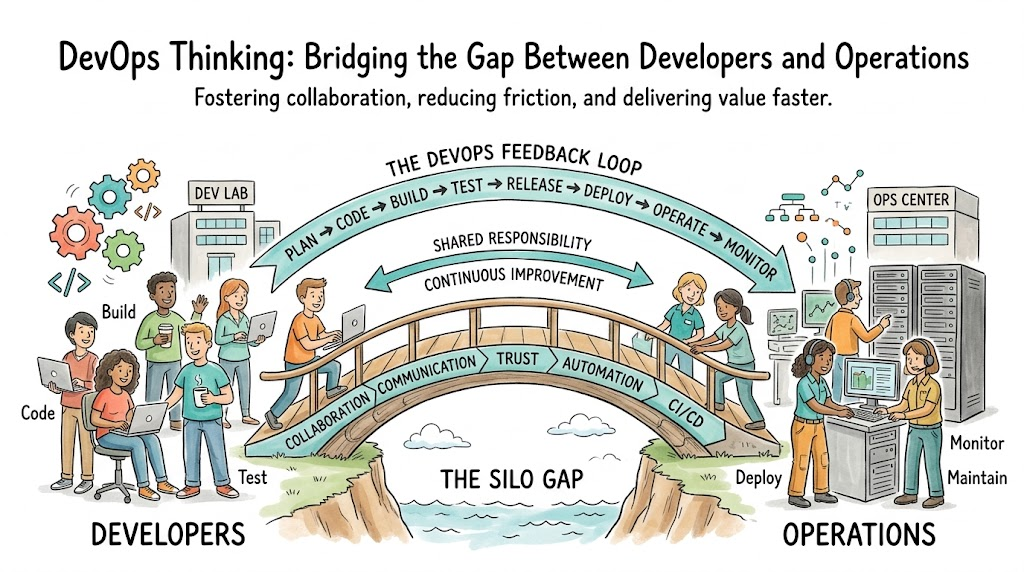
At its core, this mindset recognizes that software development and operations are not two separate entities, but rather parts of the same continuous process. It is about taking ownership of the entire lifecycle of an application, from the first line of code written on a developer’s laptop to the observability and incident response in production.
Why the DevOps Mindset Matters More Than Tools
If you focus only on learning tools, you are building your career on shifting sand. Tools have a shelf life. Five years ago, I spent months mastering specific configuration management tools that are now rarely used in modern cloud-native environments.
However, the problem-solving skills, the focus on automation, and the understanding of how to bridge development and operations teams are evergreen. When you develop a DevOps mindset, you become technology-agnostic. You learn how to look at a system, identify bottlenecks, and solve them regardless of whether you are using AWS, Azure, or an on-premise data center. This adaptability is what separates senior engineers from junior ones.
Evolution from Traditional IT to DevOps Thinking
Historically, IT organizations operated in silos. Developers wrote code and threw it over the wall to the Operations team, whose job was to ensure the system did not break. If the application failed in production, the developers blamed the operations environment, and the operations team blamed the code.
This conflict created a slow, defensive culture. Deployments happened rarely, usually on weekends, and involved high stress. DevOps emerged not as a replacement for IT, but as an evolution necessitated by the cloud. Cloud-native architecture requires that we treat infrastructure as code and that we integrate security and operations directly into the development loop.
Core Principles of the DevOps Mindset
The following table summarizes the foundational principles of a DevOps mindset and their real-world impact.
| Principle | Meaning | Real-World Impact |
| Collaboration | Removing barriers between teams. | Faster resolution of issues and shared ownership. |
| Automation | Eliminating repetitive manual tasks. | Reduced human error and faster delivery. |
| Continuous Learning | Adopting a growth mindset. | Ability to adapt to new technologies quickly. |
| Shared Responsibility | Owning the outcome, not just the code. | Improved system reliability and stability. |
| Fast Feedback | Implementing tight loops for testing. | Quicker detection and fix of bugs. |
| Reliability | Designing systems to be fault-tolerant. | Higher availability and customer satisfaction. |
Principle 1: Collaboration Over Silos
Collaboration is the bedrock of DevOps. I have worked in companies where the “dev” team was physically separated from the “ops” team. This physical or organizational separation almost always leads to a disconnect in priorities.
A DevOps mindset fosters an environment where developers understand the constraints of the production environment, and operations engineers understand the pressures of feature delivery. This means developers write code with operational observability in mind, and operations engineers contribute to the deployment automation scripts.
Principle 2: Automation-First Thinking
Automation-first means you never do the same task manually twice. If you have to configure a server, you write a script. If you have to deploy an application, you build a CI/CD pipeline.
Tools like Jenkins, Terraform, and Kubernetes are not just utilities; they are implementations of this mindset. An engineer with a DevOps mindset looks at a process and asks: “How can I make this repeatable, predictable, and self-serving?”
Principle 3: Continuous Learning and Improvement
Technology evolves at a rapid pace. A mindset rooted in continuous learning accepts that you will never “know it all.” Instead, you adopt a curious attitude toward new cloud services, security patches, and architectural patterns. When failure occurs—and it will—you look for the root cause in the system, not the person.
Principle 4: Shared Responsibility Culture
In a traditional setup, the developer’s job ends at the “deploy” button. In a DevOps mindset, the developer’s job ends when the user is successfully using the feature in production. When a service goes down, the entire team, regardless of their specialization, helps to resolve the issue. This creates a culture of accountability.
Principle 5: Fast Feedback Loops
Feedback loops are essential for quality. If a developer pushes code and finds out three weeks later that it breaks the production database, that is a failure of the feedback loop. DevOps encourages automated unit tests, integration tests, and performance monitoring that give immediate feedback to the developer.
Principle 6: Reliability and Stability Focus
Reliability is not an accident; it is engineered. By using tools like Prometheus, Grafana, and the ELK Stack, engineers ensure that systems are observable. The goal is to proactively catch issues before they affect the user, a core concept borrowed from Site Reliability Engineering (SRE).
Principle 7: Customer-Centric Engineering
Ultimately, technical performance is irrelevant if the customer is not satisfied. A DevOps mindset keeps the customer at the center of all decisions. We optimize pipelines not just to be fast, but to deliver features that improve the customer experience without compromising system integrity.
How Successful DevOps Engineers Think
Successful DevOps engineers are pragmatic problem solvers. They do not implement automation just to say they have automation. They assess the value: “Does this automation save time? Does it reduce risk?”
They think in terms of systems. When they look at a piece of code, they are also thinking about how it will scale, how it will be monitored, and how it will be secured in a cloud-native environment.
DevOps Mindset vs. Traditional IT Mindset
| Feature | Traditional IT Mindset | DevOps Mindset |
| Ownership | Siloed, “Not my job.” | Shared, “How can I help?” |
| Deployment Speed | Slow, infrequent, risky. | Fast, frequent, reliable. |
| Collaboration | Ticket-based, slow. | Chat, direct, transparent. |
| Automation | Secondary, manual focus. | Primary, automation-first. |
| Monitoring | Reactive, alert-heavy. | Proactive, observability-driven. |
| Security | Audited at the end. | Built-in (DevSecOps). |
| Feedback | Delayed, infrequent. | Immediate, constant. |
Role of Cloud-Native Thinking in the DevOps Mindset
Cloud-native engineering is the technical execution of the DevOps mindset. It involves using containers, orchestrators like Kubernetes, and serverless architectures to build systems that are inherently scalable and resilient. If you try to apply a traditional IT mindset to cloud-native architecture, you will fail because you will be managing individual servers instead of managing distributed systems.
Role of DevSecOps in the DevOps Mindset
Security cannot be an afterthought. In a DevOps mindset, we “shift left,” meaning we introduce security checks during the development and testing phases, not just before release. This ensures compliance and security are automated parts of the pipeline, rather than manual gatekeepers.
Building a DevOps Mindset as a Beginner: A Roadmap
- Step 1: Learn Linux and Networking: You cannot manage what you do not understand. Learn the command line and how traffic flows.
- Step 2: Understand Git and CI/CD: Learn how to version control and how to automate the build-test-deploy flow.
- Step 3: Practice Automation: Start by automating your own local tasks before trying to automate enterprise systems.
- Step 4: Learn Cloud Platforms: Build projects on platforms like AWS, Azure, or GCP.
- Step 5: Build Monitoring Skills: Set up dashboards to visualize the health of your applications.
- Step 6: Practice Collaboration: Contribute to open source or collaborate on team projects to learn how to communicate technical ideas.
Real-World Example: The DevOps Mindset in Action
Consider an e-commerce platform facing a “Friday afternoon deployment.”
- Traditional Approach: Developers push code to a staging server on Friday afternoon. The Ops team is afraid to deploy, fearing a system crash over the weekend. They delay the release to Monday. Conflict ensues.
- DevOps Approach: The team uses automated pipelines with rigorous testing. The code is already integrated into the main branch. The monitoring system (Prometheus/Grafana) provides real-time health data. The deployment is fully automated and can be rolled back instantly if an error is detected. Because the team trusts their automation and their feedback loops, they deploy on Friday morning with confidence, knowing they can fix any minor issues immediately if they arise.
Benefits of Building a Strong DevOps Mindset
- Faster Career Growth: Companies are hiring for “thought” leaders, not just “ticket” closers.
- Better Problem-Solving: You learn to debug systems, not just code.
- Stronger Collaboration: You become a bridge-builder between departments.
- Adaptability: New tools become easier to learn when you understand the underlying concepts.
Common Mistakes Engineers Make
- Focusing Only on Tools: Learning Kubernetes is useless if you don’t understand the application requirements.
- Ignoring Communication: Technical skills are important, but explaining why a change is necessary is equally vital.
- Avoiding Automation: “It’s easier to do it manually” is a mindset that will hold you back.
- Lack of Consistency: DevOps is a culture, not a one-time project. It requires continuous effort.
Best Practices for Developing a DevOps Mindset
- Build Real Projects: Do not just follow tutorials. Build something that fails and learn to fix it.
- Learn Incident Management: Experience the pressure of a system outage; it teaches you the value of design.
- Focus on Reliability: Always ask, “What happens if this component fails?”
- Collaborate: Work with other developers to understand their pain points.
Role of DevOpsSchool in Building Practical DevOps Thinking
To build a true DevOps mindset, you need exposure to real-world scenarios, not just theoretical exams. Platforms like DevOpsSchool focus on this practical application. By emphasizing hands-on labs, cloud-native exposure, and CI/CD best practices, they help students understand the “why” behind the technology, which is essential for developing a lasting, career-defining engineering philosophy.
Industries Benefiting from the DevOps Mindset
- Banking & Finance: Requires strict compliance, security, and high reliability.
- Healthcare: Demands audit trails, data integrity, and uptime.
- E-Commerce: Needs extreme scalability and rapid release cycles to match customer demand.
- SaaS Platforms: Dependent on constant feature delivery and system availability.
- Telecom: Relies on large-scale automation and complex infrastructure management.
- Enterprise IT: Benefits from cost optimization and operational efficiency.
Career Opportunities for Engineers with a Strong DevOps Mindset
Roles for those with this mindset are expanding rapidly.
- DevOps Engineer: Focuses on the pipeline and automation.
- Cloud Engineer: Focuses on infrastructure and cloud platforms.
- Platform Engineer: Focuses on building internal tools for other developers.
- SRE (Site Reliability Engineer): Focuses on system stability and uptime.
- DevSecOps Engineer: Focuses on embedding security into the delivery lifecycle.
Certifications & Learning Paths
While certifications are not the mindset itself, they provide a structured path to gain the knowledge required to support that mindset.
| Certification | Best For | Skill Level | Focus Area |
| Kubernetes (CKA) | Orchestration | Intermediate | Container Management |
| AWS/Azure/GCP Solutions Architect | Cloud Infrastructure | Intermediate/Advanced | Cloud Design |
| HashiCorp Terraform | Infrastructure as Code | Intermediate | Automation |
| SRE/DevOps Professional | Philosophy & Reliability | Advanced | System Stability |
Common Beginner Mistakes
- Learning tools in isolation: Don’t learn Docker without knowing Linux basics.
- Weak Networking knowledge: You cannot troubleshoot cloud issues without understanding VPCs, subnets, and routing.
- Ignoring documentation: Always read the official docs before jumping into third-party tutorials.
- Lack of consistency: Spend one hour a day consistently rather than ten hours once a week.
Future of the DevOps Mindset
The future of DevOps is moving toward AI-assisted operations and Platform Engineering. As systems become more complex, we will rely more on AI to analyze logs and suggest fixes. However, the core DevOps mindset—collaboration, automation, and continuous improvement—will remain the critical human element that directs these technologies to solve real business problems.
FAQs
1. What is a DevOps mindset?
It is a cultural and operational approach prioritizing collaboration, automation, and shared ownership of the software lifecycle.
2. Why is mindset important in DevOps?
Tools change, but the ability to solve problems, collaborate, and automate remains constant and valuable throughout your career.
3. Is DevOps only about tools?
No. Tools are merely the mechanisms we use to implement the DevOps philosophy.
4. How do beginners build a DevOps mindset?
Start by automating manual tasks, learning the fundamentals of Linux and networking, and seeking opportunities to collaborate with others.
5. Why is collaboration important in DevOps?
It removes silos, ensuring that development and operations teams work toward shared business goals rather than competing priorities.
6. What role does automation play?
It minimizes human error, increases deployment speed, and allows engineers to focus on higher-level problem-solving.
7. Is DevOps a good career path?
Yes, it is high in demand because every modern business relies on software and infrastructure that requires this specific skill set.
8. How is DevOps different from traditional IT?
Traditional IT is siloed and reactive; DevOps is collaborative, proactive, and focused on continuous delivery.
9. Can a developer become a DevOps engineer?
Absolutely. Many great DevOps engineers started as developers because they understand the code lifecycle.
10. What is an SRE mindset?
It is the application of software engineering principles to infrastructure and operations problems, with a heavy focus on reliability.
11. Is DevOps only for cloud companies?
No, DevOps principles apply to any organization that develops and maintains software.
12. How do I start learning?
Start with the basics: Linux, networking, a scripting language (like Python or Bash), and version control (Git).
13. What is the hardest part of DevOps?
Changing the culture. Adopting new tools is easy; changing how people communicate and collaborate is hard.
14. Should I focus on one cloud provider?
Learn one deeply, then understand the concepts that apply across all of them (like networking and security).
15. How does DevOps improve reliability?
By using automated testing, monitoring, and fast feedback loops, you catch and resolve issues before they reach the customer.
Final Thoughts
Building a DevOps mindset is not a task you complete in a weekend; it is a career-long practice. It requires you to be humble enough to learn constantly, brave enough to automate your own tasks, and collaborative enough to share responsibility with your team. Do not get caught up in the “tool hype.” Focus on understanding how systems work, how to identify bottlenecks, and how to communicate effectively. If you build this foundation, the tools will become easy to pick up, and your career will grow alongside the technology. Stay curious, practice continuously, and remember that the best systems are built by teams that trust, communicate, and automate.

