
Introduction
The moment you open a terminal for the first time or attempt to configure your first CI/CD pipeline, the reality of DevOps hits you. You are likely staring at a black screen with a blinking cursor, wondering if you are going to break the system or if you are simply not cut out for this. The field of DevOps is vast, involving everything from Linux administration to cloud architecture, scripting, and automation. Because the scope is so broad, it is entirely normal to feel intimidated. Many beginners feel that because they do not know every single tool, they are falling behind.
This lack of confidence is not a reflection of your intelligence; it is a symptom of trying to master an infinite field without a structured map. The fear of making mistakes, the anxiety regarding complex toolchains, and the pressure of keeping up with industry trends can stall your progress. However, confidence in this field is not something you are born with—it is something you build through consistent, practical experience.
If you are just starting, remember that every senior engineer you admire was once in your shoes. They also struggled with configuration errors, panicked during server crashes, and felt overwhelmed by the sheer number of tools. The key difference is that they learned how to approach these challenges systematically. To truly progress, you need a partner in your learning journey. Resources at DevOpsSchool provide structured pathways to help you navigate this complexity. By focusing on fundamentals rather than hype, you can build a sustainable foundation. Let us dive into how you can methodically develop the confidence required to thrive as a DevOps learner.
Why Confidence Matters in DevOps Learning
Confidence in DevOps is not about knowing the answer to every question. It is about having the belief that you can find the answer. When you lack confidence, you tend to avoid complex problems, hesitate to experiment, and rely too heavily on copy-pasting solutions you do not fully understand.
The Problem-Solving Mindset
DevOps is 80% troubleshooting and 20% building. If you are not confident, every error message feels like a failure. With a confident mindset, you view an error as a data point that leads you closer to the solution. This distinction is critical for career growth.
Experimentation Confidence
Automation requires experimentation. If you are afraid of breaking your local environment, you will never learn how to manage production environments. Confidence allows you to treat your infrastructure as code, make mistakes in a sandbox environment, and learn from them without fear.
Common Fears New DevOps Learners Face
| Fear | Why It Happens |
| Too many tools | DevOps requires a diverse toolchain (Jenkins, Docker, Kubernetes, Terraform, etc.), leading to analysis paralysis. |
| Linux commands | The command-line interface feels unforgiving and archaic to those coming from GUI-based operating systems. |
| Cloud confusion | Services like AWS, Azure, or GCP have thousands of configurations, making it hard to know where to start. |
| CI/CD complexity | Understanding how code flows from a developer’s machine to a production server involves many moving parts. |
| Feeling behind others | Seeing experienced engineers share complex setups online creates an unrealistic benchmark for beginners. |
Why Beginners Lose Confidence Quickly
The Comparison Trap
You are likely comparing your Chapter 1 to someone else’s Chapter 20. When you browse platforms like LinkedIn or Twitter, you see experienced engineers discussing advanced Kubernetes clusters. It is easy to internalize the idea that you are falling behind, which drains your motivation.
The “Tutorial Hell” Cycle
Many beginners watch video after video, following tutorials step-by-step. While this feels like progress, it is passive learning. When you try to build a project without the tutorial, you freeze because you never actually learned the logic—you only memorized the clicks.
Unrealistic Expectations
You expect to be “job-ready” in a few weeks. The reality is that DevOps is an engineering discipline. It takes time to understand how systems interact. When you don’t master Docker in three days, you feel like you have failed.
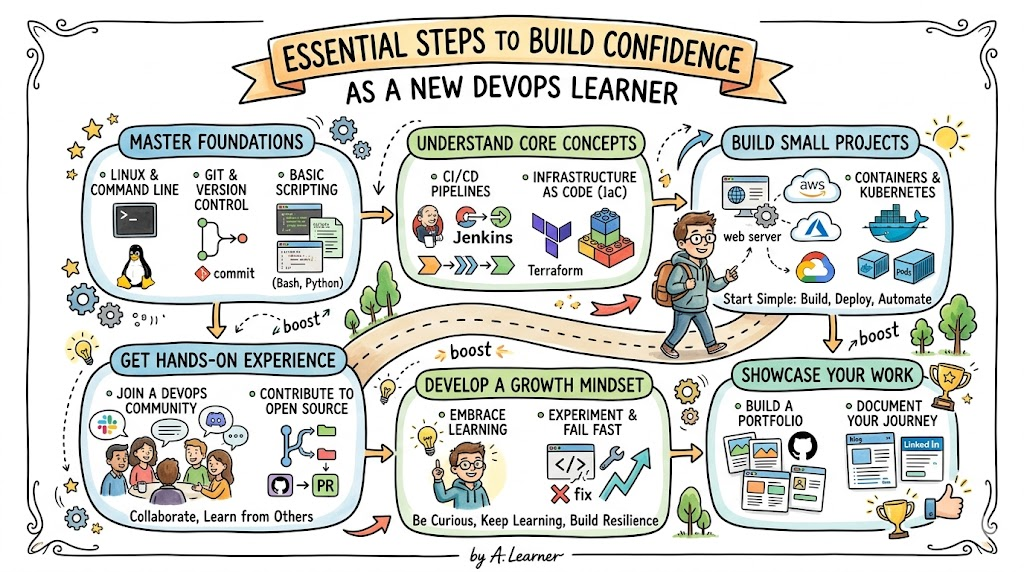
Step-by-Step Ways to Build Confidence as a New DevOps Learner
This roadmap is designed to shift your focus from “learning everything” to “learning what matters.”
| Step | Goal | Outcome |
| 1 | Master Linux Basics | You become comfortable in the terminal. |
| 2 | Understand Networking | You know how machines communicate. |
| 3 | Version Control (Git) | You learn to track and manage changes. |
| 4 | Containerization (Docker) | You learn to package and isolate applications. |
| 5 | CI/CD Foundations | You understand automated code delivery. |
| 6 | Cloud Fundamentals | You grasp virtualized infrastructure. |
| 7 | Infrastructure as Code | You learn to automate your environment. |
| 8 | Build a Portfolio | You gain tangible proof of skills. |
Step 1: Stop Trying to Learn Everything at Once
You do not need to learn Kubernetes in your first month. Start by understanding how a computer works. If you do not know how a web server processes a request, Kubernetes will make no sense. Focus on the base layer.
Step 2: Build Strong Linux Basics
Linux is the heart of DevOps. Spend time navigating the file system, managing permissions, and understanding users. If you can manage a Linux server, you can manage almost anything in the cloud. Practice basic bash scripting to automate file management tasks.
Step 3: Practice Small Hands-On Tasks Daily
Consistency beats intensity. Spend 30 minutes a day writing a shell script or setting up a local web server. Do not just read; execute. If you install Apache or Nginx on a Linux VM, you have gained more confidence than by watching five hours of lectures.
Step 4: Learn One Tool at a Time
Do not learn Ansible and Terraform simultaneously. Master one, then look at the other. For instance, learn how to run a container with Docker first. Once you understand Docker, move to Docker Compose. This logical progression prevents mental overload.
Step 5: Build Small Projects
Build a project that solves a real problem. For example, host a static website on an Nginx server, then put that server inside a Docker container. This project-based learning proves to you that you can connect the dots.
Step 6: Celebrate Small Progress
If you successfully configured a Git repository or wrote a script that moves files automatically, celebrate it. These small wins build the neural pathways required for complex tasks. Confidence is a collection of solved problems.
Step 7: Learn to Troubleshoot Without Panic
When a pipeline fails, do not look for a tutorial immediately. Read the error log. Most of the time, the error tells you exactly what is wrong. If the path is wrong, fix the path. This proactive troubleshooting is the defining trait of a confident engineer.
Step 8: Join Learning Communities
Find groups where people are learning at your level. Avoid communities that are purely elitist. Sharing your progress, even if it is a simple “Hello World” in a new language, keeps you accountable.
Step 9: Build a Beginner Portfolio
Host your scripts on GitHub. Document your learning journey in a simple README file. When you look back at your code from two months ago, you will see how far you have come, which is the best way to boost your own confidence.
Step 10: Focus on Progress, Not Perfection
You will write bad code. You will configure servers incorrectly. This is part of the process. An engineer who has never broken a system is an engineer who has never tried anything difficult.
Real-World Example: Beginner Losing Confidence
Consider “Rahul,” who decided to learn DevOps. He bought a course, skipped the Linux section because it looked “old school,” and jumped straight into Kubernetes. Two weeks later, he was stuck on a cluster configuration error he couldn’t fix because he didn’t understand the networking or Linux basics underneath. He felt stupid, stopped learning, and convinced himself he wasn’t “tech-savvy enough.” The failure wasn’t his intelligence; it was his skipping the foundation.
Real-World Example: Beginner Building Confidence Successfully
Contrast this with “Sarah,” who started by installing a Linux distribution on a virtual machine. She spent a month just learning the command line and basic networking. When she eventually started learning Docker, she understood the underlying OS architecture. When an error popped up, she knew how to check the system logs. Her confidence was high because her knowledge was built on a solid base, not on top of blind assumptions.
Common Beginner Misunderstandings
- Need to know every tool: False. You need to know the concepts (like storage, networking, compute). Tools come and go.
- DevOps is only for developers: False. System administrators, network engineers, and even freshers can excel in DevOps by focusing on operations logic.
- Errors mean I failed: False. Errors are the primary source of information in engineering.
- Certifications build confidence: False. Certifications validate knowledge, but building projects builds competence.
Best Practices for Staying Confident While Learning
- Track your progress: Keep a learning journal.
- Use the documentation: Stop relying on StackOverflow for everything. Learn to read official documentation.
- Teach what you learn: If you can explain Docker to a friend, you understand it.
- Take breaks: If you are frustrated, step away. Your brain processes information during rest.
- Focus on “Why,” not just “How”: Don’t just learn how to run a command; learn why that command is necessary.
Role of DevOpsSchool in Beginner Learning
DevOpsSchool focuses on the pedagogical approach required for beginners. The learning ecosystem emphasizes hands-on experience over theoretical memorization. By prioritizing CI/CD exposure and practical, environment-based learning, learners build a mindset of resilience. When you are guided through the “why” of infrastructure and automation, the fear of the unknown dissipates.
Career Importance of Confidence in DevOps
Confidence is a tangible asset in your career. During interviews, an interviewer is not just looking for the right answer; they are looking for how you approach a problem you have never seen before. A confident learner displays:
- Problem-solving capacity: You don’t freeze when things break.
- Adaptability: You are willing to learn new tools.
- Communication: You can explain complex concepts clearly.
These traits are required for roles such as:
- Junior DevOps Engineer: Focus on supporting teams and basic automation.
- Cloud Engineer: Managing virtualized environments and cost optimization.
- Automation Engineer: Writing scripts to reduce manual toil.
Industries Hiring Beginner DevOps Professionals
DevOps is horizontal, meaning it applies to every industry that uses software.
- SaaS Platforms: Need constant deployment and high availability.
- E-Commerce: Need robust infrastructure to handle traffic spikes.
- Banking & Finance: Need strict compliance and security automation.
- Healthcare: Need secure, audit-friendly environments.
If you understand the basics, you are valuable to any company that needs to deploy software reliably.
Future of DevOps Learning
The future is shifting toward platform engineering and AI-assisted automation. However, the core principles of DevOps—monitoring, automation, and reliability—will remain unchanged. As AI tools become common, the human element of understanding the architecture will become even more valuable. Learning how to build confidence now prepares you to adapt to these new technologies easily.
FAQs
1. Is DevOps hard for beginners?
DevOps is complex, not necessarily hard. It involves many moving parts. If you break it into small, manageable pieces, it is very learnable.
2. How do I stop feeling overwhelmed?
Focus on one specific technology at a time. If you are learning Docker, ignore Kubernetes until you are comfortable.
3. Should I learn Linux first?
Absolutely. Linux is the operating system that runs the cloud. It is the single most important skill for a DevOps learner.
4. How long does it take to feel confident?
It varies, but typically, with consistent daily practice, you will start feeling confident in specific domains within three to six months.
5. Do I need coding skills?
You need scripting skills (Bash, Python). You do not need to be a software developer, but you must be able to read and write automation scripts.
6. Are mistakes normal?
Mistakes are guaranteed. Every deployment, every script, and every server configuration will involve trial and error.
7. How do I practice DevOps without a company environment?
Use tools like VirtualBox, Vagrant, or free tiers on cloud providers to build your own “company” environment at home.
8. Can freshers learn DevOps?
Yes. Many companies look for freshers who have the right mindset and fundamental Linux/cloud knowledge.
9. Is DevOps just about tools like Jenkins?
No. Jenkins is just a tool. DevOps is a culture of collaboration and automation.
10. What is the best way to learn automation?
Start by automating something you do manually on your computer.
11. Does my age matter in DevOps?
No. Whether you are a student or a career switcher, the industry values competence and the ability to solve problems.
12. How do I know if I am ready for a job?
When you can build a simple end-to-end project (e.g., code in Git -> CI/CD pipeline -> Deployed application) without help, you are ready for entry-level roles.
13. What if I forget what I learned?
This is normal. The goal is not memorization but understanding the logic. You can always look up syntax.
14. Are certificates worth it?
They are useful for getting through HR filters, but they should never replace hands-on project work.
15. How do I handle Imposter Syndrome?
Acknowledge that everyone feels it. Focus on your own growth rather than comparing yourself to others.
Final Thoughts
Building confidence as a new DevOps learner is a marathon, not a sprint. You are training your brain to think in systems, to automate the tedious, and to troubleshoot the impossible. There is no secret shortcut; there is only consistent, practical application. When you embrace the struggle of learning as part of the process, you strip away the fear of the unknown.
Keep your setup simple. Keep your practice frequent. Rely on solid fundamentals rather than complex buzzwords. Remember that your goal is to be a reliable, problem-solving engineer, not a master of every tool on the market. Take the first step today, start with the Linux basics, and trust that your confidence will grow with every error you debug and every system you stabilize.

