
Introduction
The modern software landscape is shifting rapidly toward cloud-native architectures. As companies move away from monolithic, legacy infrastructures, the demand for professionals who can bridge the gap between development and operations has reached an all-time high. If you are exploring this field, you are embarking on a transformative DevOps learning journey that requires patience, curiosity, and a structured approach.
Many beginners find themselves overwhelmed by the sheer volume of tools and technologies associated with this role. However, success in this field is not about knowing every tool on the market; it is about understanding the core philosophies of automation, collaboration, and continuous improvement. To navigate this path effectively, it is essential to rely on structured guidance and high-quality resources, such as those provided by DevOpsSchool. Taking a systematic approach will allow you to build a robust skill set that remains relevant in a fast-paced industry.
What Is DevOps?
At its core, DevOps is a cultural and professional movement aimed at shortening the systems development life cycle and providing continuous delivery with high software quality. It represents a shift from the traditional “siloed” approach—where developers write code and operations teams handle deployment—to a collaborative model where shared responsibility is the norm.
Key pillars of this philosophy include:
- Automation: Replacing manual, error-prone tasks with scripted, repeatable processes.
- Continuous Integration/Continuous Delivery (CI/CD): Ensuring that code changes are automatically tested and deployed to production environments.
- Collaboration: Breaking down communication barriers between engineering and IT staff.
- Shared Responsibility: Every team member is responsible for the health and performance of the services they build.
Why DevOps Is a Great Career Choice
The transition to cloud-native technologies has made DevOps one of the most sought-after skill sets in the IT sector. Organizations are constantly looking for engineers who can manage complex distributed systems while maintaining high availability.
Career advantages include:
- High Industry Demand: Companies ranging from startups to global enterprises rely on DevOps practices.
- Competitive Compensation: Because the role requires a blend of development, operations, and architectural knowledge, it is generally well-compensated.
- Constant Innovation: You will work with the latest cloud-native technologies like Kubernetes and serverless platforms.
- Professional Flexibility: DevOps principles are universal, allowing you to work across various industries, from finance to healthcare.
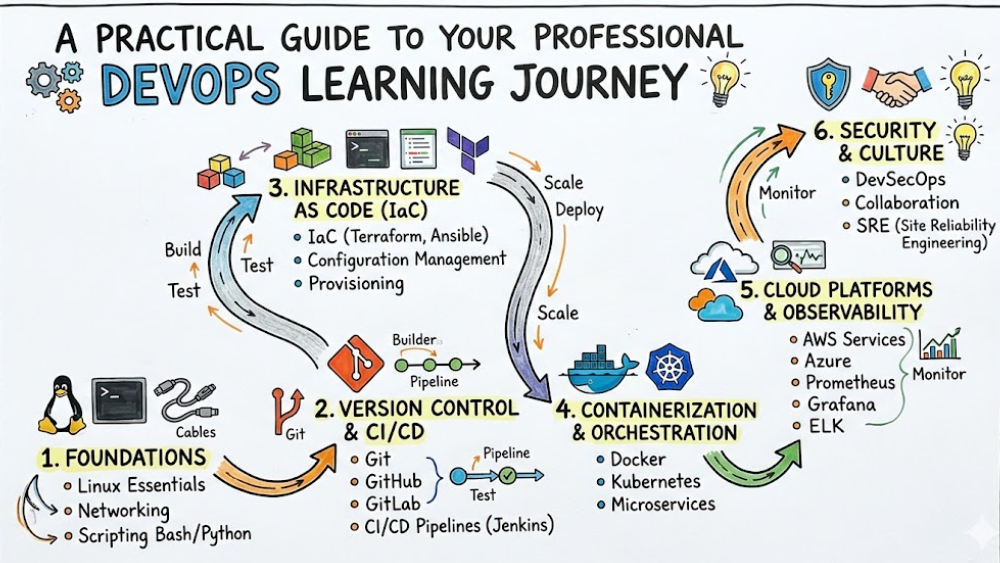
Understanding the DevOps Learning Journey
A successful DevOps learning journey is a marathon, not a sprint. Beginners often make the mistake of jumping directly into advanced tools like Kubernetes without understanding the underlying concepts of Linux or networking.
You must focus on building a strong foundation. Think of it like constructing a house: you cannot build the roof (cloud orchestration) until you have a solid foundation (Linux and networking) and a strong frame (Git and CI/CD). Embrace a continuous learning mindset, prioritize hands-on practice, and seek out real-world exposure whenever possible.
Step-by-Step DevOps Learning Roadmap
Step 1: Learn Linux Fundamentals
Linux is the backbone of almost all cloud environments. You must become comfortable navigating the terminal.
- Commands: Learn
ls,grep,awk,sed, and package managers likeaptoryum. - File Systems: Understand directory structures and permissions (
chmod,chown). - User Management: Creating users, managing groups, and sudo access.
Step 2: Understand Networking Basics
Understanding how data moves across the internet is vital for troubleshooting.
- DNS/HTTP/HTTPS: Learn how web requests travel from a client to a server.
- Load Balancing: How traffic is distributed across multiple servers.
- Firewalls & Ports: Securing connections by managing inbound and outbound traffic.
Step 3: Learn Git and Version Control
Version control is the foundation of collaboration.
- Basics:
git init,add,commit,push,pull. - Branching: Mastering workflows like Git Flow.
- Platforms: Using GitHub or GitLab for repository management.
Step 4: Learn Scripting Basics
Automation is the heart of DevOps.
- Bash Scripting: Essential for automating local tasks and server maintenance.
- Python: Highly recommended for more complex automation tasks and interacting with APIs.
Step 5: Understand CI/CD Concepts
CI/CD pipelines automate the path from code commit to production.
- Integration: Automating code testing upon every commit.
- Delivery: Automatically preparing code for release.
- Tools: Gain exposure to Jenkins, GitHub Actions, or GitLab CI/CD.
Step 6: Learn Docker and Containerization
Containers revolutionized how software is packaged and deployed.
- Fundamentals: Understanding the difference between a Virtual Machine and a Container.
- Dockerfile: Writing instructions to build your own container images.
- Docker Compose: Managing multi-container applications.
Step 7: Learn Kubernetes
Kubernetes is the standard for container orchestration.
- Architecture: Understanding Control Plane vs. Worker Nodes.
- Objects: Mastering Pods, Deployments, Services, and Namespaces.
- Scaling: Managing application load automatically.
Step 8: Learn Cloud Computing
Pick one major provider (AWS, Azure, or Google Cloud) and master its core services.
- Compute: EC2/Compute Engine.
- Storage: S3/Cloud Storage.
- Networking: VPC, subnets, and routing.
Step 9: Learn Infrastructure as Code (IaC)
Stop building servers manually; code your infrastructure.
- Terraform: The industry standard for provisioning resources.
- Ansible: Excellent for configuration management and automation.
Step 10: Learn Monitoring & Observability
You cannot improve what you cannot measure.
- Prometheus/Grafana: Creating dashboards to visualize metrics.
- Logging: Centralizing logs using the ELK stack (Elasticsearch, Logstash, Kibana).
Step 11: Learn Security & DevSecOps Basics
Security should be integrated into every step of the development lifecycle.
- IAM: Managing identities and access.
- Secret Management: Storing passwords and keys safely using tools like Vault.
Step 12: Build Real DevOps Projects
Theory is useless without application. Build a full-stack project where code is committed, tested, containerized, and deployed to a cloud environment automatically.
DevOps Learning Path for Different Backgrounds
| Background | Focus Area | Recommended Strategy |
| Developers | Ops & Infrastructure | Focus on CI/CD, Terraform, and Kubernetes. |
| SysAdmins | Scripting & Cloud | Focus on Python, Docker, and Cloud platforms. |
| Beginners | Linux & Fundamentals | Build a solid base in Linux/Networking first. |
| Students | Projects & Basics | Participate in open-source and build labs. |
Best DevOps Tools Beginners Should Learn
| Tool | Purpose | Beginner Difficulty | Industry Demand |
| Git | Version Control | Low | Extreme |
| Docker | Containerization | Medium | High |
| Jenkins | CI/CD | Medium | High |
| Terraform | IaC | Medium | High |
| Kubernetes | Orchestration | High | High |
Common Challenges Beginners Face While Learning DevOps
- Information Overload: With thousands of tools available, it is easy to lose focus. Follow a structured roadmap.
- Weak Fundamentals: Skipping Linux or Networking basics will cause significant pain later. Do not bypass these.
- Fear of Complexity: Kubernetes and Cloud networking can be daunting. Break these into smaller, manageable chunks.
- Lack of Hands-on Practice: Watching tutorials is not enough. You must build projects to truly learn.
Best Practices for Learning DevOps Faster
- Master the Basics: Spend enough time on Linux. It will pay dividends later.
- Learn by Doing: Every time you learn a concept, build a mini-project around it.
- Use Cloud Free Tiers: Take advantage of AWS or GCP free tiers to practice without incurring costs.
- Consistency is Key: Spend at least one hour daily on your studies rather than cramming on weekends.
- Join Communities: Engage with others learning the same topics to solve common problems.
Real-World DevOps Workflow Example
- Code: A developer commits code to a Git repository.
- Integration: The CI pipeline triggers, running unit tests.
- Build: If tests pass, a Docker image is built and pushed to a registry.
- Deploy: The CD pipeline updates the Kubernetes cluster with the new image.
- Monitor: Prometheus monitors the application health, and Grafana alerts the team if an error occurs.
DevOps vs Traditional IT Learning
| Feature | Traditional IT Learning | DevOps Learning |
| Automation | Manual execution | Code-driven automation |
| Collaboration | Siloed departments | Cross-functional integration |
| Cloud Skills | On-premise focus | Cloud-native focus |
| Deployment | Periodic manual releases | Continuous automated delivery |
| Monitoring | Reactive manual checks | Proactive observability |
Certifications & Learning Paths
Certifications are a great way to validate your skills. However, they should be treated as a supplement to real-world project work.
| Certification | Best For | Focus Area |
| CKA | Kubernetes Enthusiasts | Container Orchestration |
| AWS Solutions Architect | Cloud Aspirants | Cloud Infrastructure |
| Terraform Associate | IaC Specialists | Automation |
Explore DevOpsSchool for structured learning paths that combine theoretical knowledge with practical lab sessions.
Common Beginner Mistakes
- Trying to learn every tool: Focus on one tool in each category first (e.g., Jenkins for CI, not five different tools).
- Ignoring Documentation: Always read official documentation before turning to third-party tutorials.
- Giving up on troubleshooting: Debugging is 80% of the job. Embrace the challenge.
- Neglecting Security: Do not leave your cloud instances open to the public during testing.
How Long Does It Take to Learn DevOps?
Learning the basics typically takes 6 to 12 months for a dedicated student. If you are working full-time, progress may be slower, but consistency is more important than speed. The journey never truly ends, as the technology evolves every year.
Career Opportunities After Learning DevOps
- DevOps Engineer: Managing infrastructure and pipelines.
- Cloud Engineer: Specializing in cloud service architecture.
- Platform Engineer: Building internal tools for other developers.
- SRE (Site Reliability Engineer): Focusing on system reliability and uptime.
- DevSecOps Engineer: Integrating security into every process.
Future of DevOps Learning
The future lies in Platform Engineering, where DevOps teams build internal developer platforms to increase team efficiency. Additionally, AI-assisted operations are becoming common, allowing engineers to automate root-cause analysis more effectively. Stay updated on these trends to ensure long-term career growth.
FAQs
- What should I learn first in DevOps?
Start with Linux and basic networking. - Is Linux mandatory for DevOps?
Yes, it is the primary environment for most servers. - How long does it take to become a DevOps engineer?
Typically 6-12 months of structured learning. - Is coding required in DevOps?
Yes, you need scripting skills (Bash/Python). - Is Kubernetes important for beginners?
Yes, but learn Docker first. - Which cloud platform should I learn first?
AWS is the market leader, but any major platform (Azure/GCP) will teach you the same principles. - Are certifications necessary?
They are helpful for getting interviews, but project experience is vital. - Can non-programmers learn DevOps?
Yes, but you must be comfortable learning scripting languages. - How do I gain real-world experience?
Build projects and host them on the cloud. - What is the best way to practice CI/CD?
Create a GitHub repository and set up GitHub Actions. - Do I need to be a hardware expert?
No, cloud-native DevOps abstracts hardware. - What is the most important skill?
Troubleshooting/Problem-solving. - Is monitoring different from logging?
Yes, monitoring is for trends, logging is for specific events. - How do I keep up with new tools?
Follow industry blogs and newsletters. - Is DevOps a developer or operations role?
It is a hybrid role that requires knowledge of both.
Final Thoughts
Embarking on your DevOps learning journey is an investment in your future. There is no shortcut to mastery; it requires a deep understanding of how systems communicate, how code moves to production, and how infrastructure can be managed as code. Focus on the fundamentals, build projects that solve real problems, and remain curious about the evolving cloud-native landscape. Success comes to those who remain consistent and practical in their learning approach.

