
Introduction
Software delivery has undergone a profound evolution over the last two decades. In the early days, development teams built applications, tossed the code over a wall, and left the operations team to figure out how to run, scale, and maintain them. This model created rigid silos, finger-pointing during outages, and dangerously slow release cycles.
Organizations eventually realized that this friction was not just a technical bottleneck; it was a business problem. The need for faster time-to-market and higher reliability forced a shift toward better collaboration. This is where DevOps emerged not just as a set of tools, but as a fundamental cultural shift.
DevOps culture transforms engineering teams by aligning goals, breaking down communication barriers, and fostering a shared sense of ownership. For those looking to master these principles, platforms like DevOpsSchool provide structured pathways to understand how this integration works in practice. By moving away from isolated roles toward a unified approach, teams can achieve the agility required to compete in today’s cloud-native landscape.
What Is DevOps Culture?
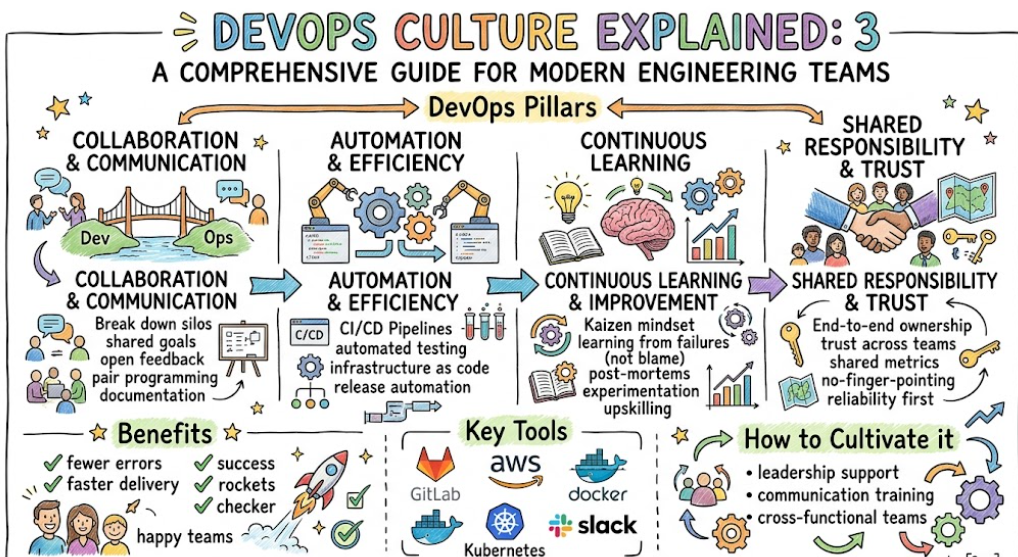
At its core, DevOps culture is a set of values and practices that emphasizes communication, collaboration, and integration between software developers and IT operations teams. It is a philosophy that replaces the traditional “us versus them” mentality with a unified “we” mindset.
A strong DevOps culture is defined by:
- Shared Ownership: Everyone involved in the development and operational lifecycle is responsible for the end product’s success and reliability.
- Continuous Learning: Teams embrace failure as a chance to improve processes rather than assign blame.
- Collaboration: Breaking down departmental silos to ensure developers and operators work toward the same business goals.
- Automation Mindset: Reducing manual, error-prone tasks to allow teams to focus on building features and improving system stability.
Think of it as moving from a relay race, where teams hand off batons and hope for the best, to a soccer team where everyone is constantly moving, supporting each other, and focused on the same goal: moving the ball toward the objective.
Why DevOps Culture Matters
Modern organizations face relentless pressure to innovate. Without a proper culture, technical tools—no matter how advanced—will fail to deliver value. DevOps culture matters because it directly impacts the bottom line.
- Faster Delivery Cycles: By automating workflows and increasing collaboration, teams can release features multiple times a day instead of once every few months.
- Reduced Downtime: When developers and operations engineers collaborate early, they identify potential issues before the code ever hits production.
- Better Customer Experience: Rapid feedback loops ensure that the software being built is exactly what the user actually needs.
- Increased Scalability: A culture that promotes infrastructure-as-code allows organizations to scale resources dynamically based on demand.
For example, in a legacy environment, a deployment might take three days of coordination between five different departments. In a mature DevOps culture, a single engineer can push a change to production in minutes because the processes are automated, tested, and culturally supported.
Traditional IT Culture vs DevOps Culture
| Feature | Traditional IT Culture | DevOps Culture |
| Team Structure | Isolated silos (Dev vs Ops) | Cross-functional teams |
| Communication | Tickets and formal handoffs | Real-time chat and shared visibility |
| Deployment | Rare, massive “big bang” events | Frequent, small, low-risk releases |
| Automation | Manual execution of scripts | Everything-as-Code |
| Incident Response | Blame-focused (Who broke it?) | Learning-focused (How to prevent it?) |
| Responsibility | “It works on my machine” | Shared ownership of the outcome |
| Feedback Loops | Slow; quarterly or yearly | Immediate; continuous monitoring |
| Innovation Speed | Low; fear of change | High; safe-to-fail experimentation |
Core Principles of DevOps Culture
Collaboration
Collaboration is the foundation. It requires developers to understand operational constraints and operators to understand the application logic.
Shared Responsibility
When an application fails, the team looks for the root cause in the system, not the person who made the mistake.
Automation
Automation is the primary tool for cultural change. By automating testing and deployment, we remove the human element that causes “human error,” freeing staff to do higher-level work.
Continuous Improvement
This is the Kaizen philosophy. Every incident, deployment, or experiment is a data point used to refine the system further.
Fast Feedback
Shortening the loop between “code written” and “customer impact” is essential. This is achieved through automated monitoring and logs.
Customer-Centric Thinking
DevOps teams do not just ship features; they ship solutions. Every decision is measured against how it impacts the end-user experience.
Transparency
Information is not kept behind closed doors. Dashboards, logs, and performance metrics are visible to the entire organization.
Learning Mindset
The technology landscape changes fast. A healthy culture encourages engineers to learn, experiment with new tools, and share knowledge daily.
Role of Collaboration in DevOps Culture
In traditional models, developers often want to change things, and operators want to keep things stable. These conflicting goals lead to friction. DevOps culture aligns these goals through cross-functional teamwork.
By placing developers and operations engineers in the same “squads,” teams share a common mission. When an issue arises, they troubleshoot together. This collaboration eliminates the “it’s not my problem” excuse, as everyone has a stake in the application’s uptime and performance.
Automation and DevOps Culture
Automation is often confused as the entirety of DevOps, but it is actually the vehicle that enables the culture.
- CI/CD Pipelines: Automatically build and test code, ensuring that only quality software reaches production.
- Infrastructure Automation: Tools that allow teams to treat servers and networks as version-controlled code.
- Monitoring: When systems automatically report health, teams spend less time “watching” and more time “improving.”
Automation forces teams to standardize their processes. You cannot automate chaos; you must first agree on the process, then codify it.
DevOps Culture in Cloud-Native Organizations
In a cloud-native world, DevOps culture is non-negotiable. With microservices architectures and technologies like Kubernetes, the complexity of managing distributed systems is too high for manual intervention.
Platform engineering has emerged as the next evolution of this culture. Instead of every team reinventing the wheel, a platform team builds an internal developer platform (IDP) that abstracts away the complexity of the cloud. This allows developers to self-service their infrastructure needs while still adhering to the guardrails set by operations.
Real-World DevOps Culture Examples
- Startups: Use DevOps to pivot quickly. With limited resources, they automate everything to allow a small team to manage high-traffic systems.
- SaaS Companies: Rely on high-frequency deployment models to fix bugs and add features without interrupting the user experience.
- Banking & Finance: Focus on “DevSecOps,” where security checks are automated into the pipeline, allowing them to remain compliant while still moving at high speeds.
- E-Commerce: Use scalability-focused DevOps culture to ensure that infrastructure can handle massive traffic spikes during holiday sales.
Benefits of DevOps Culture
The benefits of a well-implemented DevOps culture go beyond just faster deployments. It results in a more resilient organization. Key outcomes include higher employee satisfaction, as engineers spend less time on repetitive manual work; faster recovery times during outages; and a significantly higher capability to innovate at scale.
Challenges in Building DevOps Culture
Building a culture is much harder than buying a tool. Resistance to change is the most common hurdle.
- Resistance to Change: Long-time employees may fear that their expertise in legacy manual processes is becoming obsolete.
- Legacy Systems: Monolithic, outdated software can be difficult to automate.
- Leadership Support: If leadership measures success by ticket count rather than value delivery, the culture will fail.
The best strategy is to start small. Choose one project, build a cross-functional team, and show success before attempting to change the entire organization.
Leadership’s Role in DevOps Culture
Culture flows from the top down. Leaders must champion a “blameless” environment. If an engineer is punished for an outage caused by a failed deployment, that engineer will never again be willing to take the risks necessary for innovation. Leaders must provide the budget for training, the time for experimentation, and the mandate to break down silos.
DevOps Culture and SRE
Site Reliability Engineering (SRE) is the practical application of DevOps culture. While DevOps is the philosophy, SRE provides the specific metrics and practices (like Error Budgets) to measure reliability. SREs bridge the gap by holding both teams accountable for the “Service Level Objectives” of the application.
DevOps Metrics That Support Culture
To measure if your culture is healthy, look at these metrics:
- Deployment Frequency: How often do we ship?
- Mean Time to Recovery (MTTR): How fast do we fix issues when they happen?
- Change Failure Rate: What percentage of changes cause an outage?
- Lead Time for Changes: How long from code commit to production?
These metrics should be used to guide conversations, not to punish individuals.
DevOps Team Structures
Organizations often move from functional silos to:
- Cross-functional Teams: Full-stack squads containing developers, testers, and ops engineers.
- Platform Teams: Focused on creating tools that help other teams go faster.
- Shared Infrastructure Models: Ensuring consistency across the organization while allowing teams the autonomy they need to solve their specific problems.
Common Mistakes Organizations Make
- The “DevOps Team” Fallacy: Creating a separate “DevOps team” that acts as a silo, replacing the old “Operations team.”
- Tool-First Approach: Buying expensive tools without changing the underlying workflow.
- Ignoring Automation: Expecting a culture shift without automating the toil that causes burnout.
- Lack of Feedback: Failing to establish mechanisms for the team to learn from their mistakes.
Best Practices for Building DevOps Culture
- Start with Collaboration: Bring teams together physically or digitally before changing processes.
- Automate Toil: Identify the most boring, repetitive task and automate it first.
- Encourage Shared Ownership: Let developers participate in on-call rotations.
- Invest in Training: Use resources like the DevOpsSchool ecosystem to upskill the team.
- Build Feedback Loops: Always conduct “post-mortems” after incidents, focusing on system improvements.
Future of DevOps Culture
The future is focused on Platform Engineering, where the focus shifts from “DevOps as a practice” to “Internal Developer Platforms as a product.” We will see AI-assisted operations, where machine learning handles anomaly detection, and a deeper integration of security (DevSecOps) into every step of the development lifecycle.
Career Benefits of Understanding DevOps Culture
Professionals who understand DevOps culture are among the most sought-after in the industry. It proves that you understand not just how to use a specific tool (like Docker or Jenkins), but how to improve the efficiency and reliability of a business. Whether you are a developer, an SRE, or an engineering manager, this mindset is the key to leadership and career longevity.
DevOps Certifications & Learning Paths
Hands-on experience is the only way to master these concepts. The DevOpsSchool ecosystem offers curated paths to build real-world proficiency.
| Certification | Level | Best For | Focus Area |
| DevOps Foundations | Beginner | Developers / IT Admins | Culture & Principles |
| Cloud-Native Ops | Intermediate | System Engineers | Containers & K8s |
| SRE Professional | Advanced | Senior Engineers | Reliability & Metrics |
| CI/CD Automation | Intermediate | Build Engineers | Pipeline Design |
FAQs
- What is DevOps culture in simple terms? It is a way of working where developers and operations teams stop working in silos and start working as one unit.
- Why is DevOps culture important? It allows companies to deliver software faster and more reliably, which is crucial in a competitive market.
- Is DevOps only about tools? No, tools are just enablers. Without the culture of collaboration and shared responsibility, tools provide little value.
- How does DevOps improve teamwork? It aligns everyone toward the same goals, eliminating finger-pointing and creating shared accountability.
- What role does automation play? It removes human error and allows for repeatable, fast processes that support rapid growth.
- Can small startups adopt DevOps culture? Yes, it is actually easier for startups because they lack the “legacy baggage” of large enterprises.
- Is DevOps culture difficult to implement? It takes time and effort because it requires changing how people think and work, not just buying new software.
- What leadership qualities support DevOps? Leaders must be willing to delegate, trust their teams, and create a “no-blame” culture.
- How do I start building this culture? Begin with small, collaborative teams and clear, measurable goals.
- Does DevOps replace Agile? No, they complement each other. Agile focuses on how you manage work; DevOps focuses on how you build and deliver it.
- Do I need to be a developer to understand DevOps? No, it is a cross-functional discipline.
- What is the biggest mistake in DevOps? Treating DevOps as a job title rather than a cultural practice.
- How does SRE fit in? SRE is the practical framework for ensuring reliability within the DevOps model.
- Is DevOps only for cloud? No, but it is heavily optimized for cloud and cloud-native environments.
- How can I learn more? Explore the DevOpsSchool resources to see structured learning paths.
Final Thoughts
Building a DevOps culture is a marathon, not a sprint. Do not be discouraged if your organization does not change overnight. The goal is to make incremental, measurable improvements every single day. Focus on collaboration, automate the tasks that drain your team’s energy, and never stop learning. Remember, the best tools in the world are useless if your team is not working together. Prioritize the people and the processes, and the technical success will naturally follow.

