
The technology landscape has undergone a radical transformation. We have moved from the era of managing physical hardware to a world defined by the elastic power of the cloud. Throughout this journey, one truth has remained constant: data is only as valuable as the infrastructure supporting it. Today, the challenge isn’t just gathering information; it is the complex engineering required to make that information move safely, stay secure, and remain cost-effective.
For software engineers and managers across India and the globe, the shift toward a “data-first” architecture is a massive career opportunity. The AWS Certified Data Engineer – Associate is the essential credential for those who want to prove they can design and maintain the high-performance pipelines that modern businesses require. This guide is built to show you how to master this domain and why it is the strategic move for your professional future.
AWS Certified Data Engineer Associate: Strategic Master Table
This overview helps you position the certification within the broader AWS ecosystem and your personal career roadmap.
| Track | Level | Who it’s for | Prerequisites | Skills Covered | Recommended Order |
| Data Engineering | Associate | Developers, SREs, Data Leads | 1-2 years cloud data work | Ingestion, ETL, Governance, Security | After Solutions Architect Associate |
Mastering the AWS Data Engineer Associate
What it is
The AWS Certified Data Engineer – Associate (DEA-C01) is a technical blueprint for the “plumbing” of the cloud. It validates your ability to architect systems that ingest, transform, and store data at scale. Rather than a general cloud overview, it focuses on the deep mechanics of services like AWS Glue, Amazon Redshift, and Kinesis, ensuring you can choose the right tool to keep data flowing without bottlenecks.
Who should take it
This certification is designed for Software Engineers looking to specialize in data architecture, Backend Developers transitioning to DataOps, and Engineering Managers who need the technical depth to vet architectural decisions. If your goal is to build secure, scalable data platforms on the world’s most used cloud provider, this is your path.
Skills you’ll gain
Preparing for this exam forces you to adopt a “system-wide” perspective on data. You will move beyond simple storage and master the entire lifecycle of information.
- Data Lifecycle Management: Learning how to collect data from diverse sources and move it into a unified data lake or warehouse.
- Pipeline Automation: Mastering the transformation of raw data into “business-ready” assets using automated ETL (Extract, Transform, Load) processes.
- Cost & Performance Tuning: Understanding how to select the correct storage tiers and query methods to keep the cloud bill low and speed high.
- Identity & Access Control: Deepening your knowledge of AWS Lake Formation and encryption protocols to protect sensitive information.
- System Health Monitoring: Using CloudWatch and logging tools to ensure your data systems are reliable and self-healing.
Real-world projects you should be able to do
After completing this training, you will be prepared to lead actual production-level initiatives.
- Streaming Analytics Pipeline: Build a system that captures live user clicks, processes them in real-time with Kinesis and Lambda, and displays them on a dashboard.
- Serverless Data Lake: Design a multi-stage S3 environment that automatically categorizes and cleans data for analysts using AWS Glue.
- Global Access Governance: Set up a centralized security layer that manages permissions across different departments or international regions from a single console.
- Legacy-to-Cloud Migration: Lead the project to move a massive on-premise database into Amazon Redshift with minimal downtime and zero data loss.
Preparation Plan
| Timeline | Strategy |
| 7–14 Days (The Sprint) | Best for current AWS practitioners. Focus on Glue, Redshift, and Lake Formation. Take 4-5 mock exams to identify and patch knowledge gaps. |
| 30 Days (The Standard) | Week 1-2: Master storage and movement (S3, Kinesis). Week 3: Focus on processing and orchestration. Week 4: Security and final review. |
| 60 Days (The Deep Dive) | Recommended for newcomers. Spend the first 30 days on daily hands-on labs in the AWS console. Use the second month for theory and complex scenarios. |
Common Mistakes
I have seen many talented engineers stumble because they ignored these core principles:
- Neglecting the Cloud Bill: AWS expects you to build efficient systems. Choosing a high-cost service when a cheaper one works is a common “wrong” answer on the exam.
- Treating Security as a Final Step: Security must be built into the pipeline from day one. If you don’t understand IAM roles and encryption, the system is fundamentally flawed.
- Relying Solely on the Dashboard: The exam often tests your knowledge of CLI commands and APIs. If you only know how to click buttons in the web console, you will struggle.
- Poor Data Partitioning: Building a data lake without a clear folder structure in S3 leads to slow performance and high costs. Logical organization is essential.
Best Next Certification after this
Once you have cleared the Data Engineer Associate, stay ahead of the curve with these 3 options:
- Option 1: Same Track (AWS Certified Machine Learning – Specialty): The natural progression. If you know how to move data, learn how to build the “brain” that uses it.
- Option 2: Cross-Track (Certified Kubernetes Administrator – CKA): Most modern data tools run in containers. This makes you a “Full-Stack” Cloud Engineer.
- Option 3: Leadership (AWS Solutions Architect – Professional): For those aiming for Senior Architect or CTO roles. It covers the entire AWS ecosystem.
Choose Your Path: 6 Specialized Tracks
This certification serves as a powerful foundation for several high-growth career directions:
- DevOps: Focus on the infrastructure and deployment pipelines that allow data-heavy applications to scale automatically.
- DevSecOps: Make data protection your specialty by integrating security scans and encryption directly into the automated pipeline.
- SRE (Site Reliability Engineering): Ensure that massive data platforms stay online, perform well, and can handle traffic spikes without failing.
- AIOps/MLOps: Build the high-quality data pipelines that are required to feed, train, and run modern artificial intelligence models.
- DataOps: This is the core domain, focusing on the speed, quality, and collaborative nature of data delivery across the entire business.
- FinOps: Become the expert who monitors and optimizes cloud spending, ensuring data storage doesn’t become a financial burden for the company.
Role → Recommended Certifications Mapping
| Your Current Role | Primary Goal | Secondary/Support Certs |
| Data Engineer | AWS Data Engineer Assoc. | AWS Solutions Architect Assoc. |
| DevOps Engineer | AWS DevOps Engineer Prof. | AWS Developer Assoc. |
| SRE | AWS SysOps Admin Assoc. | AWS DevOps Engineer Prof. |
| Platform Engineer | AWS Solutions Architect Prof. | CKA (Kubernetes) |
| Security Engineer | AWS Security Specialty | AWS Solutions Architect Assoc. |
| Cloud Engineer | AWS Solutions Architect Assoc. | AWS SysOps Admin Assoc. |
| FinOps Practitioner | AWS Cloud Practitioner | FinOps Certified Practitioner |
| Engineering Manager | AWS Cloud Practitioner | AWS Solutions Architect Assoc. |
Next Certifications to Take (Top 3 Options)
Based on industry trends and data from Gurukul Galaxy, consider these steps:
- Option 1 (Same Track): AWS Certified Machine Learning – Associate. Move from engineering the data to building the models that use it.
- Option 2 (Cross-Track): AWS Certified Solutions Architect – Associate. Gain a broader understanding of how data services work with networking and general design.
- Option 3 (Leadership): PMP (Project Management Professional). For those moving into management, this bridges the gap between technical work and business strategy.
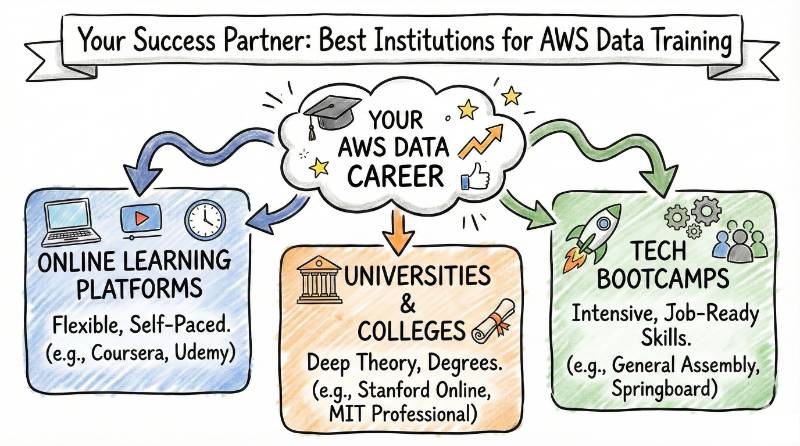
Top Institutions for AWS Data Engineer Training
- DevOpsSchool: A leading provider that offers comprehensive, instructor-led bootcamps focusing on real-world projects and technical labs.
- Cotocus: Specializes in technical deep-dives for corporate teams, helping professionals bridge the gap between classroom theory and industry implementation.
- Scmgalaxy: Focuses on the entire software lifecycle, helping engineers understand how data fits into the wider DevOps and supply chain ecosystem.
- BestDevOps: Provides targeted, fast-paced training modules designed to help you upskill quickly in specific AWS data tools.
- devsecopsschool: If you want to focus on protection, this school specializes in the intersection of security and engineering.
- sreschool: Their curriculum is built around reliability, teaching you how to build data systems that can handle any load without failing.
- aiopsschool: Perfect for those looking at the future of operations, focusing on how data supports AI and machine learning workflows.
- dataopsschool: Dedicated specifically to the DataOps domain, offering training on the entire journey of data from collection to delivery.
- finopsschool: Teaches you how to manage the financial side of the cloud, ensuring your data architectures remain profitable.
FAQs (12): Career, Difficulty, and Strategy
1. How difficult is the AWS Data Engineer Associate exam?
It is more technically narrow but deeper than the Solutions Architect exam. You need specific expertise in Glue, Redshift, and Athena rather than a general overview.
2. How much time do I need to commit to studying?
Most working professionals need between 40 and 60 hours of focused study, depending on their existing cloud experience.
3. Are there any mandatory prerequisites?
No. You can take this exam without any other certifications, though understanding cloud basics (Cloud Practitioner level) is very helpful.
4. What is the best sequence for these certifications?
The ideal path is: Cloud Practitioner -> Solutions Architect Associate -> Data Engineer Associate.
5. Is this certification valuable for managers?
Yes. It gives managers the technical vocabulary to lead teams, hire the right talent, and make better architectural decisions.
6. What are the career outcomes?
Certified professionals often move into roles like Senior Data Engineer or Analytics Architect, which are in high demand globally.
7. How long is the certification valid?
It is valid for three years. You can renew it by retaking the exam or moving up to a Professional-level certification.
8. Is this better than the old Data Analytics Specialty?
Yes. This is the modern standard that focuses on the engineering of data systems, which is currently the biggest priority for businesses.
9. Can a Software Engineer switch to Data Engineering with this?
Absolutely. This certification is specifically designed to help developers apply their coding skills to manage large-scale data systems.
10. How does this help with global job opportunities?
AWS certifications are a global standard. Having this credential makes it much easier to pass technical screenings for roles in the US, Europe, or Asia.
11. What is the passing score?
You need a minimum score of 720 out of 1,000 to pass the exam.
12. Is there a lab portion in the actual exam?
Currently, the exam is multiple-choice. However, the questions are scenario-based and require hands-on experience to answer correctly.
FAQs (8): Technical Training & Exam Content
1. Which AWS service is the most important to study?
AWS Glue is the most critical service. You must understand the Data Catalog, Crawlers, and ETL jobs.
2. Do I need to be a Python expert?
No, but you should be able to read and understand basic Python or Spark code snippets, as they will appear in the exam.
3. How much focus is there on “Streaming” data?
Significant. You will need to know when to use Kinesis Data Streams for low-latency processing and when to use Firehose for delivery.
4. Does the training cover SQL?
Yes. You should be comfortable writing and optimizing SQL queries for Amazon Athena and Redshift.
5. What is the role of “Data Lakes”?
Data Lakes are foundational. You will be tested on how to store data in S3 and use Lake Formation to manage access.
6. Is cost management a major part of the test?
Yes. You will be expected to choose the most cost-effective storage tiers and query methods.
7. How are security and compliance handled?
The exam focuses on “Security by Design,” covering encryption (KMS) and fine-grained access control (IAM).
8. What kind of orchestration tools are covered?
The training focuses on AWS Step Functions and Amazon MWAA (Managed Airflow) for automating complex data tasks.
Conclusion
The shift toward data-driven operations is a permanent change in the global economy. By earning the AWS Certified Data Engineer – Associate, you are doing more than just adding a line to your resume; you are proving that you can architect the backbone of the intelligence age. Whether you are a software engineer looking to specialize or a manager aiming to lead more technical teams, this training provides the depth needed to build secure, scalable, and efficient data platforms. The cloud is built on data, and now is the perfect time to ensure you have the skills to lead the way in this field.

