
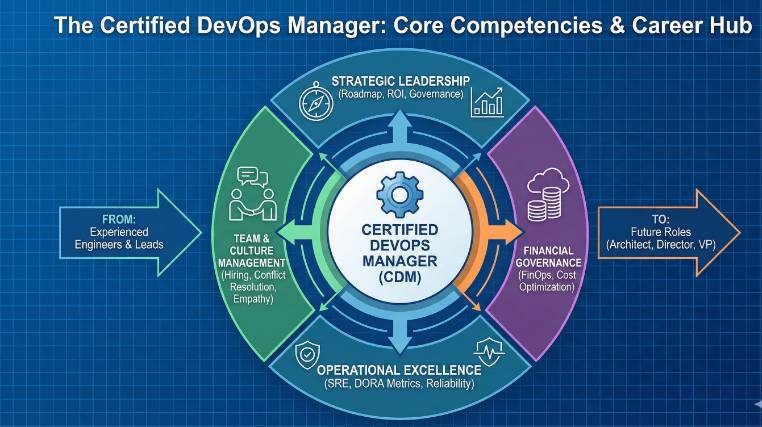
The shift from being a hands-on engineer to a manager is one of the most significant transitions in a professional career. It is no longer just about writing the perfect script or debugging a complex pipeline in the middle of the night. It becomes about strategy, people, and business value.
In the tech world today, specifically across India and the global market, there is a massive demand for people who can lead DevOps teams. This guide is designed for software engineers and working managers who want to validate their leadership skills and master the art of delivery management through the Certified DevOps Manager program.
What is the Certified DevOps Manager Certification?
The Certified DevOps Manager (CDM) is a top-tier professional certification that focuses on the leadership and governance side of DevOps. While many certifications teach you how to use a tool, this one teaches you how to use those tools to meet business goals. It covers everything from ROI analysis and team building to high-level architectural decision-making.
Detailed Breakdown: Certified DevOps Manager
What it is
This is a comprehensive management-level program that prepares you to lead DevOps transformations in large organizations. It moves beyond the “how-to” of coding and dives deep into the “why” of organizational change. It focuses on creating a culture of continuous improvement while maintaining high standards of security and reliability.
Who should take it
This certification is tailor-made for Senior Software Engineers, Team Leads, Project Managers, and aspiring Engineering Managers. The provider, DevOpsSchool, is a premier global institution known for its deep roots in the DevOps community. They emphasize practical, real-world knowledge over theoretical rote learning. Their trainers, including industry veterans like Rajesh Kumar, bring decades of experience in managing large-scale infrastructure and software delivery.
Skills you’ll gain
- Strategic Roadmap Design: Learning how to plan a 12-to-24-month DevOps journey for a company.
- Financial Oversight (FinOps): Mastering the ability to track, manage, and optimize cloud costs.
- Performance Metrics (DORA): Using data to measure deployment frequency, lead time for changes, and failure rates.
- Release Governance: Managing complex release cycles across multi-cloud environments without losing speed.
- Conflict Resolution & Culture: Breaking down the traditional “wall of confusion” between Dev and Ops teams.
Real-world projects you should be able to do
- Build a DevOps Business Case: You will be able to create a formal proposal for stakeholders showing how DevOps will save money and increase revenue.
- Design an Incident Post-Mortem Workflow: You will create a “blameless” culture where teams learn from production failures instead of pointing fingers.
- Enterprise Toolchain Blueprinting: You will be able to map out exactly which tools (from Git to Kubernetes) fit into your specific company’s security and budget constraints.
Preparation Plan
- 7–14 Days (The Fast Track): Focus on the core philosophy of DevOps (The Three Ways), Lean management principles, and the high-level architecture of CI/CD.
- 30 Days (Standard Prep): Spend time understanding the interaction between different roles (SRE, Security, Dev) and deep-diving into FinOps and ROI calculations.
- 60 Days (Comprehensive Mastery): This includes working through multiple real-world case studies, participating in mock leadership scenarios, and reviewing architectural designs for scalability and security.
Common Mistakes
- Treating it like a technical exam: Many fail because they try to solve problems with “more code” instead of “better process.”
- Ignoring the Culture: DevOps is about people. If you ignore the “soft skills” of management, the certification loses its value.
- Underestimating ROI: Managers must speak the language of money. If you cannot explain the cost-benefit of a tool, you aren’t managing effectively.
Best next certification after this
Once you have mastered the management track, the best next steps involve specializing or moving into higher leadership roles:
- Leadership: DevOps Architect or Director of Platform Engineering.
- Cross-Track: Certified DevSecOps Manager for those focusing on security.
- Specialization: Certified Site Reliability Engineer (SRE) to focus on extreme scale and uptime.
Master Comparison Table: Professional Certifications
| Track | Level | Who it’s for | Prerequisites | Skills Covered | Recommended Order | Link |
| DevOps | Manager | Senior Engineers / Leads | 5+ Years Exp | Strategy, ROI, Leadership | 3rd (Final) | DevOps Manager |
| DevOps | Professional | Working Engineers | Basic CLI / Git | Jenkins, Docker, Ansible | 2nd | DevOps Professional |
| SRE | Professional | Operations / SREs | Linux / Python | SLOs, SLIs, Observability | 2nd | SRE Cert |
| DevSecOps | Professional | Security / Devs | DevOps Basics | SAST, DAST, Compliance | 2nd | DevSecOps Cert |
| AIOps | Advanced | Data Scientists / SREs | ML Basics | Predictive Monitoring | 3rd | AIOps Cert |
| FinOps | Professional | Managers / Finance | Cloud Basics | Cost Optimization | 2nd | FinOps Cert |
Choose Your Path: 6 Specialized Learning Tracks
1. The DevOps Path
This is the standard, high-value path for those who love the entire lifecycle. It covers everything from the first line of code to the final deployment. It is ideal for generalists who want to see the “big picture.”
2. The DevSecOps Path
In this track, you learn to shift security to the left. You don’t wait for a security audit at the end of the month; you build security into the pipeline. It is perfect for those who want to protect the company’s data at scale.
3. The SRE Path (Site Reliability Engineering)
SRE is about applying software engineering mindsets to operations problems. You learn how to automate “toil” and ensure that systems stay up even when parts of them are failing.
4. The AIOps/MLOps Path
As systems become too complex for humans to monitor, we use AI. This path teaches you how to use machine learning to predict outages and how to manage the lifecycle of AI models in production.
5. The DataOps Path
Data is the new oil, but it’s hard to manage. DataOps focuses on getting data from its source to the user as fast and accurately as possible. It is great for engineers working with Big Data and Analytics.
6. The FinOps Path
Cloud bills can be terrifying. FinOps is the practice of bringing financial accountability to the variable spend model of the cloud. This is a must-have skill for modern engineering managers.
Role → Recommended Certifications Mapping
- DevOps Engineer: DevOps Foundation → Certified DevOps Professional → Kubernetes Administrator.
- SRE: Certified SRE → Master in Observability → Chaos Engineering Professional.
- Platform Engineer: DevOps Architect → Certified DevOps Professional → Cloud Architect.
- Cloud Engineer: AWS/Azure Specialist → Certified DevOps Professional.
- Security Engineer: Certified DevSecOps Professional → Certified DevSecOps Manager.
- Data Engineer: DataOps Certified Professional → Big Data Specialist.
- FinOps Practitioner: Certified FinOps Engineer → Certified DevOps Manager.
- Engineering Manager: Certified DevOps Manager → Agile Leadership → DevOps Architect.
Top Institutions for Training and Certification
DevOpsSchool
DevOpsSchool is a leading name in India and globally for technical upskilling. They offer highly interactive programs with a focus on real-world projects and mentorship from experts like Rajesh Kumar. Their curriculum is updated constantly to reflect the latest industry shifts.
Cotocus
Cotocus specializes in high-end consulting and corporate training. They focus on the technical implementation of automation and cloud-native technologies. Their training is known for being very direct and focused on solving enterprise-level problems.
Scmgalaxy
Starting as a community platform, Scmgalaxy has grown into a massive resource for SCM and DevOps professionals. They provide extensive free resources, tutorials, and certification programs that have helped thousands of engineers since 2008.
BestDevOps
BestDevOps focuses on simplified learning paths. They take complex, scary technical concepts and break them down into easy-to-understand modules. This is a great starting point for those who find the “alphabet soup” of DevOps overwhelming.
DevSecOpsSchool
As the name suggests, they are the go-to specialists for security integration. They teach engineers how to automate security checks and maintain compliance in highly regulated industries like finance and healthcare.
SREschool
SREschool focuses entirely on reliability and scalability. Their courses dive deep into monitoring, logging, tracing, and error budgets, making them ideal for anyone aspiring to work at giant tech firms.
AIOpsschool
This institution focuses on the future of operations. They teach how to integrate Artificial Intelligence and Machine Learning into the DevOps pipeline to create self-healing infrastructures.
DataOpsschool
DataOpsschool addresses the specific needs of data engineering and science teams. They provide certifications that help professionals streamline data delivery pipelines with speed and quality.
FinOpsschool
Focusing on the financial side of the cloud, this school helps managers and finance professionals understand how to optimize cloud costs and manage departmental budgets in a cloud-first world.
FAQs: General Career & Certifications
- How difficult is the transition to management? It is a mindset shift. You have to move from “doing” to “enabling.” The difficulty lies in letting go of the keyboard.
- How much time should I dedicate to study? For most, 5–10 hours a week for two months is the “sweet spot” to truly absorb the material.
- Are there prerequisites for the Manager cert? While not strictly enforced, having at least 3-5 years of engineering experience is highly recommended.
- In what sequence should I take these? Follow the “Foundation -> Professional -> Manager/Specialist” sequence to build a solid base.
- Is the ROI of these certifications high? Yes. Certified Managers in the DevOps space often see a 30% to 50% increase in salary offers.
- Can I take these exams online? Yes, most providers, including DevOpsSchool, offer flexible online formats.
- Do these certifications expire? Most are valid for 2-3 years, after which you may need to renew to show you are up to date with new tools.
- Is DevOps just for startups? No, enterprises (Banks, Retail, Govt) are the biggest consumers of DevOps management skills today.
- What if I am from a non-tech background? It is harder, but starting with the DevOps Foundation is a great way to learn the language of modern tech.
- Does it help with remote work? Absolutely. DevOps is the backbone of remote engineering teams.
- What is the most valued skill for a manager? Empathy and clear communication. You are the bridge between the business and the code.
- Will these certifications help in a global job search? Yes, DevOps principles are universal. These certifications are recognized from Bangalore to Berlin to Boston.
FAQs: Certified DevOps Manager Specific
- What makes the CDM different from a PMP? While PMP is general project management, CDM is specific to the “high-speed” nature of software delivery and automation.
- Does CDM cover people management? Yes, it includes modules on hiring, team structure, and conflict resolution.
- How does CDM help with cloud migration? It teaches you how to manage the strategy and risks of moving from on-premise to the cloud.
- Is there a focus on open-source tools? Yes, the program emphasizes a tool-agnostic approach using popular open-source frameworks.
- Does the CDM cover Agile? Yes, it explores how DevOps and Agile work together to create a continuous flow of value.
- How do I handle “Resistance to Change” in a company? The CDM curriculum specifically teaches you “Change Management” strategies to get buy-in from skeptical teams.
- Is Rajesh Kumar involved in this program? Yes, Rajesh Kumar is a lead mentor for the CDM program at DevOpsSchool, bringing years of practical leadership experience.
- How do I apply for the exam? You can register directly through the official DevOpsSchool website.
Next Certifications to Take
Based on current industry trends, here are the three logical directions you can take after becoming a Certified DevOps Manager:
- Same Track (Leadership): Certified DevOps Architect. This focuses on the high-level design of systems rather than the management of people.
- Cross-Track (Security): Certified DevSecOps Professional. As a manager, knowing the technical details of security will make you indispensable.
- Cross-Track (Data/Cloud): Certified FinOps Engineer. This allows you to specialize in the financial health of your organization’s cloud infrastructure.
Conclusion
The journey to becoming a Certified DevOps Manager is about more than just a title. It is about gaining the tools to lead teams through the complexities of modern software development. Whether you are in India or working for a global firm, these skills will set you apart as a leader who understands both the code and the bottom line.
Would you like me to help you draft a 30-day personalized study schedule to get started with your Certified DevOps Manager preparation?

