
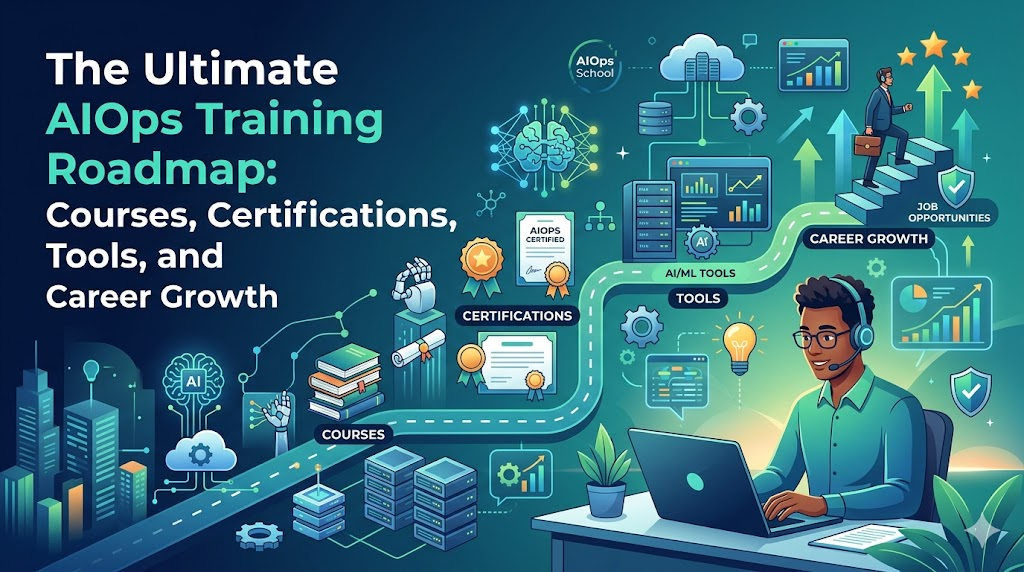
The era of managing enterprise IT infrastructure through static thresholds and manual playbooks is coming to an end. As monolithic architectures dissolve into ephemeral microservices across multi-cloud environments, modern engineering teams face an unprecedented explosion of telemetry data. For DevOps engineers and SREs, this complexity leads to constant firefighting, alert fatigue, and observability gaps that stall root-cause analysis.
Artificial Intelligence for IT Operations (AIOps) solves this crisis by applying machine learning models and automated pipelines directly to telemetry streams, transforming raw noise into actionable insights. To navigate this shift and move from reactive troubleshooting to predictive, self-healing operations, professionals are increasingly turning to structured AIOps Training to future-proof their careers.
What is AIOps?
Coined originally by Gartner, AIOps stands for Artificial Intelligence for IT Operations. At its core, it is the practice of leveraging big data, machine learning (ML), and advanced analytics to automate incident identification, correlation, and resolution within an IT ecosystem.
┌────────────────────────────────────────────────────────┐
│  Telemetry Ingestion (Metrics, Logs, Traces, Events)   │
└───────────────────────────┬────────────────────────────┘
                            ▼
┌────────────────────────────────────────────────────────┐
│    Big Data Platform / Streaming Analytics Pipeline    │
└───────────────────────────┬────────────────────────────┘
                            ▼
┌────────────────────────────────────────────────────────┐
│   ML Analytics Engine (Anomaly Detection & Clustering) │
└───────────────────────────┬────────────────────────────┘
                            ▼
┌────────────────────────────────────────────────────────┐
│  Intelligent Action Plane (Correlation & Remediation)  │
└───────────────────────────┴────────────────────────────┘
Historically, IT operations relied on static thresholding—such as triggering a high-priority alert whenever CPU usage exceeded 85%. While this worked fine for simple physical servers, it fails in a modern Kubernetes cluster where auto-scaling resources fluctuate constantly. AIOps shifts the paradigm from deterministic, rules-based alerts to dynamic, probabilistic systems.
To understand how AIOps operates, look at how an intelligent ingestion pipeline feeds data directly into automated alerting networks:
AIOps sits directly at the intersection of several core technical disciplines:
- Big Data: Ingesting massive, high-velocity data streams from disparate sources (infrastructure, applications, logs, network packets) into unified data lakes.
- Machine Learning: Training algorithms to recognize steady-state system baselines, spot statistically significant anomalies, and group related alerts together.
- Observability: Utilizing deep telemetry datasets—specifically metrics, logs, and distributed traces—to extract clear context about system health.
- Continuous Automation: Triggering automated scripts or orchestration playbooks to resolve issues without human intervention.
Traditional Monitoring vs. AIOps
Traditional monitoring tools simply tell you when something breaks based on past rules. An AIOps framework, by contrast, helps you understand why it broke, what else is affected, and how to fix it automatically.
| Operational Metric | Traditional Monitoring | AIOps Approach |
| Data Ingestion | Siloed by tool type (e.g., separate log app and metric app) | Unified ingestion of metrics, logs, traces, and events |
| Alert Triggering | Fixed static thresholds (e.g., CPU greater than 80%) | Dynamic baselining using machine learning models |
| Contextual Awareness | Independent alerts; no system-wide correlation | Algorithmic event correlation across different infrastructure layers |
| Analysis Focus | Retrospective analysis (What happened in the past?) | Predictive analytics (Where are we heading next?) |
| Remediation Speed | Fully manual page outs and human troubleshooting | Automated workflow triage and self-healing systems |
Why AIOps Matters in Modern IT Operations
Implementing an AIOps Course strategy helps organizations solve real operational bottlenecks that directly impact bottom-line revenue.
1. Significant Noise Reduction and Event Correlation
On-call engineers routinely face thousands of daily alerts, a problem known as alert fatigue. A single database latency spike can ripple outward, triggering hundreds of downstream application errors. AIOps platforms use clustering algorithms to consolidate those individual alerts into a single, comprehensive incident ticket. This group contains all the relevant upstream and downstream context, eliminating background noise so teams can focus on the core issue.
2. Automated Root Cause Analysis (RCA)
Instead of manually searching through log lines across different servers, an AIOps system analyzes topology maps, code traces, and timestamped anomalies concurrently. It identifies the exact point of failure—like a bad code deployment or a saturated connection pool—within seconds, rather than hours.
3. Predictive Analytics and Proactive Capacity Planning
AIOps doesn’t just react when things go wrong; it looks for trends. By analyzing historical disk-write growth, memory utilization patterns, and seasonal user traffic, machine learning models can predict exactly when an application will run out of resources. This allows engineering teams to scale capacity long before users experience a slowdown.
4. Intelligent Auto-Remediation
The ultimate goal of an advanced enterprise infrastructure is self-healing. When an AIOps platform identifies a known issue with a high degree of confidence, it can trigger an automated fix. This might mean spinning up an Ansible playbook to clear disk space, restarting a stuck container, or adjusting a cloud load balancer.
[ System Anomaly Detected ] ──> [ Algorithmic Analysis ] ──> [ Match Found in Runbook ] ──> [ Self-Healing Script Triggered ]
Enterprise Impact: Faster MTTR and Bulletproof Reliability
For modern digital businesses, downtime is incredibly expensive. By shifting from manual triage to AI-assisted automated operations, enterprises regularly reduce their Mean Time to Resolution (MTTR) from several hours down to a few minutes. This speed helps keep production applications highly available and dependable.
Who Should Take an AIOps Training Program?
As operations teams adopt machine learning workflows, day-to-day responsibilities are evolving across the entire engineering department.
- DevOps & Platform Engineers: If you are responsible for building and maintaining internal developer platforms, you need to know how to integrate automated intelligence directly into your CI/CD pipelines and infrastructure deployments.
- Site Reliability Engineers (SREs): SREs benefit immensely from an AIOps Tutorial curriculum. Learning to use AI platforms helps you protect Service Level Objectives (SLOs), manage error budgets efficiently, and build automated guardrails that replace manual work with scalable code.
- Cloud Architects & IT Infrastructure Managers: Leaders must understand how to select the right platform tools, design resilient multi-cloud telemetry architectures, and steer their teams away from outdated, reactive operational models.
- Monitoring Specialists & NOC Analysts: Traditional Network Operations Center roles are changing rapidly. Upgrading your skills to manage machine-learning alert models ensures your profile remains competitive as organizations automate standard tier-1 support tasks.
What Will You Learn in a Comprehensive AIOps Course?
A production-ready AIOps Training program must combine theoretical data science concepts with hands-on systems engineering. A professional curriculum is typically structured into focused technical modules:
Module 1: AIOps Fundamentals
- Core principles of AI-driven operations.
- Transitioning from legacy APM (Application Performance Monitoring) to intelligent analytics.
- Understanding the end-to-end data pipeline: Ingestion, Analysis, Insight, and Automation.
Module 2: Observability Foundations
- Breaking down the three pillars of observability: Metrics, Logs, and Traces.
- Designing balanced collection strategies that avoid high data storage costs.
- Implementing semantic conventions across enterprise systems.
Module 3: Metrics Collection and Analysis
- Structuring time-series data streams.
- Working with counters, gauges, and histograms.
- Aggregating high-cardinality cloud-native metrics at scale.
Module 4: Log Management and Analytics
- Centralizing unstructured, semi-structured, and structured logs.
- Building log parsing pipelines using regular expressions and patterns.
- Applying natural language processing (NLP) to detect errors within text logs.
Module 5: Distributed Tracing
- Following requests across complex microservice architectures.
- Managing context propagation across API endpoints.
- Using trace spans to pinpoint exactly which service is causing latency bottlenecks.
Module 6: Advanced Event Correlation
- Aggregating alerts based on shared time windows and network topologies.
- Leveraging graph databases to map cross-system dependencies.
- Reducing alert volume by grouping duplicate notifications into single incidents.
Module 7: Anomaly Detection Techniques
- Moving past rigid static thresholds.
- Implementing dynamic baseline models that adapt to seasonal traffic variations.
- Configuring multi-dimensional anomaly detection algorithms.
Module 8: Machine Learning for Operations
- Understanding supervised vs. unsupervised learning models for infrastructure data.
- Applying clustering algorithms (like K-Means or DBSCAN) to discover hidden system patterns.
- Training classification models to categorize historical incident types.
Module 9: Incident Intelligence
- Enriching incoming alerts with real-time asset configuration data.
- Using historical resolution data to surface contextually relevant remediation notes.
- Streamlining collaboration across on-call teams during major outagess.
Module 10: Auto-Remediation Pipelines
- Building event-driven automation systems.
- Integrating AIOps engines with orchestration tools like Ansible, Terraform, and custom webhooks.
- Designing safe automated loops with built-in human approval checkpoints.
Module 11: OpenTelemetry Standards
- Vendor-neutral data collection using the OpenTelemetry (OTel) framework.
- Configuring OTel agents, language SDKs, and data collectors.
- Building flexible data ingestion pipelines that prevent vendor lock-in.
Module 12: Enterprise AIOps Architecture
- Designing highly available, secure, and cost-effective data pipelines.
- Balancing edge processing against centralized cloud analytics storage.
- Balancing data compliance, data masking, and privacy rules across enterprise telemetry streams.
Top AIOps Tools You Should Know
Modern enterprise engineering relies heavily on picking the right AIOps Tools for the job. This comparative breakdown highlights how the industry’s leading platforms handle data analysis and operational automation:
| Tool Platform | AI & Machine Learning Capabilities | Event Correlation & Noise Reduction | Automation & Out-of-the-Box Remediation | Integrations & Data Ingestion Ecosystem | Pricing & Licensing Model | Ease of Enterprise Adoption |
| Splunk Enterprise Security / ITSI | Very high; custom Machine Learning Toolkit (MLTK) for building tailored models. | Strong; uses Notable Events Review frameworks to group alerts dynamically. | High; connects with Splunk SOAR for playbook automation. | Massive; supported by thousands of apps via Splunkbase. | Premium volume-based or compute-based enterprise ingest pricing. | Moderate; requires dedicated training and engineering staff. |
| Dynatrace | Advanced; utilizes “Davis”, a deterministic AI engine for causal root-cause analysis. | Exceptional; automatically matches anomalies to topological dependencies. | High; triggers automated workflows directly through Cloud Automation modules. | Automatic; uses a single-agent architecture for instant deployment. | Premium consumption-based tier pricing. | Smooth; low configuration required for initial setup. |
| Datadog | High; utilizes “Watchdog” for automated anomaly and outlier detection. | Strong; bundles issues across multi-cloud environments automatically. | Moderate; provides workflow automation engine blocks. | Excellent; offers native integrations for virtually all cloud-native platforms. | Usage-based pricing calculated per host, per metric, or per GB. | High; very user-friendly with low operational overhead. |
| Prometheus & Grafana Stack | Moderate; relies on extensions or custom PromQL formulas for predictive math. | Basic; relies on Alertmanager routing rules and Grafana alert grouping. | Low; requires custom webhook scripts to trigger external runbooks. | Industry standard for cloud-native Kubernetes environments. | Open-source and free; paid enterprise cloud hosting options available. | High for engineers, but requires hands-on configuration. |
| Elastic Stack (ELK) | High; built-in machine learning models for forecasting and anomaly detection. | Good; clusters log classifications and events automatically. | Moderate; relies on alert actions and external webhooks. | Broad; supported by Elastic Agent and Logstash inputs. | Open-source foundation with paid subscription licensing tiers. | Moderate; requires storage and cluster tuning expertise. |
| Moogsoft | Advanced; focused on algorithmic noise reduction and early incident detection. | Outstanding; groups disparate alerts using unsupervised machine learning. | Moderate; passes enriched alerts to separate automation tools. | Flexible; ingests data via API from many third-party monitoring managers. | Subscription-based model tailored to event volume. | Moderate; requires careful tuning of correlation logic. |
| BigPanda | High; open integration architecture focused on cross-source alert correlation. | Exceptional; normalizes data from many tools into unified incidents. | High; shares context directly with downstream automation tools. | Specialized; connects with major monitoring systems and ITSM software. | Enterprise subscription pricing scaled to alert volumes. | Moderate; integrates cleanly with existing monitoring investments. |
| New Relic | High; utilizes Applied Intelligence engine for anomaly and pattern detection. | Strong; compresses alert noise automatically across data types. | Moderate; connects alerts to incident response engines. | Comprehensive; features open-source agents and integrations. | Consumption-based pricing calculated per user and per GB. | High; features a unified telemetry platform interface. |
Benefits of Earning an AIOps Certification
Studying concepts online is a great start, but completing an AIOps Certification validates your practical skills to enterprise employers.
- Accelerated Career Progression: Moving from basic monitoring into complex data-driven automation positions you for high-impact roles like Senior SRE, Reliability Architect, or Platform Director.
- Substantial Salary Growth: Because combining systems engineering with machine learning expertise is a rare skill set, certified AIOps professionals regularly command salaries 30% higher than traditional system administrators.
- Future-Proofing Your Skill Set: As routine operations tasks become automated, engineers who know how to build and maintain the automation platforms will remain highly sought after.
- Validating Enterprise Engineering Skills: A formal certification proves you understand how to design massive telemetry pipelines, control cloud data costs, and keep mission-critical enterprise applications running smoothly.
Why Choose AIOps School for AIOps Training?
When you are ready to invest in your professional skills, AIOps School provides an educational platform designed specifically for working technology professionals. Rather than just teaching abstract data science theories, the training focus centers on practical application and real-world infrastructure systems.
[ Structural Foundation ] ──> [ Hands-on Sandbox Labs ] ──> [ Live Industry Capstone ] ──> [ Certified Expert ]
- Hands-on, Sandbox Laboratory Learning: You won’t just sit through video lectures. You will spend your time building real data ingest pipelines, tuning machine learning models, and configuring auto-remediation scripts inside live lab environments.
- Comprehensive Professional Tracks: Structured educational paths guide you smoothly from basic operational foundations up to advanced enterprise architect certifications.
- Expert Instruction from the Field: Courses are developed and taught by seasoned SREs, systems architects, and infrastructure automation practitioners who manage large, complex cloud systems daily.
- Flexible Schedule Options for Professionals: Self-paced digital modules combined with live mentoring sessions allow you to balance intensive skill-building alongside your full-time job.
- A Supportive Global Professional Community: Join a vibrant network of thousands of engineering professionals spanning over 50 countries to share architecture patterns, collaborate on projects, and discover new career opportunities.
Career Opportunities After Completing an AIOps Certification
Earning an advanced operations certification opens doors to specialized technical roles across modern engineering organizations:
AIOps Engineer / Automation Specialist
- Core Responsibilities: Building, managing, and tuning the company’s central analytics platform. Configuring log ingestion parsing, adjusting anomaly detection thresholds, and building reliable self-healing runbook playbooks.
Site Reliability Engineer (SRE)
- Core Responsibilities: Ensuring core customer-facing systems meet performance and availability goals. Using AI insights to manage error budgets, find performance bottlenecks early, and run systematic post-incident investigations.
Observability Architect
- Core Responsibilities: Designing data infrastructure for collecting metrics, logs, and distributed traces across global applications. Ensuring high data quality while keeping cloud storage fees under control.
Incident Response Engineer
- Core Responsibilities: Managing major production issues. Using automated correlation dashboards to cut through alert noise, coordinate response teams, and minimize business impact during outages.
Frequently Asked Questions (FAQ)
What is AIOps Training?
AIOps Training is a structured educational framework that teaches engineering professionals how to apply machine learning, big data platforms, and automated runbooks to cloud infrastructure operations. It bridges the gap between traditional monitoring work and advanced, data-driven automation.
Is AIOps difficult to learn for operations professionals?
It can feel challenging at first because it requires learning both data science concepts and classic software automation. However, a well-structured course breaks down complex topics—like clustering models or distributed tracing pipelines—into step-by-step, practical engineering projects.
Which AIOps tools are most widely used across the industry?
Enterprise ecosystems rely heavily on platforms like Splunk ITSI, Dynatrace, Datadog, New Relic, and the open-source Prometheus/Grafana stack. Specialized platforms like BigPanda and Moogsoft are also widely used for cross-tool event correlation.
Is an AIOps Certification worth the time and financial investment?
Yes. Validating your skills with a formal certification demonstrates to employers that you know how to manage modern cloud scale. It gives you a strong competitive advantage and often leads to significant salary increases.
How long does it take to complete a professional AIOps Course?
Foundational tracks typically require roughly 30 days with a commitment of 10 to 12 hours per week. Advanced engineering or architecture certifications generally take 45 days or longer of structured study and hands-on lab work.
Can DevOps Engineers easily transition into AIOps roles?
Absolutely. DevOps engineers already understand core CI/CD concepts, infrastructure-as-code principles, and basic cloud architecture. Learning AIOps builds naturally on top of those skills by adding machine learning data pipelines and automated incident response tools.
What technical prerequisites are recommended before starting?
It helps to have a basic understanding of cloud-native infrastructure (like Docker or Kubernetes), familiarity with core monitoring principles, and a foundational grasp of scripting languages like Python or Bash.
Why are hands-on labs so critical for mastering these concepts?
You can’t learn to tune machine learning models or fix broken tracing pipelines just by reading a textbook. Working in live sandbox environments lets you interact with real telemetry noise and practice configuring auto-remediation scripts safely.
Which specific industries are adopting AIOps platforms the fastest?
Any business running large-scale digital applications is adopting these tools quickly. Growth is particularly high across financial services, e-commerce platforms, healthcare networks, global telecommunications provider setups, and large SaaS software enterprises.
What does the future look like for AIOps over the next few years?
The discipline is moving toward deeper integration with Large Language Models (LLMs) to enable natural-language incident triage. We are also seeing a major push toward unified OpenTelemetry data standards and fully autonomous, self-healing cloud operations networks.
Conclusion: Take the Next Step in Your Engineering Career
The scale of modern multi-cloud systems has outgrown the capacity of manual oversight. To build reliable systems moving forward, teams must complement human expertise with automated machine-learning insights. For technology professionals, continuing to rely on legacy static alerting configurations introduces unnecessary career risks. Enrolling in a comprehensive AIOps Course gives you the practical skills needed to design, implement, and lead intelligent operational strategies. Mastering event correlation, anomaly detection models, and auto-remediation tools helps you clear out background alert noise and resolve incidents faster.
Whether you choose to step into an architecture role, join a forward-looking SRE team, or bring automated intelligence to your current DevOps pipeline, earning an AIOps Certification ensures your skills stay highly relevant. Explore the structured training paths at AIOps School today to start moving away from reactive firefighting and toward an optimized, AI-driven career.

