
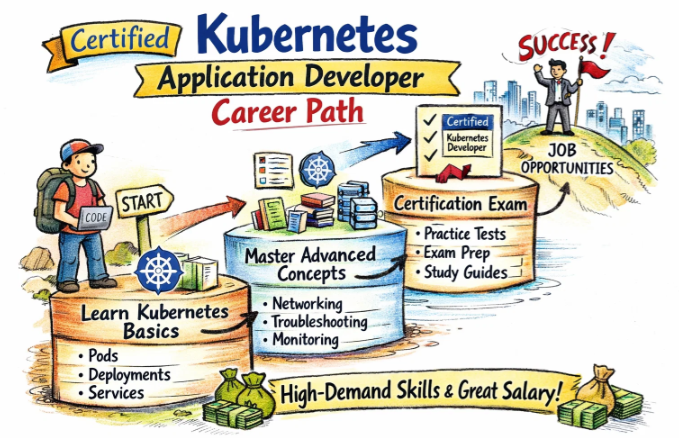
The gap between a good engineer and a great one often comes down to one thing: how much of the system they actually own. In the past, you could get by just knowing your language of choice—Java, Python, or Go. Today, that isn’t enough. If your code runs in the cloud, you are part of the infrastructure. You are no longer just a coder; you are a system architect.
Kubernetes has become the global standard for running these systems. But there is a big difference between “knowing about” Kubernetes and being able to “operate” it. I have mentored hundreds of engineers and managers, and the biggest hurdle is always the move from theory to practice. This is why the Certified Kubernetes Application Developer (CKAD) program is so vital. It isn’t a memory test. It is a performance test.
This guide is for those who want to accelerate their careers. Whether you are an engineer in India looking to break into global roles or a manager trying to build a resilient team, this roadmap will show you exactly how to master the cloud-native world.
The Global Ecosystem: Mapping Your Technical Growth
Navigating the world of certifications can feel overwhelming. To lead effectively, you need a map. This table shows where the CKAD fits in the broader landscape of modern engineering.
| Track | Level | Who it’s for | Prerequisites | Skills Covered | Recommended Order |
| Cloud Foundations | Associate | Managers & Beginners | General IT Awareness | Cloud basics, Container theory | 1 |
| K8s App Development | Professional | Software Engineers | Container Fundamentals | Pod Design, Networking, Deployment | 2 (The Core) |
| K8s Administration | Professional | SREs & DevOps Pros | Linux & Networking | Cluster setup, Logging, Fixes | 3 |
| K8s Security | Specialist | Security Engineers | CKA Certification | System Hardening, Safe Supply | 4 |
| Automation / IaC | Associate | Cloud Engineers | Basic Cloud Proficiency | Terraform, Automation, Scale | 5 |
| Management | Foundation | Engineering Leaders | Delivery Experience | Culture, Metrics, Business Value | 6 |
A Leadership Deep-Dive: The CKAD Program
The CKAD is the most practical validation of your engineering skills. It doesn’t care if you can define a “Deployment.” it cares if you can create one that actually works.
What it is
The Certified Kubernetes Application Developer (CKAD) is a hands-on, performance-based exam managed by the CNCF and The Linux Foundation. You get 120 minutes to solve a series of real-world problems in a live terminal. There are no multiple-choice questions. You are expected to use the command line to build, configure, and troubleshoot applications. It proves you have the technical muscle memory to survive in a production environment.
Who should take it
This is for the modern Software Engineer. If you build microservices, you need this. It is also a secret weapon for Engineering Managers. A manager who understands the mechanics of Kubernetes can better estimate timelines, understand technical debt, and lead their team with a level of credibility that “non-technical” managers simply don’t have.
Skills you’ll gain
Preparing for the CKAD forces you to think in a “declarative” way. You stop giving the computer a list of steps and start giving it a “desired state.”
- Designing Systems (20%): You will master multi-container pods. You’ll learn how to use sidecars for logging and ambassadors for networking.
- Deployment Mastery (20%): You will learn to update applications with zero downtime. You will also master Helm to make your deployments repeatable.
- System Health (15%): You will learn how to use probes. These are the “heartbeats” of your app that tell Kubernetes when to restart a container.
- Configuration & Security (25%): You will learn to manage secrets and passwords safely. You will also learn how to limit how much CPU and memory an app uses.
- Networking Logic (20%): You will learn how to connect services and how to use Ingress to let the world see your application safely.
Real-world projects you should be able to do after it
The value of the CKAD isn’t the paper; it’s the capability. After this, you should be able to:
- Build Self-Healing Architectures: Create apps that automatically recover from crashes without a human ever getting a late-night alert.
- Secure Application Secrets: Move passwords out of your code and into Kubernetes Secrets, mounting them securely into your containers.
- Execute Rollouts and Rollbacks: Update a critical service in the middle of a busy day, and roll it back instantly if the new version has a bug.
- Enforce Network Isolation: Write rules that ensure your database only talks to your backend, preventing lateral movement from hackers.
- Resource Management: Right-size your applications so they don’t waste cloud budget while still performing at high speed.
Preparation plan (7–14 days / 30 days / 60 days)
How long you need depends on your “terminal time.” Don’t just watch videos; you must type the commands.
The 14-Day “Lead Developer” Sprint
Warning: This is only for people already using Kubernetes daily.
- Week 1: Review the syllabus. Focus on the niche areas like Network Policies or CronJobs that you might skip in your daily work.
- Week 2: Practice speed. The exam is a race. Learn every
kubectlshortcut you can find. Take mock exams to get used to the pressure.
The 30-Day “Engineering Standard”
This is the path I recommend for most working software engineers.
- Days 1-10: Master Pods, Deployments, and Services. Understand how labels and selectors connect them.
- Days 11-20: Deep dive into ConfigMaps, Secrets, and Persistent Volumes. Learn how to store data safely.
- Days 21-30: Practice, practice, practice. Do mock exams until you can solve the basic tasks in under 5 minutes each.
The 60-Day “Career Builder”
For those who are new to containers and the cloud.
- Month 1: Focus on Linux and Docker. You cannot run Kubernetes if you don’t understand the container inside it.
- Month 2: Follow the 30-day plan. Spend extra time on hands-on labs to build your confidence in the terminal.
Common mistakes
Even the best engineers fail because they treat this like a normal test.
- Manual YAML Writing: If you try to write YAML from scratch, you will run out of time. Use
kubectlcommands to generate the files for you. - Namespace Errors: If you do a perfect job but put it in the wrong “namespace,” you get zero points. Always check your context.
- Fixation: If a question is worth 2% and it’s taking you 15 minutes, skip it. You only need a 66% to pass. Move on and get the easy points.
- Lack of Dry Runs: Always use the
--dry-run=client -o yamlflag to test your logic before you apply it to the cluster.
Choose Your Path: 6 Career Specializations
Mastering Kubernetes is the foundation. Once you have your CKAD, you have six major paths you can follow to reach the top of your field.
1. The DevOps Pillar
This is about speed and safety. You focus on building the “delivery highway” that takes code from a developer’s brain to a production server automatically.
2. The DevSecOps Pillar
Security is no longer a separate team. In this path, you learn to scan every container and lock down every network rule before the code even leaves the gate.
3. The SRE Pillar
This is the engineering of reliability. You focus on making sure the system is always fast, always up, and able to handle massive traffic spikes without breaking.
4. The AIOps/MLOps Pillar
This is the intersection of AI and infrastructure. You focus on running massive data models on Kubernetes, managing the huge power and storage they need.
5. The DataOps Pillar
Data is messy. This path is about automating the flow of data, ensuring that your databases and data pipelines run perfectly on a containerized platform.
6. The FinOps Pillar
Cloud costs can destroy a company’s profit. In this path, you use your technical knowledge to make sure you are getting the most value for every dollar spent on the cloud.
Role → Recommended Certifications: Your Career Blueprint
If you are aiming for a promotion or a new role, use this map to choose your next learning target.
| Target Role | Primary Certification | Next Strategic Step |
| Software Engineer | CKAD | Cloud Associate (AWS/GCP) |
| DevOps Engineer | CKA | Terraform Associate |
| SRE | CKA | CKAD / SRE Foundation |
| Platform Engineer | CKA | CKS / Terraform |
| Security Engineer | CKS | DevSecOps Foundation |
| Data Engineer | DataOps Foundation | CKAD |
| FinOps Practitioner | FinOps Practitioner | Cloud Fundamentals |
| Engineering Manager | Cloud Basics | CKAD (Expertise) |
The Road Ahead: What Comes After CKAD?
Don’t let your learning stop once you get your certificate. I recommend one of these three directions depending on your goals:
- Deepen the Track: Take the CKA (Administrator) exam. This will show you how to build and fix the “engine” (the cluster) that your apps run in.
- Cross-Train: Learn Terraform. While Kubernetes manages your apps, Terraform manages the servers they live on. They are the “perfect pair.”
- Move into Leadership: Focus on the DevOps Foundation. This teaches you about culture, people, and strategy—things that are harder to change than code.
For more data on how these certifications impact your salary and career, refer to gurukulgalaxy.com.
Top Training Partners for CKAD Mastery
Choosing the right training partner is a strategic decision. You want institutions that focus on hands-on skills and real-world scenarios.
- DevOpsSchool: A leading global provider that offers deep-dive, practical training. They are known for having instructors who have spent years in the industry. Their CKAD program is designed to build genuine capability, not just help you pass the test.
- Scmgalaxy: A very established name in the community. They focus on the practical side of configuration and source code management. Their labs are excellent for building muscle memory.
- Cotocus: They specialize in technical workshops and corporate upskilling. If you want your entire engineering team to reach a high standard together, they are a great partner.
- BestDevOps: They offer training that is focused on results. Their courses are designed to help you build the speed and accuracy you need specifically for the CKAD environment.
- devsecopsschool: If you want to learn Kubernetes with a security-first mindset from the very first day, this is the right place for you.
- sreschool: Their training is built around uptime and monitoring. It is perfect for those who want to specialize in keeping systems healthy.
- aiopsschool: For those moving into the world of AI, they teach you how to handle the heavy processing needs of machine learning on a cluster.
- dataopsschool: They focus on the specific challenges of running large-scale data systems and pipelines in a containerized world.
- finopsschool: This is a vital resource for learning how to manage cloud costs, a skill that is becoming a requirement for senior engineers and managers.
Career Strategic FAQs: Insights for Leaders
1. Why is a performance exam better than a written one?
A written exam tests what you can remember. A performance exam tests what you can do. In a production crisis, you want the person who has proven they can solve problems in a terminal.
2. How much time should a developer set aside for study?
For most software engineers, 30 days is the standard. This allows for learning the concepts and plenty of time for hands-on practice.
3. Are there prerequisites for the exam?
No formal ones, but your team should know Linux basics and have a good understanding of containers before they start.
4. Is CKAD or CKA better for my team?
CKAD is better for people who use the cluster (Developers). CKA is for those who manage the cluster (Admins). Most senior teams benefit from having both.
5. Is this certification recognized globally?
Yes, it is the global standard. Major tech companies around the world look for this certification when hiring senior engineers.
6. Can my team learn this through self-study?
It is possible, but it takes much longer. Guided training usually cuts the learning time in half because it focuses on the topics that actually appear in the exam.
7. Does the certification expire?
Yes, it is valid for two years. Because Kubernetes changes so fast, this ensures that engineers are always up to date with the latest features.
8. Does the exam allow the use of documentation?
Yes, you can access official documentation during the test. This makes it more like a real workday, where knowing how to find the answer is part of the job.
9. What is the most common reason for failure?
Running out of time. Most candidates know the answers but aren’t fast enough at typing commands or spend too long on a single question.
10. Should managers take the CKAD?
Yes. A manager who understands the platform can make better decisions, set realistic expectations, and lead their team with more credibility.
11. What is the value of the free retake?
It lowers the stress. Knowing you have a second chance allows engineers to take the first attempt as a learning experience.
12. Is Kubernetes too complex for every company?
It can be, but following the standards taught in the CKAD prevents the “messy custom solutions” that become very expensive to fix later.
Operational FAQs: Questions About the Test
1. Where do I find the official registration link?
The official site is here: CKAD Official URL. The training is provided by DevOpsSchool.
2. How long is the exam?
The exam is exactly two hours long and is proctored online.
3. What score do I need to pass?
You need to score at least 66% to earn your certification.
4. Can I take the exam from home?
Yes, it is an online exam. You just need a quiet room, a webcam, and a stable internet connection.
5. When will I receive my results?
Results are usually sent to you via email within 24 to 48 hours after you finish.
6. Do I need any other certifications first?
No, the CKAD is a standalone certification. You can take it whenever you are ready.
7. Can I use my own laptop?
Yes, you can use your own computer as long as it meets the basic technical requirements for the proctoring software.
8. How can I save time during the exam?
The first thing you should do is set up a few aliases, like alias k=kubectl, to save time on every command you type.
Conclusion
The shift to cloud-native technology is not a temporary trend; it is a fundamental change in how software is created and managed. For a software engineer, mastering Kubernetes is no longer an optional “extra” skill—it is a requirement for anyone who wants to reach the highest levels of the profession. The Certified Kubernetes Application Developer (CKAD) program provides the most practical and respected way to prove you have these essential skills. It is a challenging journey, but it builds the technical muscle memory and confidence needed to handle complex production environments. Whether you are an individual engineer looking to advance your career or a leader looking to build a high-performing team, the CKAD is a strategic investment that pays off in more reliable systems and faster delivery. Start your journey today, find a solid training partner, and become a master of the modern cloud.

