
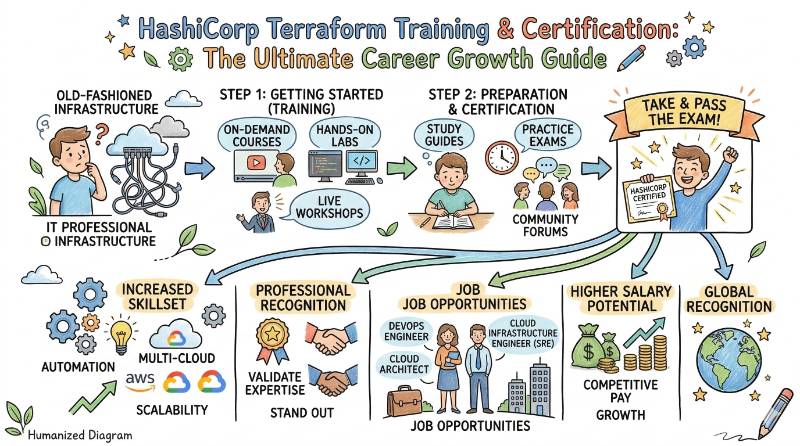
In the current era of digital transformation, the bridge between a software developer and a systems engineer has narrowed significantly. We no longer live in a world where “throwing code over the wall” to an operations team is acceptable. Instead, we have entered the age of the “Full-Cycle Engineer,” where the ability to define, deploy, and manage your own environment is the ultimate competitive advantage.
HashiCorp Terraform has emerged as the heartbeat of this movement. It is the common language used by professionals in India and across the globe to turn complex cloud architectures into simple, versioned code. As someone who has navigated the evolution of data centers from physical racks to virtualized clusters and finally to cloud-native ecosystems, I can tell you that Terraform is the most critical tool in your belt. It is the engine that drives modern DevOps, SRE, and DevSecOps workflows.
This guide is designed to help software engineers, DevOps practitioners, and managers understand the HashiCorp certification landscape and how to use it as a stepping stone toward even greater mastery in Kubernetes and specialized cloud domains.
Why Modern Infrastructure Demands Automation
The era of “hand-crafted” infrastructure is over. In a fast-moving market, waiting days for a network to be configured manually is a liability. Automation is the only way to ensure that deployments are fast, consistent, and documented. When your infrastructure is defined in code, it becomes searchable, versionable, and easy to share among team members.
For managers, the benefit is clear: it reduces the “toil” that burns out talented engineers. It also provides a clear audit trail of every change made to the system. For engineers, mastering a tool like Terraform is a career insurance policy. It proves that you can handle the complexities of multi-cloud environments (like AWS, Azure, and Google Cloud) without being tied to the limitations of a single provider’s console.
The Critical Link: Observability Engineering
Building the infrastructure is only half of the battle; the other half is knowing how that infrastructure behaves under pressure. This is where the Master in Observability Engineering Certifications Program becomes vital. If Terraform is the “body” of your cloud environment, Observability is the “nervous system.” It provides the telemetry needed to understand the internal state of your systems.
Through this advanced program, engineers learn how to move beyond simple monitoring. You gain expertise in distributed tracing, advanced logging, and metric analysis. This ensures that when a system fails, you aren’t just looking at a red dashboard—you actually understand the “why” behind the failure. Combining automation skills with observability creates a professional who can build systems that are not only automated but also resilient and transparent.
Summary of Professional Certification Path
Choosing the right entry point for your certification journey is important. The table below outlines the primary track for those looking to validate their expertise in infrastructure automation.
| Track | Level | Who it’s for | Prerequisites | Skills covered | Recommended order |
| Infrastructure Automation | Associate | Cloud & Software Engineers | Basic Cloud Knowledge | HCL Syntax, State, Modules, CLI | Primary Step |
Certification Focus: Hashicorp Terraform Associate
What it is
The Hashicorp Certified Terraform Associate is a globally recognized credential that verifies your ability to use the core features of the tool. It is focused on the open-source version of the software. It confirms that you understand the basic lifecycle of a resource—from initial planning and deployment to its eventual destruction.
Who should take it
This certification is ideal for Software Engineers, Site Reliability Engineers (SREs), and Cloud Architects who want to prove their skills in automation. It is also highly recommended for Engineering Managers who need to lead teams using these technologies. If you are responsible for maintaining cloud resources, this is the industry standard for your role.
Skills you’ll gain
This training transforms how you interact with cloud providers. You move away from being a user of a console to becoming a writer of infrastructure logic.
You will develop a deep understanding of how to manage the “State” file—the brain of your configuration. You will also learn how to build reusable components so that your team doesn’t have to reinvent the wheel for every new project.
- Mastery of the HashiCorp Configuration Language (HCL).
- Deep knowledge of State Management and Locking.
- Ability to use variables, locals, and outputs for dynamic environments.
- Expertise in building and consuming reusable Modules.
- Fluency in the Terraform CLI (init, plan, apply, destroy).
Real-world projects you should be able to do
After successfully completing this training, you will have the technical confidence to handle production-grade tasks. These projects represent the daily challenges faced by top-tier engineering teams.
- Automating a multi-tier Virtual Private Cloud (VPC) with public and private subnets.
- Launching an auto-scaling group of web servers with attached load balancers.
- Creating a multi-cloud database setup that replicates data across AWS and Azure.
- Implementing “Policy as Code” to ensure no one launches an insecure server.
Preparation plan
A structured approach to studying is the best way to ensure you pass on your first attempt.
- 7–14 days: This is for those already using the tool at work. Focus on the official exam objectives and read the documentation for features you don’t use daily.
- 30 days: This is the ideal path for most. Spend two weeks on labs and two weeks reviewing the theoretical concepts of state and providers.
- 60 days: Recommended for beginners. The first month should be spent learning basic cloud networking, followed by a month of intensive hands-on practice.
Common mistakes
Many candidates fail because they treat the exam as purely theoretical. It is a practical assessment of how you would handle real infrastructure.
- Underestimating State: Failing to realize how the state file interacts with real resources can lead to critical errors.
- Hardcoding Secrets: Putting passwords directly into your code is a major security risk and a common point of failure.
- Ignoring the CLI: Not knowing the specific behavior of commands like “taint” or “import” can cause confusion during the test.
- Module Complexity: Creating modules that are too complex makes them impossible for others to use and maintain.
Choose Your Path: 6 Specialized Learning Journeys
Automation is a versatile skill that can lead you into many different career specializations. Depending on your interests, you can follow one of these six paths:
- DevOps Path: Focuses on the integration of code and operations. You learn to build pipelines that deploy code and infrastructure together.
- DevSecOps Path: The focus here is on “Shift Left” security. You use automation to scan for vulnerabilities before the server even exists.
- SRE Path: Centers on reliability and system health. You use code to ensure that your systems are always available and performing well.
- AIOps/MLOps Path: Automates the massive infrastructure required to train and run artificial intelligence models.
- DataOps Path: Focuses on the data pipeline. You use automation to manage data warehouses and processing engines.
- FinOps Path: The goal is cost-efficiency. You use automation to tag resources and shut down unused servers to save the company money.
Role → Recommended Certifications Mapping
To help you decide which certifications to prioritize, here is a mapping based on your professional goals:
- DevOps Engineer: Terraform Associate + Kubernetes Administrator (CKA).
- SRE: Terraform Associate + Master in Observability.
- Platform Engineer: Terraform Associate + Multi-cloud Architect.
- Cloud Engineer: Terraform Associate + AWS/Azure Professional.
- Security Engineer: Terraform Associate + Hashicorp Vault.
- Data Engineer: Terraform Associate + Google Data Specialist.
- FinOps Practitioner: Terraform Associate + Cloud Financial Management.
- Engineering Manager: Terraform Associate + Strategic Cloud Leadership.
Why Choose DevOpsSchool?
DevOpsSchool is recognized as a leader in technical training because they prioritize the human element of learning. They provide a structured environment where students aren’t just watching videos but are solving real problems in live labs. The mentors have deep experience in the industry, which means they can answer the “why” behind the technology, not just the “how.”
Choosing this institution means you are getting a curriculum that is updated constantly to match the fast-changing world of cloud computing. Their focus on practical application ensures that when you finish the course, you are ready to contribute to a production environment immediately. It is an investment in a future where you are the expert that companies rely on.
Next Certifications to Consider
After you have mastered the basics of infrastructure automation, you should look at these three directions for your next step:
- Same Track: Look into Hashicorp Vault to learn about secret management and security within the same ecosystem.
- Cross-Track: Move into container orchestration with Kubernetes, which is the perfect partner for Terraform.
- Leadership: Focus on certifications that teach you how to manage large-scale cloud budgets and architecture strategy.
Top Institutions Providing Training and Support
DevOpsSchool This institution offers a wide range of courses that focus on the practical application of automation tools. They provide a supportive environment with access to mentors who have worked on high-stakes cloud projects for years.
Cotocus Cotocus is known for its customized corporate training sessions. They help organizations move away from traditional IT models and toward modern, automated workflows through intensive, hands-on workshops.
Scmgalaxy This community-driven platform is a massive source of knowledge for engineers. They offer extensive documentation and tutorials that help professionals stay current with the latest trends in DevOps and IaC.
BestDevOps Training at this school is designed for individuals who want to fast-track their careers. Their curriculum is focused on the specific skills that the top-tier tech companies are looking for in new hires.
DevSecOpsSchool If you are interested in the security side of automation, this is the right place. They teach you how to bake security into the very foundation of your infrastructure code.
Sreschool Reliability is the core of everything taught at this institution. They show you how to use tools like Terraform to build systems that can survive massive spikes in traffic without failing.
Aiopsschool This school focuses on the intersection of AI and operations. They provide the skills needed to manage the complex, GPU-heavy infrastructure required for modern machine learning tasks.
Dataopsschool Specialized training for data professionals. They teach how to use infrastructure as code to maintain the integrity and speed of large-scale data processing systems.
Finopsschool This institution focuses on the financial management of the cloud. They help engineers and managers understand how to use automation to reduce cloud waste and optimize spending.
Career & Technical FAQs
1. How difficult is the Terraform Associate exam? It is a professional-level test that requires a solid grasp of both theory and practical application. If you have done the labs, you will find it manageable.
2. How long does it take to get certified? For most working professionals, 30 days of consistent study is the average time needed to feel confident.
3. Are there prerequisites for the exam? There are no formal prerequisites, but knowing basic cloud concepts (like what a server or a network is) will help you tremendously.
4. In what order should I take these certifications? It is usually best to start with the Terraform Associate. After that, move into a cloud-specific certification or the Master in Observability program.
5. Is this certification valuable in 2026? Yes. As more companies move to the cloud, the need for engineers who can automate that transition is at an all-time high.
6. What are the career outcomes? Many professionals see significant salary increases and opportunities to move into specialized “Lead” or “Architect” roles.
7. Can I pass with only theoretical study? It is very difficult. The exam asks questions about specific command behaviors that you only learn by actually typing them into a terminal.
8. Does the certification expire? Yes, most technical certifications expire after two years to ensure you stay updated with the latest software changes.
9. How does Terraform compare to CloudFormation? Terraform works with many different clouds, while CloudFormation only works with AWS. This makes Terraform a more versatile skill to have.
10. Do I need to be a programmer? You don’t need to be a software developer, but understanding basic logic like “if/then” statements will make learning the language much easier.
11. Why is Observability mentioned here? Because building a system is only half the job. Knowing how that system is performing is what makes you a true expert.
12. Is this certification good for managers? Yes. It gives managers the technical context they need to set realistic timelines and understand the risks their teams face.
FAQs on Hashicorp Terraform Training & Certification Program
1. Where can I find the official registration link? You can find all the details and sign up at the official certification page.
2. What is the format of the questions? The exam consists of multiple-choice, multiple-response, and true/false questions in an online proctored environment.
3. Is hands-on lab access provided? Yes, reputable providers like DevOpsSchool include dedicated lab environments where you can practice without using your own cloud account.
4. Can I take the exam in India? Yes, the exam is available globally and can be taken from any quiet room with a stable internet connection.
5. What is the passing score? A score of approximately 70% is generally required to pass the exam and receive your certificate.
6. What happens if I fail the first time? You can schedule a retake after a short waiting period and payment of the exam fee.
7. Are these certifications recognized by major tech firms? Yes, companies like Amazon, Microsoft, and Google recognize Hashicorp certifications as a proof of high-level automation skill.
8. Will this help me in technical interviews? The practical knowledge you gain will allow you to answer complex architectural questions that often stump uncertified candidates.
Conclusion
Mastering Hashicorp Terraform is about more than just learning a piece of software; it is about adopting a professional mindset of efficiency and reliability. As the industry continues to move away from manual processes, those who can define the world through code will be the ones who lead. This journey from a basic understanding to professional certification is a path toward greater career freedom and impact. By combining your automation skills with a deep understanding of observability, you position yourself as a rare expert capable of handling the entire lifecycle of a cloud system. Whether you are an engineer looking to grow or a manager looking to stabilize your team, the investment in this certification program is the most strategic move you can make in today’s technology landscape.

